Vin Santo, the wine that is made by waiting
Drying, caratelli and the madre. How Tuscan Vin Santo is made, what changes in Trentino and Umbria, and why cantucci are not the only answer.
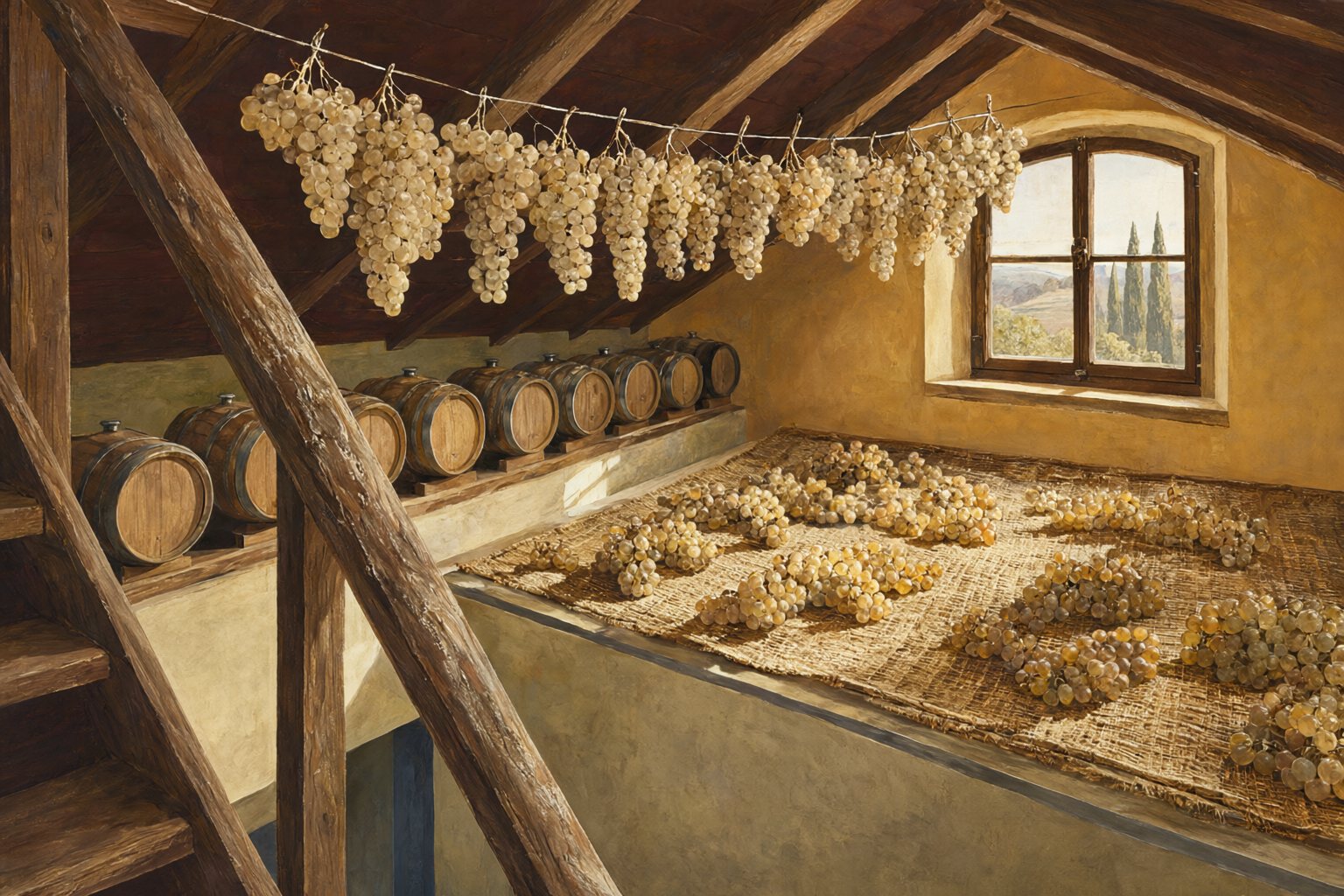
Vin Santo is the only Italian wine that begins with an act of distrust towards the grape. You pick it healthy, lay it out or hang it in an airy room and leave it there for months, losing water and concentrating, while outside people talk about the harvest as if it were already over. The real wine begins afterwards, when almost nobody is looking any more.
Drying, not rotting
The starting point is the appassimento: carefully chosen bunches, in Tuscany traditionally Trebbiano Toscano and Malvasia, left on racks or hung from beams in attics and in rooms known as vinsantaie. The air must circulate, the humidity must not overdo it, and whoever has the patience to discard every berry that turns mouldy makes the difference.
To give an order of magnitude, the regulations for Vin Santo del Chianti, a DOC since 1997, call for dried grapes with at least 260 grams of sugar per litre, rising to 270 for Occhio di Pernice. These are the numbers of a serious sweet wine, not of a syrup. And they explain why a kilo of grapes yields so little must.
Caratelli and madre
The must goes into caratelli, small barrels, historically chestnut and today often oak too, which are sealed and forgotten for years. The Chianti regulations speak of a minimum of about three years in barrel, four for the Riserva. Fermentation is extremely slow, often stop-start, and follows the seasons: it wakes with the heat, calms with the cold, and passes from one summer to the next without hurry.
Then there is the madre, the most romantic part and the one least precisely described. It is the dense deposit left in the caratello after the wine is drawn off, and in many houses it is reused to kick-start fermentation the following year: yeasts, residues and aromas of an old wine passing into a new one. Some cellars guard it like an inheritance. Technically it is a starter with a history; humanly, it is proof that Vin Santo is not invented anew each vintage but continued.
The result ranges from dry to decidedly sweet, from pale amber to mahogany, with notes of dried fruit, dark honey, candied orange peel and that oxidative nuance which is the signature of the style. Alcohol is high, around 13 degrees as a minimum for Vin Santo del Chianti and 14 for Occhio di Pernice.
Occhio di Pernice and other cousins
Occhio di Pernice is the rosé-tinted variant, with at least 50% Sangiovese in the blend under the Chianti regulations. The name evokes its coppery colour, which to the eye recalls the eye of the partridge. It is not better than white Vin Santo for that reason: it is a different voice.
Outside Tuscany the family is large and the differences matter. In Trentino, Vino Santo is made from Nosiola and is a world apart, with long drying and ageing measured in many years. In Umbria and other parts of central Italy, the tradition of passito wines left to rest in small barrels has existed for centuries, with rules and grapes that vary from zone to zone. The common thread is not the grape; it is patience.
Why it is called that
The origin of the name is one of those stories every Tuscan family tells in its own way, so treat all of them as legend. The most credited ties it to use at Mass: a sweet wine suited to the liturgy. Then come the more colourful versions. The Council of Florence in 1439, where a Greek prelate supposedly compared the local wine to one from Santorini, with the Florentines hearing “santo”. The Sienese friar who supposedly healed the sick with leftover Mass wine. The Venetian label “Vin” plus “Santo” for Santorini. And the calendar: fermentation starting around All Saints, bottling during Holy Week.
None is documented with certainty. That takes nothing from the charm: a wine that for decades nobody was in a hurry to understand deserves a name nobody is in a hurry to explain.
The cantucci ritual
Here we reach the contentious point. Dipped in Vin Santo, cantucci have become a kind of lay sacrament of Tuscan menus. And it works, nobody denies it: the almond, the crunch, the sweetness melting into the glass.
But the ritual has a cost. Too often the dunking covers what the wine has to say, and a mediocre Vin Santo becomes tolerable only because the biscuit does half the work. A good Vin Santo, after years in the caratello, can stand alone, at the end of a meal, in a small glass, perhaps with aged cheese or a piece of dark chocolate. Dunking is perfectly fine, provided it is a choice and not a conditioned reflex.
My view is this: the cantuccio is a welcome guest, not the master of the house. Whoever makes a wine for years, at the risk of losing it, deserves at least to be tasted before being drowned in a biscuit.
❦