The right wine glass: how much does glass shape really matter?
Bowl, rim, stem, crystal: what science says about wine glass shape, why the tongue map is a myth, and whether a single universal glass is enough.
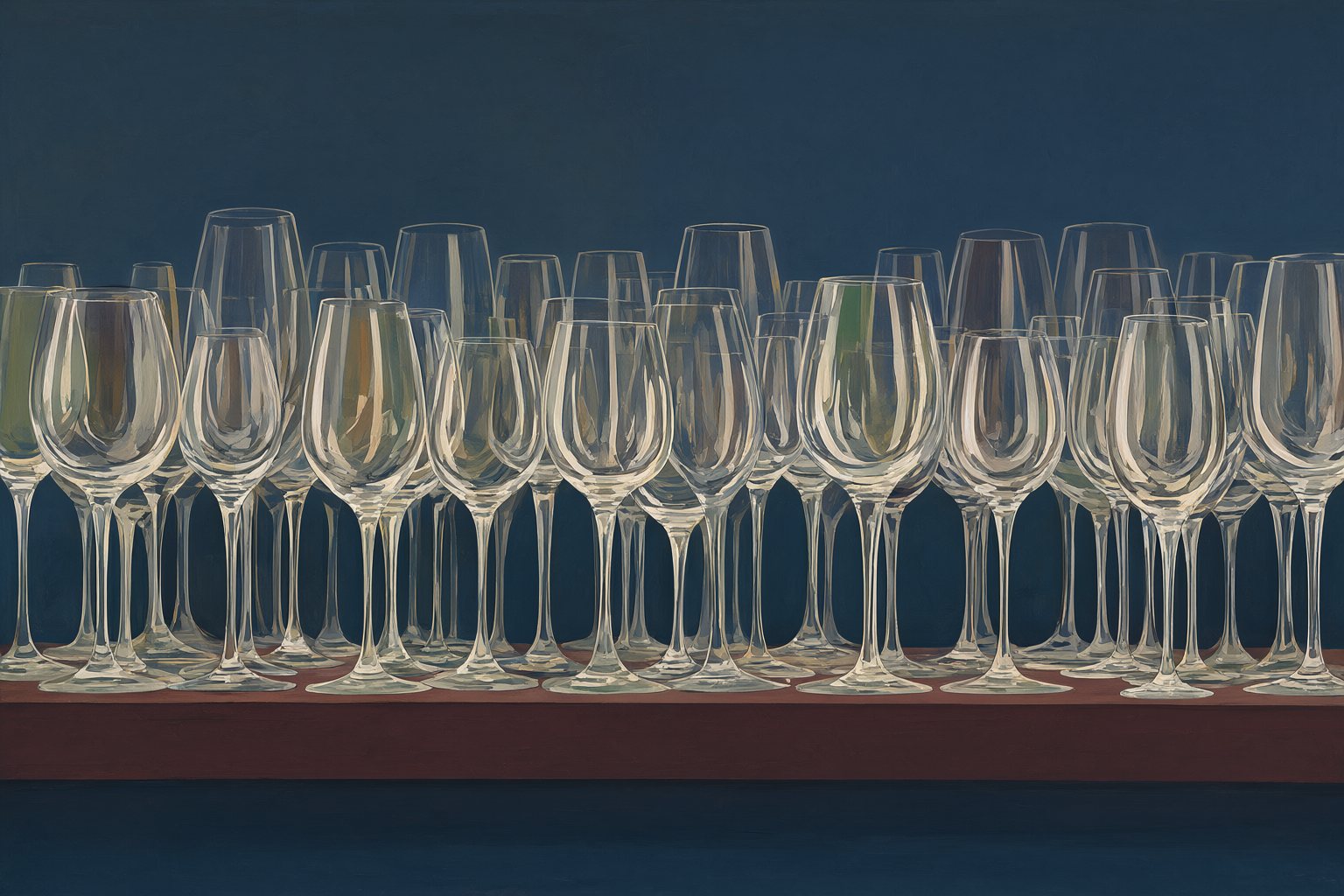
No object on the table has been loaded with as many promises as the wine glass. It is asked to “open up” a Barolo, to “accompany” the acidity of a Riesling, to deliver the wine to exactly the right spot on the tongue. Some of these promises are physics. Others are marketing literature written with great elegance. Separating the one from the other is the best way to respect the wine, and your wallet too.
The myth to clear away: the tongue map
Let us begin with what is simply false. For decades textbooks reproduced a tongue divided into zones: sweet at the tip, salty and sour at the sides, bitter at the back. A certain rhetoric of the wine glass leaned on this cartography too, the claim that a particular shape “places” the wine where its acidity or sweetness will be read best.
The history of the error is almost a textbook case in itself. In 1901 the German physiologist David P. Hänig published measurements of the perception thresholds for tastes in different areas of the tongue: small variations in sensitivity, nothing more. In 1942 the Harvard psychologist Edwin Boring reworked those data into a graph which, read too hastily by later popularisers, turned minimal differences into sharp boundaries. In 1974 Virginia Collings returned to the question and showed what modern physiology confirms: all the basic tastes are perceived across the whole surface of the tongue wherever there are taste buds.
A simple consequence follows. Any glass described as capable of “directing” wine towards a specific area of the tongue is selling a suggestion, not a function. Once in the mouth, wine spreads everywhere in an instant.
Where shape really works: the nose
If the mouth is democratic, the nose is not. Much of what we call “flavour” is aroma perceived retronasally and orthonasally, and here the geometry of the glass has solid arguments on its side.
The mechanism is intuitive. A wide bowl offers the wine a large surface from which volatile compounds evaporate; a rim narrower than the bowl holds them in and concentrates them towards the nose; the volume of air above the liquid acts as a small collecting chamber. Swirling, possible only with a sufficiently roomy bowl, multiplies the wetted surface and therefore the evaporation.
There are direct measurements, too. In 2015 a team from Tokyo Medical and Dental University led by Kohji Mitsubayashi published in the journal Analyst the results of a “sniffer-camera”, a system capable of visualising the distribution of ethanol vapour above the glass. In a traditional wine glass, at a serving temperature of around 13 °C, the alcohol tended to arrange itself in a ring along the rim, leaving the centre of the opening relatively poorer in ethanol. In a straight glass or a martini glass the ring did not form. The authors’ interpretation is that the tulip shape allows the nose, positioned in the centre, to pick up the aromas with less interference from the pungency of the alcohol. It is an elegant result, but it should be read for what it is: a physical measurement of vapour, not proof that the wine “tastes” better.
What tasters say (and what they don’t)
The step from physics to perception is where the literature becomes more cautious. A study by Thomas Hummel’s group in Dresden, published in 2003, involved non-expert tasters asked to assess the same wines in glasses of different shapes with the same height and rim diameter: the more rounded glasses tended to receive higher ratings for aromatic intensity. Many participants, moreover, were convinced they had tasted different wines when the wine was always the same.
More cautious in tone is the work of Jeannine Delwiche and Marcia Pelchat, published in 2002 in the Journal of Sensory Studies. Here the tasters were blindfolded and the position of the nose was controlled by a chin rest, so as to neutralise the appearance of the glass and the distance from the wine. The result: for most attributes no significant differences emerged between the four glasses, with the exception of a taller Bordeaux glass, in which the wine was perceived as less intense, plausibly because of the greater distance between liquid and nose.
Taken together, these studies tell a consistent story. Shape produces real physical effects on the concentration of aromas; part of what we perceive as difference, however, comes from the eye, the hand, our expectations. A review published in 2017 by Charles Spence and George Van Doorn in the journal Beverages insists on precisely this interplay: the physics of volatiles, sensory evaluations and crossmodal associations between shape and expected flavour. The glass acts on the nose, but also on the mind.
Stem, thickness, crystal
The stem has a less romantic function than people think, but a concrete one: it keeps the hand away from the bowl, avoiding warming the wine and leaving fingerprints that cloud its colour. It is ergonomics, and that is enough.
The question of material is more nuanced. Traditional crystal contains lead oxide: European rules, starting with Directive 69/493/EEC, reserve the name “lead crystal” for glass with at least 24% lead oxide, and “full lead crystal” for glass reaching 30%. Today many manufacturers use lead-free crystal glass based on other oxides. The advantage of crystal lies not in some supposed chemical interaction with the wine, which has not been demonstrated, but in its workability: it allows extremely thin walls, cut rather than rolled rims, a brilliant transparency. A fine rim lets the wine slide into the mouth without the sensation of a step. It is a tactile effect, and it matters, but it concerns the pleasure of the gesture more than the aromatic make-up.
The universal glass and the temptation to collect
Since 1958, when Claus Riedel presented in Brussels a large glass designed for Burgundy wines and for Nebbiolo, and above all since 1973, the year of the Sommeliers series, the idea of a glass for every grape variety has become almost a dogma of fine dining. The starting principle, putting function before decoration, was a healthy revolution compared with the cut and coloured glasses of the past. The multiplication of shapes, however, has followed a logic that has less and less to do with oenology.
The reaction came with the so-called universal glass, championed in recent years by some authoritative critics too: a single bowl, generous in size, a moderate tulip, thin walls, suitable for whites, reds and sparkling wines. Critics object that no shape serves a Port and a Metodo Classico equally well. True, but it is a laboratory objection. When tested against the evidence, the variables that really count are few: a bowl wide enough to swirl the wine, a rim that narrows relative to the bowl, thin, colourless glass, a stem.
And here is our view, without beating about the bush: anyone who owns a good universal glass and fills it to a third has already obtained almost everything science can guarantee. The rest, twelve shapes for twelve grapes, is a legitimate pleasure, sometimes even a beautiful ritual, but it should be called by its name: aesthetics, not necessity. Wine deserves a glass that lets it breathe. It does not need a wardrobe.
❦