To decant or not: when a decanter helps and when it does harm
Removing sediment or adding oxygen? When to decant a young wine, when to protect a fragile old red, and what to do with whites and sparkling wines.
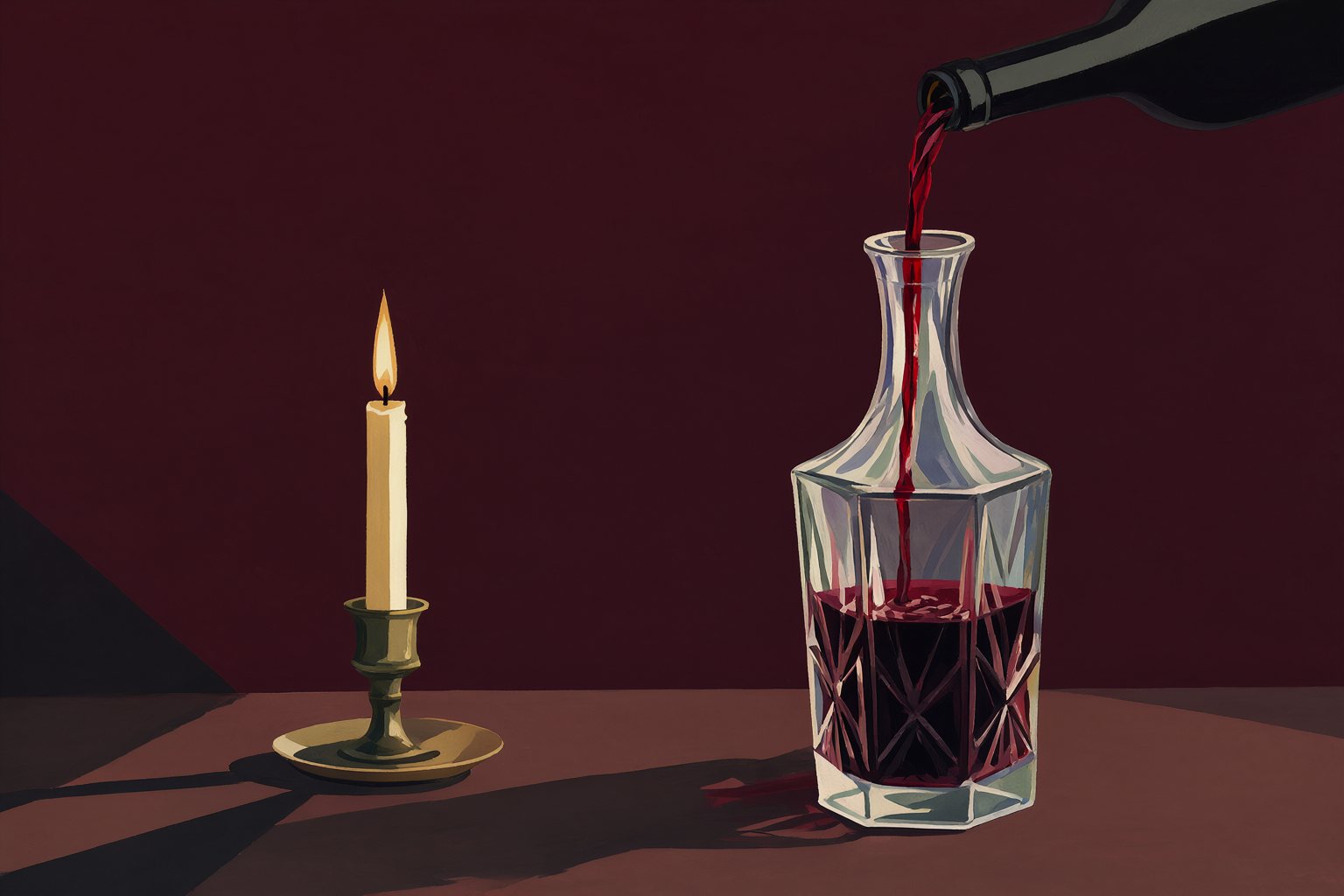
The decanter is the most theatrical object on the table, and for that very reason the most misunderstood. It turns up next to bottles that have no need of it whatsoever, and goes missing when it would genuinely help. The gesture itself says little: pouring a wine into a carafe can rescue it, improve it, or strip away in half an hour what time had given it over twenty years. Everything depends on what you’re trying to achieve, and the first thing to grasp is that there are two reasons to decant, distinct from each other and often at odds.
Two gestures, one name
The first meaning, the historical one, is mechanical. Over years in bottle, the pigments and tannins of a red bind together and fall out of solution, forming a deposit at the bottom or along the side. As a rough guide, a structured red starts to throw sediment after five to ten years, and in Vintage Port a deposit is practically guaranteed. Decanting, in this case, means transferring the clear wine and leaving the cloudy part behind, which in the glass would bring dullness and a bitter, dusty feel in the mouth.
The second meaning is chemical, or at least that is how the story goes: giving the wine oxygen. Here the decanter becomes a tool for “opening up” a closed wine, softening its rough edges, releasing its aromas. And it’s over this second use that opinions truly divide.
It’s worth keeping the two apart in language as well. Those in Italy who speak of ossigenazione or aerazione (oxygenation, aeration) for the second case and reserve decantazione for the first are not being pedantic: they are describing two operations that call for different timings, different gestures and even different vessels.
Oxygen is not an ageing accelerator
The widespread idea is that a few hours in a carafe will do for a young wine what years in the cellar would: softer tannins, a rounder structure. It’s a seductive picture, but the chemistry doesn’t do much to support it. The evolution of tannins in bottle is a slow process, requiring years and minute quantities of oxygen meted out over time; a couple of hours in the open air are not enough to reproduce it. More than one blind comparison carried out by people in the trade has produced results that sit poorly with the theory, with young wines sometimes coming across as fresher and more precise straight after opening than after a long stay in the carafe.
Émile Peynaud, the Bordeaux oenologist who trained generations of winemakers, was already sceptical of aeration as a routine practice: for him the decanter was for removing deposit, to be done shortly before serving, and dissolved oxygen was more of a risk than a benefit.
This doesn’t mean air does nothing. What it does is more modest, but real. It disperses the volatile compounds that can veil the nose of a young wine: notes of reduction, those whiffs of sulphur, struck match, egg or rubber that appear above all in wines kept long away from oxygen, under screwcap, for instance. The point is that the effect works on aromas more than on structure: a green tannin stays green.
Young and tannic, old and fragile
Hence a practical rule, more common sense than dogma.
A young, concentrated red that is closed on the nose (a Barolo or Taurasi only a few years old, a Bordeaux from a big vintage) can benefit from an hour or two of aeration, sometimes more if it is mute or reduced on opening. The risk here is low: the wine has reserves of structure and freshness that air won’t use up quickly. The ideal vessel is broad at the base, to offer surface area.
An old red is a different creature. Past fifteen or twenty years, many wines have a fragile balance, delicate tertiary aromas that express themselves for a limited time once exposed to air. For these, decanting serves only to separate the deposit, and should be done as late as possible: the most cautious advice speaks of half an hour before serving, no more. Technique matters. The bottle should stand upright for at least a day so the sediment slides to the bottom; then it is poured slowly, with a light source beneath the neck, stopping as soon as the deposit reaches the shoulder. A narrow vessel is better, to limit contact with the air. And if the bottle has no deposit, many sommeliers prefer simply to open it and serve it, letting the wine evolve in the glass before the drinker’s eyes.
There is one exception worth mentioning: some old reds made in an oxidative style, already used to air by the way they were produced, hold up to, and sometimes improve with, a long aeration. But recognising them takes experience with that specific wine, and the mistake is costly: there’s no bringing back an old red that has faded away.
The case of whites
A white in a carafe looks like an affectation, and often it is. But not always. Whites rarely throw a deposit (at most a few harmless tartrate crystals), so the reason is almost always aromatic. A young, structured white, a serious Chardonnay, a German Riesling with a sulphurous note or two, a weighty Fiano or Verdicchio can show up closed or reduced when first uncorked, and a quarter of an hour in a carafe unlocks them. There is a side benefit too: a white served too cold warms up after a few minutes in a decanter and reveals aromas the chill was keeping hidden.
For whites that are expressive by nature, aromatic and immediate, there’s no need: they already have everything in the shop window and air adds nothing. And old whites deserve the same caution as old reds: some, especially among great mature Chardonnays, can oxidise rapidly once transferred.
And sparkling wine?
Here we enter the territory of heated opinions. Decanting a Champagne or a Metodo Classico looks like a contradiction in terms, and indeed the main objection is obvious: air makes the wine lose its fizz, and the bubbles are not an accessory but part of the wine. Some Champagne houses openly declare themselves against it.
And yet there are those who do it with conviction, some producers included, above all with wines of great structure, vintage cuvées or long ageing on the lees, where the young, lively carbon dioxide seems to mask the complexity. The transfer, done gently and at a low temperature, tames the mousse and lets the wine emerge. It’s a niche practice, recent rather than traditional, and still debated. The more cautious alternative is the one many sommeliers suggest: a generous wine glass in place of the flute, and a little patience. The evolution happens anyway, but more slowly and under control.
The carafe as a choice, not a ritual
A decanter should be used the way one uses a tool, not an ornament. Faced with a bottle, one question is enough: what do I want to remove, the deposit or the closedness? If it’s the deposit, decant shortly beforehand and protect the wine from air. If it’s the closedness, give it air judiciously, knowing you are acting on the aromas and not the structure. If it’s neither, the carafe stays on the sideboard.
The position we feel ready to defend is this: when in doubt, open the bottle and pour it into the glass. A wine that opens slowly in front of the person drinking it tells far more than one that has been “ready” for hours, and it leaves the taster the most interesting part, namely working out for themselves how it changes. When a decanter is needed, it is truly needed. The rest of the time it’s stagecraft, and the wine can do without it.
❦