Verdicchio, the white wine that ages better than many reds
Castelli di Jesi and Matelica, the amphora bottle, the Riserva DOCG: why Verdicchio is the Italian white wine that truly knows how to wait in the cellar.
There is an Italian white wine that, left in the cellar for ten years, apologises to no one. It has not gone limp, it has not become a caricature of itself, and it is often more interesting than many illustrious reds bought the same week. It is called Verdicchio, it comes from the Marche, and for decades we knew it mainly for the shape of its bottle. A paradox that deserves to be taken apart.
The weight of a curve
In 1953 a winery in Cupramontana launched a competition to give its Verdicchio a container that could be recognised at a glance. It was won by the architect Antonio Maiocchi with a sinuous bottle inspired by ancient amphorae, which in the following years went round the world. In America, the company’s own accounts tell us, it was jokingly nicknamed “the Sophia Loren”. It worked splendidly: for a generation of consumers, Verdicchio meant that green silhouette on the table of the Italian trattoria abroad.
The trouble is that the success of an image tends to fix the idea of the contents as well. The amphora became synonymous with a light, easy-drinking white, for grilled fish and to be finished by the end of summer. A convenient reputation for selling a great many bottles, an inconvenient one for a grape with quite different ambitions in its DNA. Even today many producers aiming for longevity choose sober glass, as if to burn their bridges with that oh-so-photogenic curve. The amphora remains a piece of Italian design history; it is just that, for years, it told only half the story.
Two Verdicchios, two landscapes
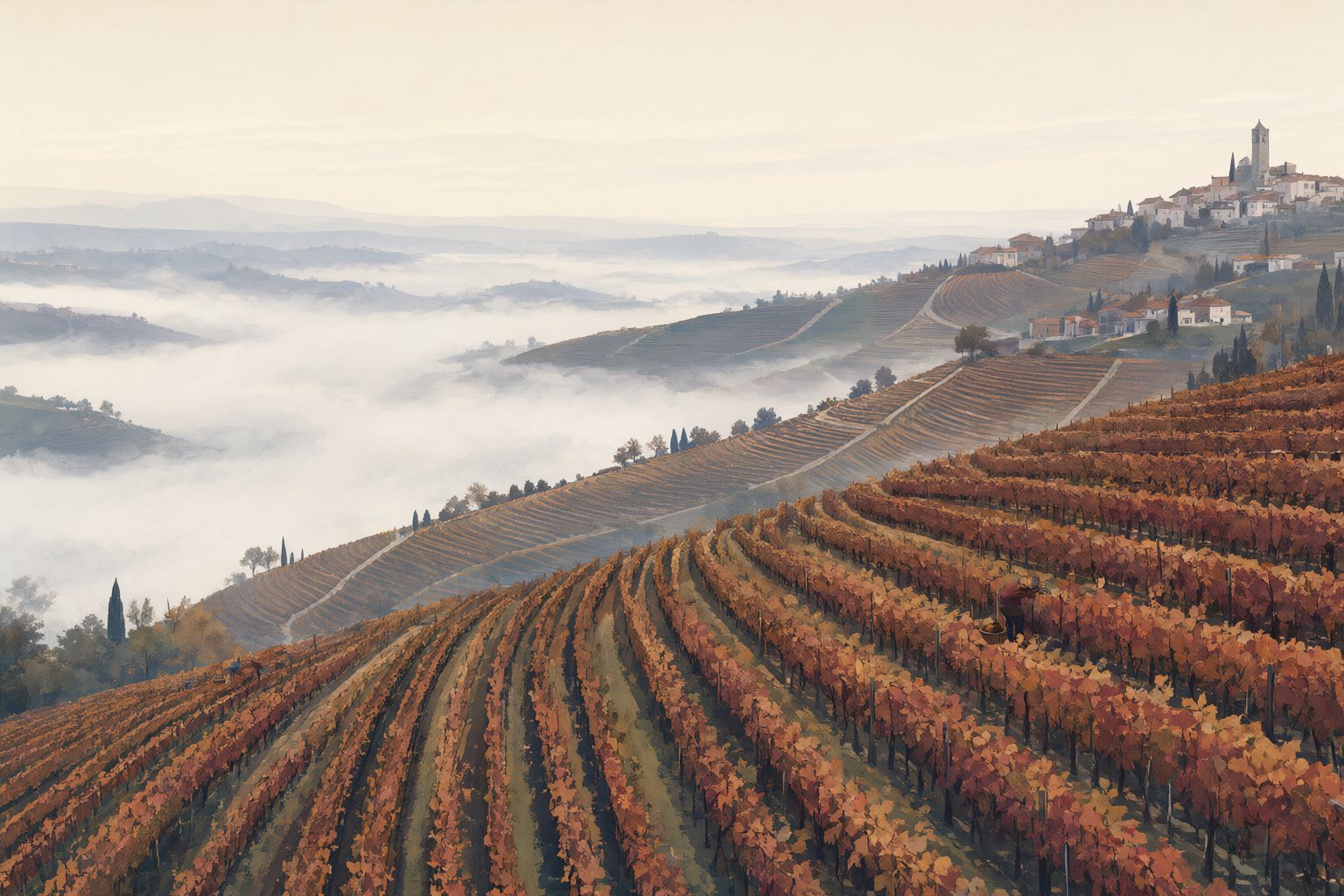
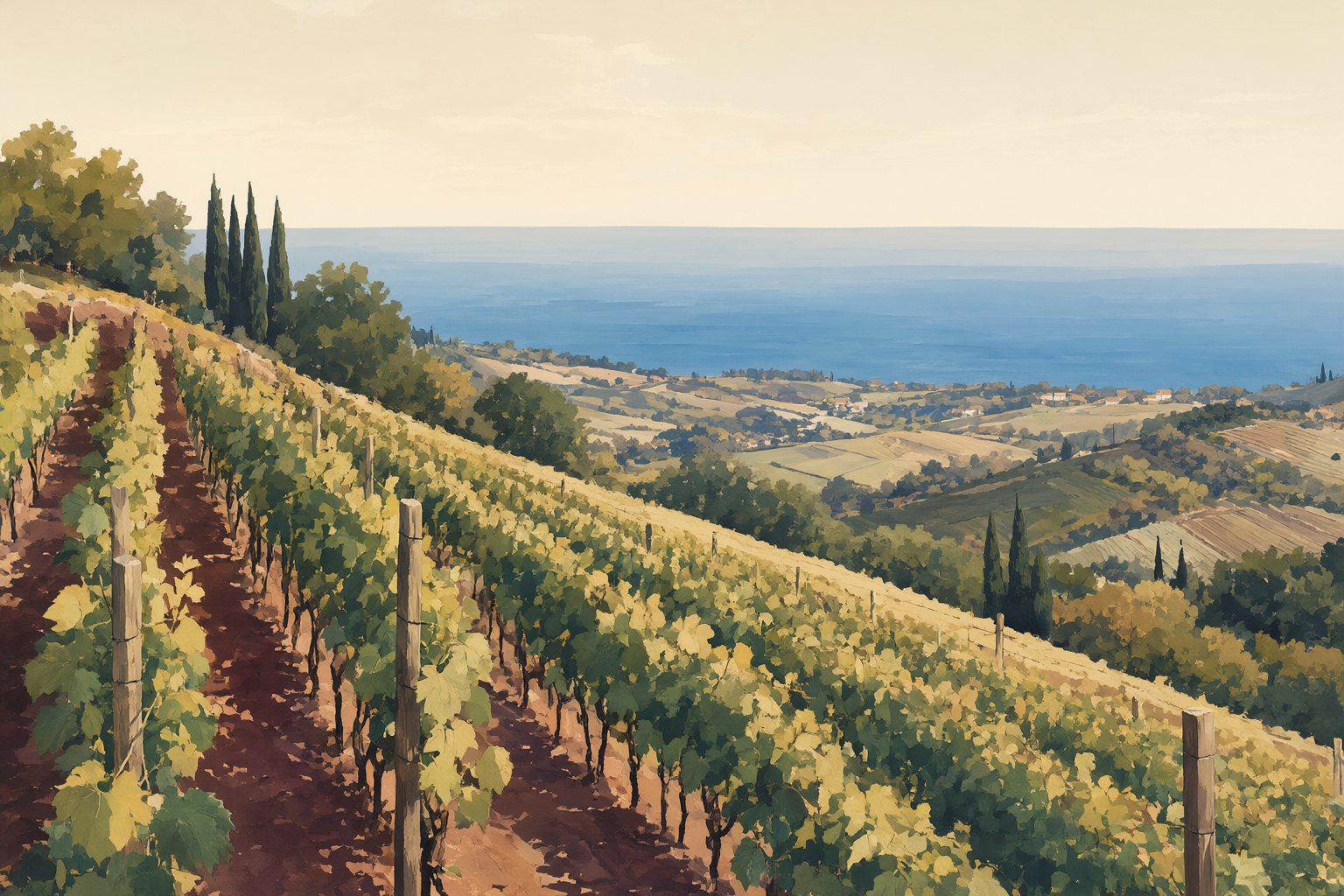
Verdicchio has two main homelands, and they are not alike. The first and larger is the Castelli di Jesi, in the province of Ancona with a few communes in the province of Macerata: hills that slope down towards the Adriatic along valleys open to the sea, such as that of the Esino. The appellation has been a DOC since September 1968, and within it there is a Classico zone, the historic one, which excludes the land to the left of the river Misa and the communes of Ostra and Senigallia. Here sea breezes temper the summers, and the wines lean towards a certain fullness, towards yellow fruit and almond, with a roundness that by no means rules out tension.
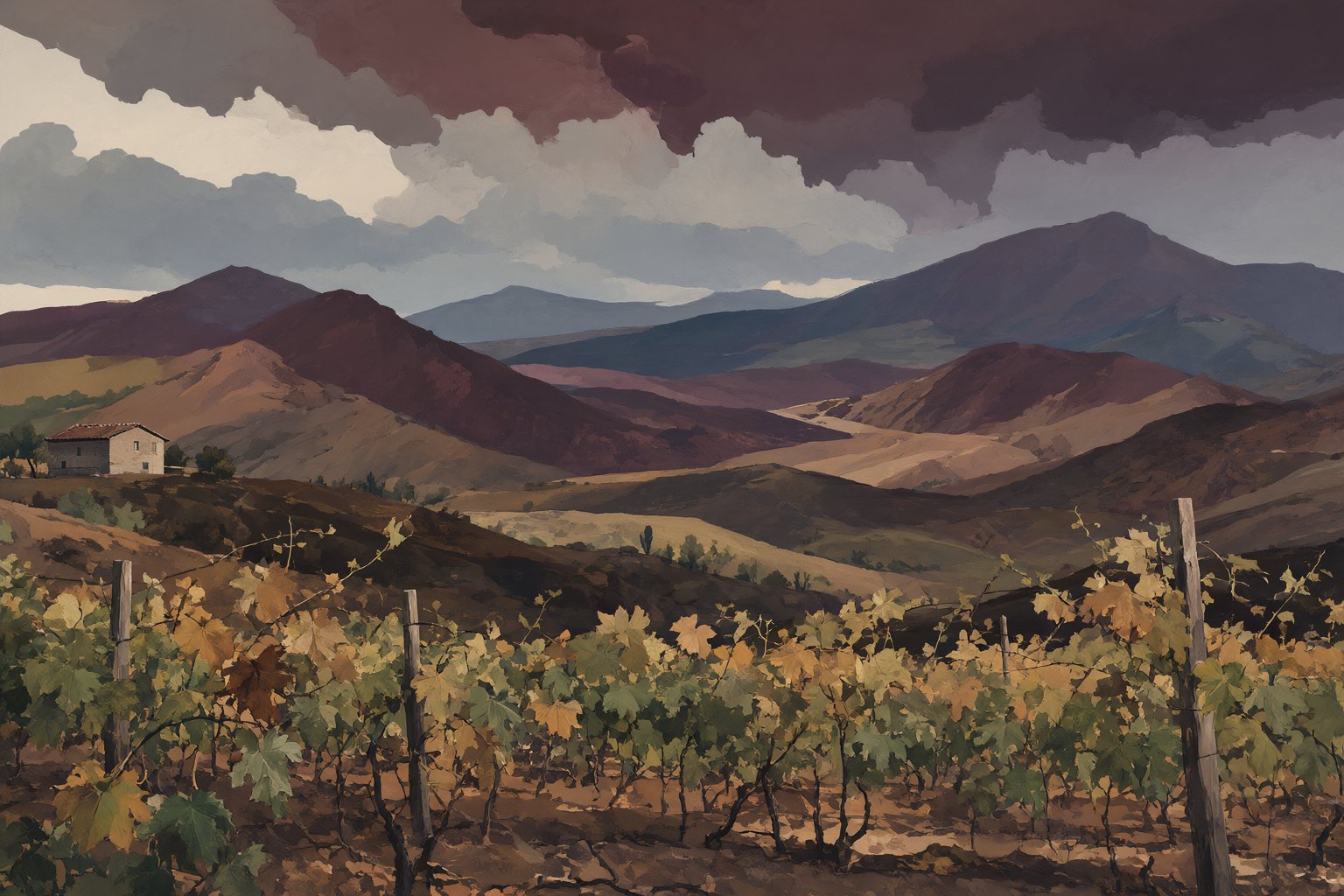
The second is Matelica, smaller and tougher in character. It has been a DOC since July 1967, a full year before Jesi, and occupies a valley with a geographical peculiarity rare in the Marche: it runs north to south, parallel to the Apennines, instead of opening towards the sea. The result is a climate of continental stamp, higher vineyards, marked swings in temperature between day and night, and harvests that are often late for a white grape. Matelica tends to be drier, more vertical, with an acidity that in youth can seem almost angular. Yet it is precisely that edge that serves as a backbone over the years.
Two interpretations of the same grape, then: one sunnier and more generous, the other more mountainous and cutting. Anyone who loves Verdicchio ends up taking sides sooner or later, only to betray their own faction at the first well-made bottle from the other.
The Riserva, or permission to wait
In 2010 both areas obtained a DOCG dedicated to their Riservas: Castelli di Jesi Verdicchio Riserva and Verdicchio di Matelica Riserva, approved by the same decree in February of that year. The rules are similar. At least 85% Verdicchio is required, and the wine cannot be released before eighteen months of ageing, counted from 1 December of the harvest year. For the Castelli di Jesi Riserva the rulebook specifies that at least six of those months must be spent in bottle, and it also provides for a Classico version.
Eighteen months may seem little to anyone thinking of the timescales of a Barolo, but for a white wine they are a precise signal: it is a declaration that this wine is not to be drunk straight away, and that on the contrary it needs time to become itself. It is a statement of intent before it is a technical rule. And it must be said that many of the most ambitious Verdicchios do not even carry the word Riserva on the label: some producers prefer the DOC and the Superiore designation, or simply wait longer than the required minimum. The DOCG deserves credit for giving a public name to a vocation that, in the best cellars, already existed.
What happens over time
Why does Verdicchio stand up to the years? The short answer is: acidity, structure and a certain aromatic reticence in youth. It is not a grape that gives everything away on the first sip. Young wines speak of herbs, citrus, fresh almond, sometimes of a faintly bitter note on the finish that is almost a signature. With time these traits are transformed: aromas of dried fruit, honey, chamomile and delicate hydrocarbons appear, along with a savouriness that seems to grow deeper rather than fade. The colour slides from straw towards gold, but the palate, in the best cases, keeps its backbone.
A curious detail: genetic analyses have indicated that Verdicchio is the same variety that in the Veneto and on Lake Garda is called Trebbiano di Soave or Turbiana. A kinship that helps explain its resistance to time, given that those areas too have whites capable of ageing with dignity. The name changes; the tenacity remains.
Not everything, of course, ages well. A Verdicchio conceived to be light and immediate will stay that way, and after a few years will simply lose its freshness. Longevity is not a magical property of the grape: it depends on yields, on the vineyard, on the hand in the cellar. But when the conditions are there, Verdicchio needs less outside help than people think: it asks for no intrusive oak or artifice in order to last.
A family of stubborn whites
Verdicchio is not alone. It belongs to a small family of Italian whites that give the lie to the commonplace that white wine should be drunk within the year. In Campania, Fiano di Avellino is known for developing smoky, mineral tones with age. In Piedmont, in the Colli Tortonesi, Timorasso was brought back to life by a handful of obstinate producers from the last decades of the twentieth century, after almost disappearing, and is today one of the most talked-about whites of the North. In Abruzzo, some historic interpretations of Trebbiano d’Abruzzo have shown that even a grape considered modest can yield wines of very long life.
Each has its own story, but Verdicchio has an advantage: it exists in quantity, it has two appellations with clear identities and a codified Riserva. It is not a rarity for collectors; it is a widely shared heritage.
And that is precisely why its undervaluation seems almost wilful. We go on filling our cellars with reds we will never open, while the white that would best repay the wait sits there, often still associated with a bottle from 1953. Our view is simple: anyone who wants to understand how much an Italian white can change over time should start here, and have the patience to forget about it for a few years.
❦