Collio, where Italian white wine learned to be taken seriously
Ponca, Friulano (formerly Tocai), Ribolla Gialla, Malvasia and a border running through the vineyards: why Collio in Friuli is home to Italy’s great white wines.
For much of the twentieth century, in Italy, a serious white wine was almost a contradiction in terms. It was drunk young, cold, preferably without a second thought. Then there is a strip of hills between Gorizia and the Slovenian border that spent decades proving the opposite, and did so with a stubbornness typical of frontier lands. Collio is small, windswept, awkward to work, cut in half by a line drawn on diplomats’ maps. And it is here that Italian white wine stopped apologising.
A stone that peels apart
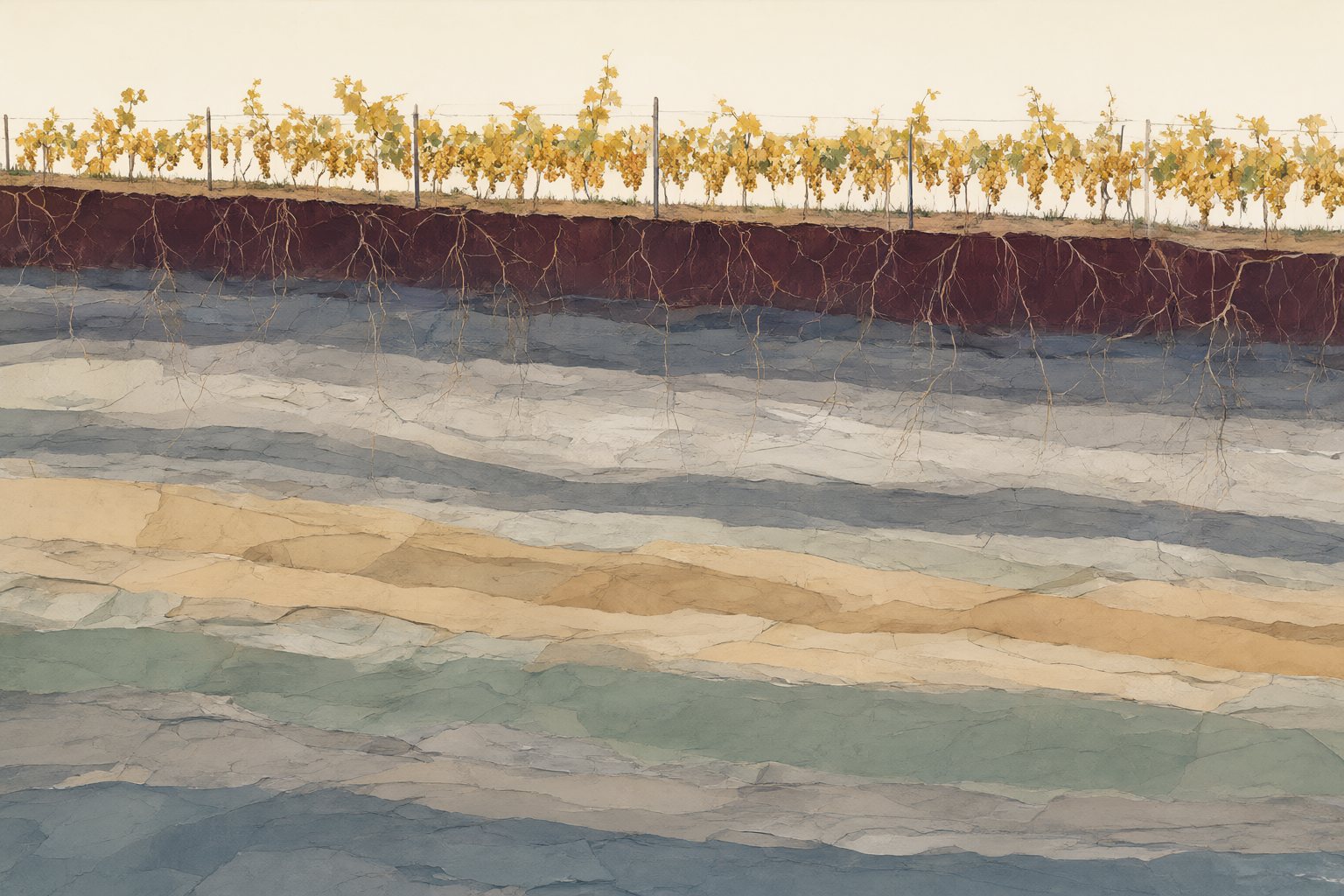
It all begins underfoot. The Friulians call it ponca, the Slovenians opoka: it is an alternation of layers of marl and sandstone of marine origin, dating back to the Eocene, when this area was the floor of a shallow sea. Tectonic uplift brought those sediments to the surface, and today you can see them cropping out in road cuttings like a blue-grey mille-feuille.
Ponca has a curious character: it is hard when compact, but in air and rain it crumbles into flakes. The sandstone drains, the marl holds a little water; the vine is forced to dig deep to find what it needs. From this combination comes what tasters call, with a word now overused but here hard to avoid, sapidity. Tension is the better word: Collio whites tend to have a backbone, a saline, almost tactile quality that keeps them upright even when the fruit is ripe.
Add the microclimate: the Julian Alps behind act as a screen against cold northern currents, the Adriatic a few kilometres away brings mild air, and the swings in temperature between day and night preserve the aromas. It is no accident that the Collio DOC is among the oldest in Italy: recognition came in 1968, when many areas that are illustrious today did not yet know they were.
The grape that lost its name
If there is one grape that tells the story of Collio, it is the one that for centuries was called Tocai. And that since 2007 can no longer be.
The story, in brief. In 1993 the European Community signed an agreement with Hungary on the protection of wine names: the name Tokaji, linked to the famous Hungarian region of sweet wines, was to be protected, and other people’s homonyms had to disappear after a transition period ending in 2007. The Friuli Venezia Giulia region took the matter before the European Court of Justice, arguing that Friulian Tocai had nothing to do with Tokaji, either as a grape or as a wine. In 2005 the Court ruled against the Friulians. Attempts at local resistance followed, including a regional law that the Italian Constitutional Court declared unlawful in 2008. The same fate, incidentally, befell the Alsatians, who had to give up their “Tokay Pinot Gris”.
And so the grape became Friulano. In ampelographic terms, what is more, the variety is identical to the Sauvignonasse (or Sauvignon Vert) found in France and Chile, which makes the battle over a name that had no botanical link with Hungary all the more paradoxical. Yet in Friuli Tocai was a social habit before it was a label: the taj, the mid-morning glass at the osteria. Renaming that glass felt like an eviction.
The paradox is that defeat did it good. Friulano is a name that says where it comes from, and the wine has been able to present itself for what it is: a white with a soft profile, a note of bitter almond on the finish that is almost its signature, and a capacity to age better than its osteria reputation might suggest.
Ribolla and Malvasia, the two ancient souls
Ribolla Gialla is the oldest grape in the area, or at least the best documented. Credible references appear as early as the thirteenth century in church records, and on the Slovenian side, where it is called Rebula, a deed of 1336 mentions the sale of a vineyard. It is a variety of little aromatic intensity, high acidity and moderate alcohol, which ripens late and gives its best on steep, poor slopes. In other words, a grape that rewards patience and difficult soils.
In recent years Ribolla has also enjoyed a second, more commercial life as the base for easy-drinking sparkling wines. Nothing wrong with that, but it is a different story from still hillside Ribolla, which is dry, taut, almost austere. On the Slovenian side it remained the benchmark variety for decades; in Friuli, by the mid-twentieth century, it had lost ground to international varieties before being rediscovered. (There is also skin-macerated Ribolla, made famous by a few of the area’s producers, but that is a chapter that deserves space of its own.)
Collio’s Malvasia is Malvasia Istriana, not to be confused with Italy’s many other Malvasias, which are different families under a common name. It is the grape of the eastern Adriatic, found from Istria to the Carso: fragrant but never cloying, with floral notes and a frame that takes it well beyond aperitif wine. Alongside these three, Collio has long grown international varieties too, Pinot Grigio, Sauvignon, Chardonnay, Pinot Bianco, which have given remarkable results here and are fully part of the area’s recent history.
One vineyard, two countries
In 1947, with the peace treaty, the border between Italy and Yugoslavia was redrawn and ran through the middle of the hills. On one side remained Collio; on the other, for the geography books, Goriška Brda was born. Same rocks, same climate, same grapes, often the same families: there are producers who for decades had vineyards on both sides, with everything it meant to cross a border to go pruning.
Today the frontier is little more than a road sign, and this has made plain what politics had obscured: Collio and Brda are a single wine territory with two administrations. Slovenian Rebula and Friulian Ribolla are the same grape; ponca and opoka are the same stone. The differences are above all of style and production choices, not of nature. Those who taste wines from both sides without looking at the labels often struggle to tell which side of the border they come from.
The blend, or the art of not choosing
Collio’s real contribution to Italian wine is perhaps not a grape but an idea: the blended white as a top-tier wine. For years, while elsewhere the focus was on single varieties, some producers here brought together Friulano, Ribolla, Malvasia and international varieties to build wines more complete than the sum of their parts. Collio Bianco is the category that carries on that legacy.
Today it is also a subject of debate. In December 2024 the Consorzio’s assembly approved by a large majority the start of a process to define a Collio Bianco based solely on native grapes, Friulano, Ribolla Gialla and Malvasia, after a group of producers had already begun doing so on their own. At the time of writing, neither the percentages nor the final name of the new category can be verified: it is a work in progress, and like every work in progress in Italian wine, it may take time.
Our view is simple. Collio has already won the battle for respect: no one any longer doubts that whites capable of ageing and of expressing a place are made here. The challenge now is to make itself understood. A blended white made only from local grapes, with a clear name and readable rules, would be the most honest way of telling the world what this hillside can do. Having lost Tocai over a question of names, it would be a fine revenge to win thanks to one.
❦