What wine goes with spicy food? Sugar, acidity and low alcohol
Curry, tom yum, Sichuan mala and ’nduja. Why alcohol and tannin fan the burn, and which wines really tame it, from Riesling to rosé.
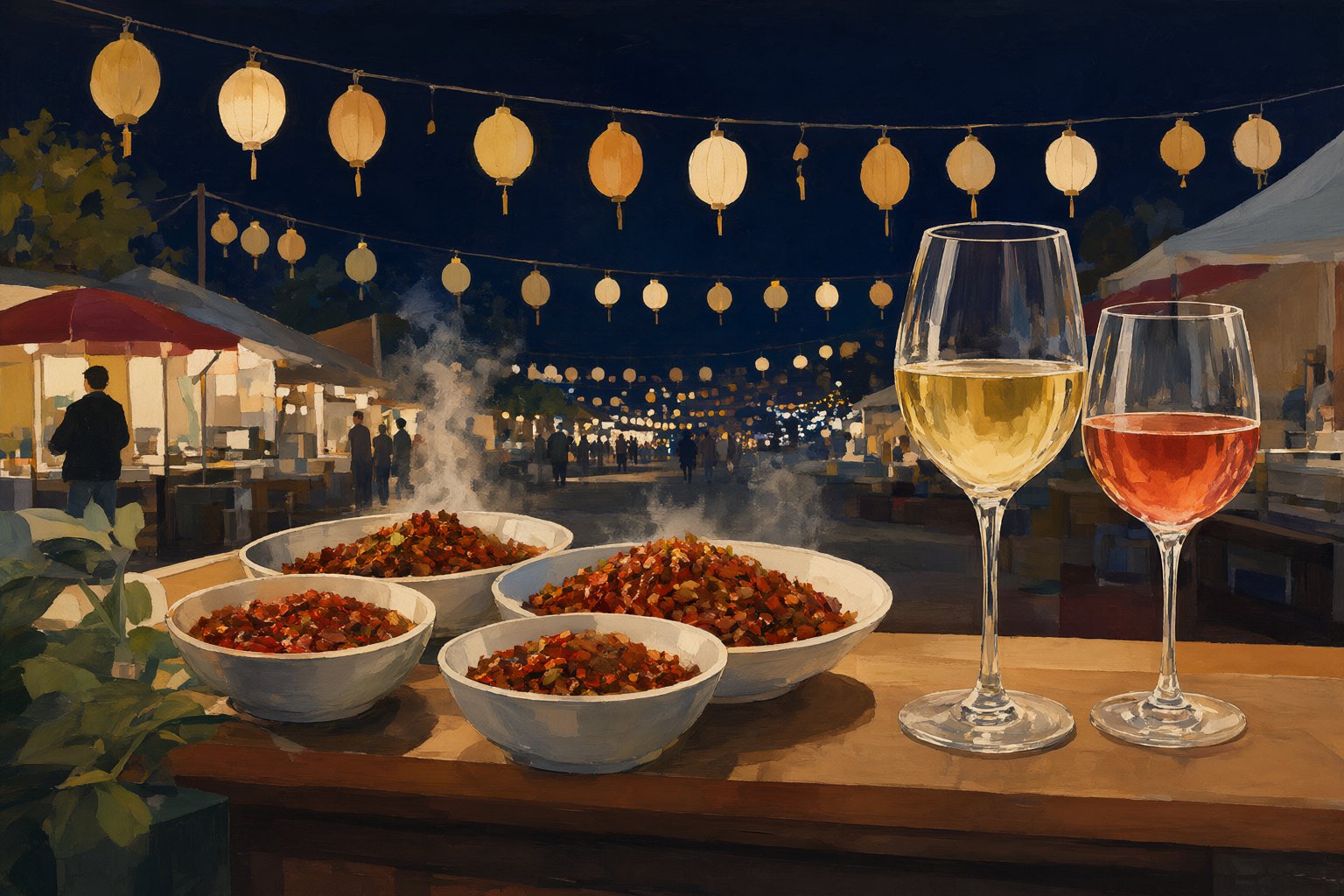
Heat is the only flavour that isn’t a flavour. Chilli does not speak to the tongue the way salt or sugar do: it tricks the heat receptors, the same ones that warn us when a coffee is scalding. For a moment, the mouth believes it is on fire. And then someone turns up with a sixteen-degree Amarone and asks why it is burning even more.
It burns more because that glass is petrol. Before choosing a wine for a curry, a Thai dish or a jar of ’nduja, it is worth understanding what happens in the mouth, because the rules that follow are few and surprisingly solid.
Why alcohol is the enemy
Capsaicin, the molecule responsible for chilli’s burn, binds to a receptor called TRPV1, the sensor our body uses to signal excessive heat. In 2002 a study published in Nature Neuroscience by a group of researchers led by Marcello Trevisani showed that ethanol acts on the same receptor and lowers its activation threshold. Translated from neurophysiology to the dinner table: alcohol makes the nerves more sensitive, and the chilli that used to tingle now bites.
That is not all. Capsaicin dissolves readily in fat and alcohol, far less in water: an alcoholic sip spreads it around the whole mouth instead of putting it out. Which is why the ice-cold, light beer everyone instinctively orders at the Indian restaurant works more because of the cold and the low strength than through any kind of magic. The first rule, then, is brutal: with spicy food, the less alcohol in the glass, the better. A wine under twelve degrees is playing at home; one over fourteen is playing away, in the rain.
Tannin, the other arsonist
The second trap is tannin, the substance that dries the mouth in structured reds. Tannin is astringent and rough, and on a lining already irritated by capsaicin that roughness adds to the burn instead of balancing it. To complicate matters, many spicy dishes lack the fatty, succulent meat that usually “softens” a tannic red. A great Barolo beside a chicken curry is not a daring pairing: it is a misunderstanding. Both are lost, the wine turns bitter and metallic, the dish becomes an endurance test.
New oak, with its toasty, vanilla notes, makes things worse still. If you really want a red, choose a young one, lightly extracted, served cool.
Sugar and acidity, the firefighters
If alcohol and tannin raise the flame, two allies put it out: a touch of residual sugar and good acidity. Sugar has a calming effect documented by several sensory studies, even if the size of the benefit varies from person to person: it does not eliminate the burn, but it makes it less aggressive and, above all, gives the mouth something pleasant to rest on. Acidity does the rest, because it refreshes, makes you salivate and “cleans” the palate between one mouthful and the next.
The wine that sums all this up has existed for centuries: German Riesling in its slightly sweet versions, the Kabinett and Spätlese of the Mosel and the Rheingau. Strengths often between eight and ten degrees, cutting acidity, sugar you can taste but that never tires. It is the ideal companion for Thai dishes, where heat lives alongside lime, lemongrass, fish sauce and coriander leaves: Riesling answers citrus with citrus and caresses where the chilli scratches.
Gewürztraminer is the second route, more opulent. It smells of lychee, rose and sweet spices, has less acidity than Riesling and often a little more alcohol, so it needs choosing with care, favouring the Alsace versions with a touch of residual sugar or the lighter ones from Alto Adige. With northern Indian cooking, rich in cardamom, cinnamon, cloves and cream sauces, that aromatic quality mirrors the spices almost shamelessly. With a Goan vindaloo, one of the hottest curries around, it is better to go back to Riesling.
One dish, one glass
Mexican cooking is perhaps the most accommodating, because its heat often comes through smoked and dried chillies, chipotle and ancho, and dishes with beans, corn and lime. Here rosé is an excellent weapon: fresh, fruity, with very little tannin and enough body to stand up to a tortilla filled with grilled meat. A Provence rosé, a Cerasuolo d’Abruzzo or a Chiaretto from Lake Garda served cold does a better job than any serious red.
Sichuan cooking is a case apart. Its trademark is “mala”, the combination of là, the burn of chilli, and má, the almost electric tingle of Sichuan pepper, caused by a family of molecules called sanshools that do not burn at all but make the lips buzz. With mapo tofu or kung pao chicken, acidity and fruit are decisive: an off-dry Riesling remains the safest bet, but a very light red served at cellar temperature, a Gamay from Beaujolais or a Grignolino, can also surprise, because it brings crunchy red fruit and almost no tannin. The fiercest hot pot broth, on the other hand, no wine can save: there you drink tea, and accept defeat with dignity.
That leaves ’nduja, the spreadable salume from Spilinga, in the province of Vibo Valentia, made from pork meat and fat worked together with plenty of Calabrian chilli. It is a different kind of heat from the others, because it arrives wrapped in fat, and fat changes the rules: a modicum of structure in the glass becomes possible, even useful. The regional temptation is legitimate. A Cirò Rosato, from Gaglioppo grapes, has the right freshness and fruit for a bruschetta with ’nduja; if you prefer red, a young Cirò served at around sixteen degrees is better than a long-aged riserva. Dry, assertive sparkling wines, a pas dosé Metodo Classico (traditional-method sparkling wine), also work well: acidity and carbon dioxide cut through the fat and reset the palate with every sip.
Our view
The wine world has a small inferiority complex when it comes to spicy food. For decades the pairing was dismissed with a shrug (“with Indian, beer, end of story”), as though the most heavily spiced cuisines on the planet were territory where wine had nothing to say. It is untrue, and a little provincial. Wine has a great deal to say, provided you give up the idea that more important means more suitable.
The problem is that the right wines, the light, fresh ones with a touch of sugar, are exactly the ones a certain wine culture has learnt to look down on. A nine-degree Riesling Kabinett beside a green curry is a smarter pairing than any hundred-point red. Anyone still afraid of the word amabile (off-dry) should try ordering one with a tom yum. They will come away with their lips still warm, but with a few prejudices fewer.
❦