Decanter Fine Wine Encounter: London opens a thousand wines in two days
On 6 and 7 November the Decanter Fine Wine Encounter returns to The Landmark in London: what a fine wine is and how to survive a big tasting.
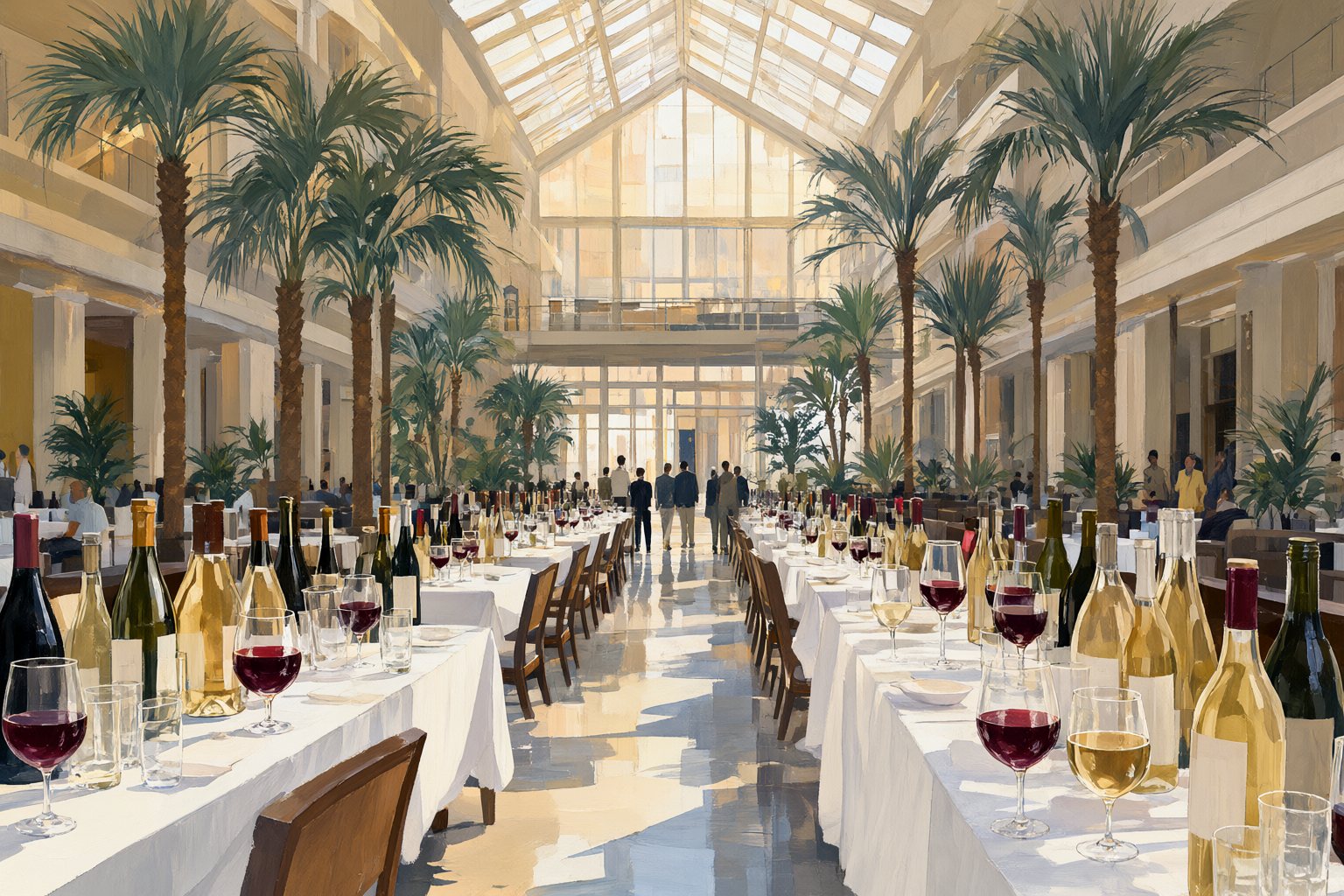
A thousand wines, a hundred and thirty producers, sixteen countries and two days to get through them: put like that it sounds like a challenge at a village fair, and yet it is one of the most refined fixtures in the European calendar. On Friday 6 and Saturday 7 November the Decanter Fine Wine Encounter will return to London, beneath the palms of The Landmark, and for lovers of “serious” wine it will be a chance to taste in one afternoon what would normally take years of dinners, travel and the right connections.
What “fine wine” means
Let us start with the term, because it is a slippery one. “Fine wine” is not an appellation; there are no regulations and no committee that confers it. It is a category of market and reputation: wines with a history, capable of evolving for a long time in bottle, produced in limited quantities from specific places, and for that reason traded, collected and sometimes resold years later. A classified Bordeaux, a great Burgundy, a vintage Champagne, a single-cru Barolo: this is the territory.
The most honest criterion, however, remains time. A fine wine is a wine that after ten or twenty years still has something to say, and often says things it did not know how to say in its youth. A high price is a consequence, not a definition: there are extremely expensive bottles that age badly and moderately priced wines that cross the decades with ease. And this is precisely where an event like this becomes useful, because it allows you to compare different vintages of the same wine and understand, with your own palate, what “evolution” really means.
Why London
England has never been a great producing country, and yet for centuries it has been the place where wine is bought, judged and written about. The bond began in 1152, when the marriage of Eleanor of Aquitaine and Henry Plantagenet brought Gascony under the English crown: from then on, Bordeaux claret sailed up the Thames for three centuries. Later came Port, Sherry and Madeira, all wines that still bear names and styles conceived for the British market.
Around this trade the capital built institutions that exist nowhere else. The examinations to become a Master of Wine, the most feared title in the business, were first held in London in 1953, and the Institute of Masters of Wine was founded in 1955. In 2000 two former stockbrokers founded Liv-ex in the city, the platform on which merchants around the world trade fine wine and whose index has become the benchmark for secondary-market prices. Even today a significant share of the trade in great vintages passes through London before ending up in a cellar in Hong Kong, New York or Milan.
Decanter, too, is a child of this city: the magazine was born in 1975 and organised the first Fine Wine Encounter in 1997, seven years before launching its Decanter World Wine Awards. The 2026 edition therefore belongs to a tradition stretching back almost thirty years.
What to expect at The Landmark
The venue is already half the charm. The Landmark, on Marylebone Road, opened in 1899 as the Hotel Great Central, one of the great Victorian railway hotels; in the 1920s the inner courtyard was turned into a winter garden, and today the atrium with its palms and glass roof is one of the most photographed rooms in the city.
The heart of the event will be the Grand Tasting: around a hundred and twenty producers at their tables, each with a selection chosen for the occasion, plus a table devoted to wines awarded 95 points or more at the Decanter World Wine Awards. Among the names announced are houses and estates from France, Italy, Spain, Argentina, Australia, Chile, Hungary, Switzerland and even the Czech Republic: Champagne next to Rioja, Tokaji next to Tuscany, Bordeaux next to Tasmania.
For those who want to go deeper there is the Cellar Collection, organised in three sessions: twenty-one producers will each present three vintages of the same wine, including some rarely available library releases. It is the most educational part and, in our view, the most valuable, because a vertical comparison teaches more than a hundred scattered tastings. On Saturday 7 there are three masterclasses led by Dom Pérignon, Baron Philippe de Rothschild and Seña, while on Friday 6 there will be six limited-seat lunches with the winemakers.
How to tackle a big tasting
A thousand wines is an illusion: nobody tastes them all, and anyone who tries ends the day remembering none of them. The golden rule is to choose beforehand. Go through the list of exhibitors, mark fifteen or twenty tables you don’t want to miss and treat the rest as a bonus.
Then there is the question that embarrasses beginners: spitting. You spit, and everyone does it, from Masters of Wine to producers. It is not bad manners; it is the only way to reach the last glass with a clear head. At big tastings there is never a shortage of spittoons; a small sip, a few seconds in the mouth, a draw of air to let the aromas speak, and out. Drink plenty of water instead, eat something before going in and along the way, and allow yourself a break every hour.
Order matters. Common sense says whites before reds, light before powerful, dry before sweet; a useful trick is to finish with a sip of something sparkling, which cleans the palate better than anything else. If you are targeting very tannic or very concentrated wines, don’t put them at the start: they anaesthetise the mouth for half an hour.
Finally, notes. Three lines per wine are enough: what struck you on the nose, what the structure is like on the palate, how long the finish lasts. A photo of the label will save your memory, a score from one to five will help you reconstruct the day the next morning. And ask questions: behind the tables there is often the person who actually made the wine, and five minutes of conversation are worth more than any technical sheet.
And for those staying at home?
Those who won’t be in London can do the same exercise on a small scale. On 6 or 7 November open two different vintages of the same wine, even a modest one, and taste them side by side: it is the lesson the Cellar Collection will give on a far more ambitious scale. Alternatively, a historical tribute to London: a red Bordeaux, the claret on which the city built its palate.
Our view is simple. Events like the Fine Wine Encounter make sense if you go to learn and not to collect tastings. Anyone who arrives with a plan, spits without shame and goes home with ten clear notes will have understood more about fine wine than someone who has “done” a hundred tables. The real luxury in there will not be the rare bottle: it will be the comparison.
Practical information
- Dates: Friday 6 and Saturday 7 November 2026
- Venue: The Landmark London, 222 Marylebone Road, London
- Grand Tasting hours: Friday 15–21, Saturday 11–17.30
- Cellar Collection: Friday 17–20; Saturday 10.30–13.30 or 14.30–17.30
- Tickets: bought online on the organiser’s website, with one-day options and packages that include the Cellar Collection; prices and availability should be checked there
- Notes: admission for over-18s only, smart casual dress
- Official website: decanter.com
❦