How many bottles of wine for a dinner party? The sum nobody wants to do
How many glasses in a bottle, how much wine per person, what order to serve it in and at what temperature: a practical guide for a dinner or a party.
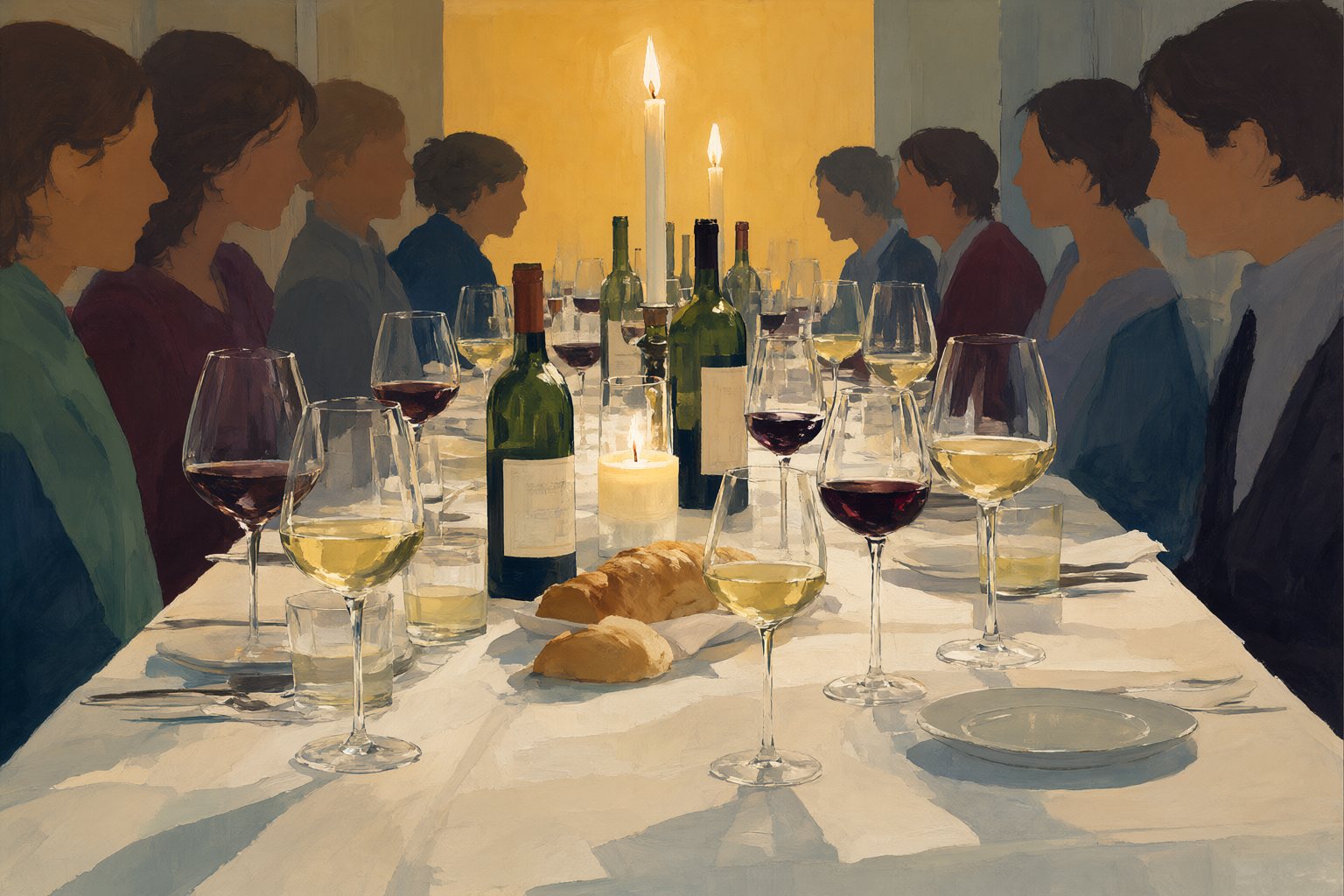
Every dinner among friends has two moments of panic. The first comes at a quarter to eight, when you realise the oven is not on. The second comes at half past eleven, when someone holds the last bottle up to the light and finds it empty. The first is solved with a long round of starters. The second is not: at that hour the wine shops are closed, and the cooking wine, the one meant for the risotto, nobody wants.
The good news is that the arithmetic is simple, and can be done on your phone’s calculator while you write the shopping list. The bad news is that almost everyone does it by eye, and the eye, where wine is concerned, is a terrible accountant.
How many glasses are in a bottle
Let us start with the unit of measurement. A standard bottle holds 75 centilitres, that is, 750 millilitres. How many glasses it yields depends on how much you pour, and here the schools of thought diverge more than one might think.
In restaurants a glass is usually somewhere between 100 and 125 ml: in that case a bottle gives six or seven glasses. At home people are more generous, and the figure that recurs most often in English-language guides is a glass of about 150 ml, which brings the count down to five. The rule of thumb, then, is this: one bottle, five or six glasses. If you have large glasses and a heavy hand, count five. If you pour sensibly, that is, up to the widest point of the bowl and no further, count six.
It is worth saying: filling the glass to the brim is no act of affection towards your guests. Wine needs air above it to express itself, and a brimming glass warms up in the hand before it is half drunk.
The per-person calculation
This is where the formula caterers have used for decades comes in, and it works surprisingly well at home too: half a bottle per head for a sit-down dinner. Translated into glasses, that is two or three per person over the evening, which for a three- or four-hour dinner is a reasonable average: some drink a single glass and some drink four, and in the end it evens out.
So: eight people at the table, four bottles. Ten people, five bottles. Then you adjust.
For a standing party the reasoning changes, because time counts for more than the menu. The most common guidance suggests a third to half a bottle per person every two hours, erring on the low side if there is also beer and cocktails. If the wine is self-service, with nobody pouring, a little more gets drunk, in the order of ten per cent: the half-finished glass forgotten on a shelf is a classic that nobody ever accounts for.
Then the adjustments by feel: a summer lunch on the terrace calls for more white and more sparkling wine than a January dinner; a fish menu tips the balance towards whites; a group of committed teetotallers, obviously, brings everything down.
The right order: from lightest to richest
If several wines are coming to the table, the classic sequence still holds, and not out of snobbery: it is there so that no wine is flattened by the one before it.
You begin with sparkling wine, at the aperitivo. It is the wine of waiting, of standing conversation, of the oven finally heating up. Then the whites, with the starters and first courses; within this family, first the younger and lighter ones, then the more structured ones or those with a few years behind them. If there is a rosé, it goes here in the middle. Then the reds, also on a rising scale: first the leaner ones, then the more robust, for meat main courses or aged cheeses. Finally, if you like, a sweet wine with dessert or with a blue cheese.
There is only one principle: from dry to sweet, from light to heavy, from young to old. Exceptions exist, and are sometimes delicious, but it pays to know the rule before breaking it.
For the shopping, a rough proportion for an Italian-style dinner with a mixed menu: one bottle of sparkling wine for every four or five people for the aperitivo, then the rest split more or less evenly between whites and reds, depending on the menu. The sweet wine is counted separately: with a half-litre bottle, the glasses are small and there is enough for a whole table.
How much extra to buy (and what temperature to serve it at)
The honest answer is: always one or two bottles more than the calculation. Leftover wine is not a problem; it keeps in the cellar or in a cool corner of the house until the next occasion. Wine that runs out at eleven, on the other hand, is the only real logistical failure of a dinner. Those buying from a trusted wine shop can also ask whether it takes back unopened bottles: some do, but it is not a rule, so ask beforehand.
As for temperatures, the guidance found in most serving charts is as follows, to be taken as ranges rather than dogma:
- sparkling wines: 6-8 °C;
- fresh, light whites: 8-10 °C;
- aromatic whites and rosés: 10-12 °C;
- structured whites: 12-14 °C;
- light reds: 14-16 °C;
- more structured reds: 16-18 °C, up to 18-20 °C for very mature ones.
The practical trick is this: the famous “room temperature” is a legacy of houses without central heating. In a flat at 22 degrees a red is too warm, and what you mostly taste is the alcohol. Half an hour in the fridge before serving does it a world of good. For whites the opposite applies: taken out of the fridge ten or fifteen minutes beforehand, they open up better. To chill quickly, an ice bucket with water and ice works much faster than the freezer, and without the risk of forgetting the bottle inside.
The case for the magnum
A magnum holds a litre and a half, that is, two standard bottles: ten or twelve glasses. For a table of eight to ten people it is a choice that makes sense not only for the show. A single wine accompanies the whole main course with no changeover halfway, and whoever gets up to open it only has to do so once. Among enthusiasts the idea has always circulated that wine evolves more slowly in large formats, because of the lower ratio of air to liquid: it is a widespread and plausible opinion, but for a dinner next Saturday it matters little.
What matters more is a practical detail: a magnum is heavy, awkward to pour and slow to chill. For sparkling wine or a white, put it on ice well in advance, at least an hour beforehand.
One last thing, the simplest: on the table, next to every bottle of wine, a jug of water. Drinking well also means drinking the right amount, and a successful dinner is measured by its conversation, not by its empties.
The sum, in the end, is easy: half a bottle per head, one or two in reserve, the red a little cooler than you think. The rest is hospitality. And the best guest, let us be honest, is not the one who brings the most expensive bottle, but the one who remembers to bring an extra one.
❦