Hong Kong Wine & Dine 2026: the harbour where wine pays no duty
From 29 October to 1 November Hong Kong opens its Wine & Dine Festival on the harbour: history, Bordeaux, what to expect and what to open at home.
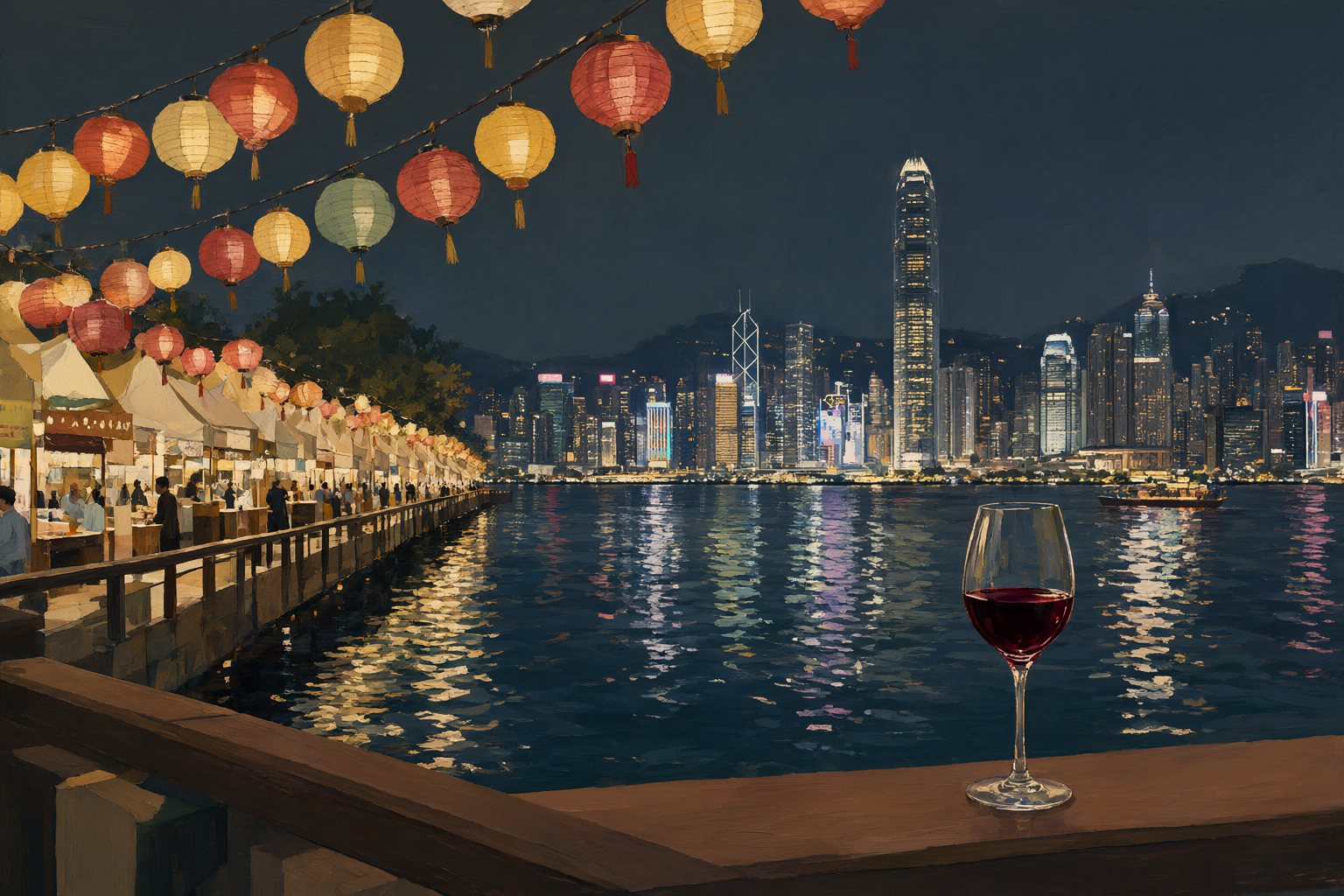
There are cities that make wine and cities that move it. Hong Kong belongs firmly to the second kind: it has not a single row of vines, not one historic cellar, and yet for almost twenty years it has been one of the places where the world’s wine passes through, is sold, auctioned and drunk with the greatest ease. From 29 October to 1 November 2026 this mercantile calling will once again take the form of an open-air party, on the Central waterfront, with the Victoria Harbour skyline as a backdrop: the Hong Kong Wine & Dine Festival, organised by the Hong Kong Tourism Board.
A party born of a tax law
To understand the festival you have to start with a budget measure, which is an unromantic but honest way of telling the story of wine. Until 2007 wine imported into Hong Kong was subject to an 80% duty; that year the rate was halved to 40% and in 2008 the government scrapped it altogether. The effect was almost immediate: merchants, auction houses and logistics operators moved en masse to a territory that offered a free port, a British-style legal system and the most convenient gateway to mainland China. In the years that followed came a customs agreement with the Mainland to ease re-exports (from 2010, later strengthened) and an accreditation scheme for wine storage facilities. Hong Kong thus became one of the most important auction centres in the world and, in the view of many industry observers, the true wine hub of Asia, ahead of Tokyo and Singapore.
The Wine & Dine Festival is a direct offspring of that turning point. The first edition was held in 2009, the year after the duty was abolished, with the idea of turning a tax advantage into a public habit: taking wine out of the auction rooms and private clubs and putting it in the hands of anyone strolling along the waterfront. The format has remained recognisable ever since: four days, hundreds of stands, a system of passes and tokens for tastings, a crowd that mixes residents, tourists and trade. In 2013 the tourism board reported some 140,000 visitors over four days; in 2025, according to figures released by the organisers and reported by the trade press, there were around 163,000.
Bordeaux, the guest who never leaves
If the festival has a long-standing partner, it is Bordeaux. The bond goes back to 2008 itself, when Hong Kong was guest city at the Bordeaux wine festival, and from the following year the collaboration became part of the very organisation of the festival. In June 2026 the Hong Kong Tourism Board and the Conseil Interprofessionnel du Vin de Bordeaux signed a new five-year memorandum of understanding on promoting food and wine tourism, and this year’s edition will give Bordeaux a dedicated space.
This is no diplomatic courtesy. Hong Kong is the third-largest export market for Bordeaux wines, after the United States and the United Kingdom, and above all it is a market at the very top end: in the twelve months to March 2026 volumes fell by a few points while value grew, with an average price per bottle that the specialist press puts at close to three times what American buyers pay. In other words: Hong Kong drinks less Bordeaux than it used to, but chooses it from higher up the ladder. It is a faithful mirror of the whole Asian fine-wine market, which after the years of speculative fever over the great châteaux has become more selective, more curious and less inclined to buy collectors’ labels alone.
What to expect on the waterfront
The announced programme speaks of more than 300 stands from wineries, distributors and restaurants, with regions and countries reaching well beyond France: Italy, Spain, Georgia, the United Kingdom, Australia, Canada, South Korea and China. The Chinese presence is one of the most interesting details: areas such as Ningxia stopped being a curiosity some time ago, and the festival is one of the few places where a Western visitor can taste them alongside wines they already know, free of any prejudice of context.
The heart of the festival for enthusiasts will be the Grand Wine Pavilion, which will bring together more than twenty fine-wine merchants and a calendar of over twenty masterclasses and guided tastings, some led by Master Sommeliers. On the food side, the Tasting Room will offer menus created for the festival and paired with wine, with international chefs including Edward Lee and Thierry Marx, while the “Only in Hong Kong” Flavours area will gather more than a hundred of the city’s restaurants with their signature dishes. And the party will not end with the festival: throughout November, Wine & Dine Month will extend menus and initiatives to participating restaurants and venues across the city.
One practical tip, valid for any festival of this kind: the masterclasses are where you really learn, and they are also the first to sell out. It pays to check the programme in advance and to arrive in the early afternoon, before the waterfront fills up for the evening.
At home: what to open
Those following the festival from afar have one advantage: they can choose their pairing at leisure. The most fitting choice is of course a red Bordeaux, and there is no need to aim for a grand cru: a good Bordeaux Supérieur or a Right Bank red based on Merlot has just the right softness to go with char siu, Cantonese glazed pork, or a roast duck. Anyone wanting to enter into the spirit of Hong Kong, though, should look to the cuisine before the flag. Dim sum, with its sweet, salty and fried notes in the same mouthful, calls for aromatic whites with a touch of residual sugar, such as a Mosel Riesling Kabinett, or else the freshness of bubbles: a Franciacorta or a Trento Doc works beautifully with steamed dumplings and light fried dishes. For steamed fish with ginger and spring onion, the Cantonese dish par excellence, the minerality of a Vermentino or a Verdicchio is a pairing that surprises anyone who has never tried it.
And if you want to make a gesture in keeping with the festival’s openness to less obvious countries, this is a good opportunity to seek out a Georgian amphora wine or, with a little luck in the best-stocked wine shops, a red from Ningxia.
Why it matters to us
It is easy to see Hong Kong as a marketplace of money alone, where wine is a safe-haven asset to be kept in climate-controlled warehouses. The Wine & Dine Festival tells another side of the same story: a city that decided, through a tax law, to become a market, and then realised that a market without curious drinkers is fragile. For European producers, and Italian ones in particular, who in Asia still trail behind the French, the lesson is clear: four days on the Central waterfront are not enough to conquer a continent, but they reveal with precision who, on that continent, is tasting. And that is where it is worth being found.
Practical information
- Dates: from 29 October to 1 November 2026
- Venue: Central Harbourfront Event Space, Central, Hong Kong
- Organiser: Hong Kong Tourism Board
- After the festival: Wine & Dine Month throughout November at participating venues
- Official website: discoverhongkong.com
- Tickets and tasting passes: terms and prices to be checked on the official website
❦