Harvest day, who decides it and how they know
Sugar, acidity, tannin ripeness and berry tasting, and how growers pick the harvest date, by hand or machine, in an age of earlier vintages and night picking.
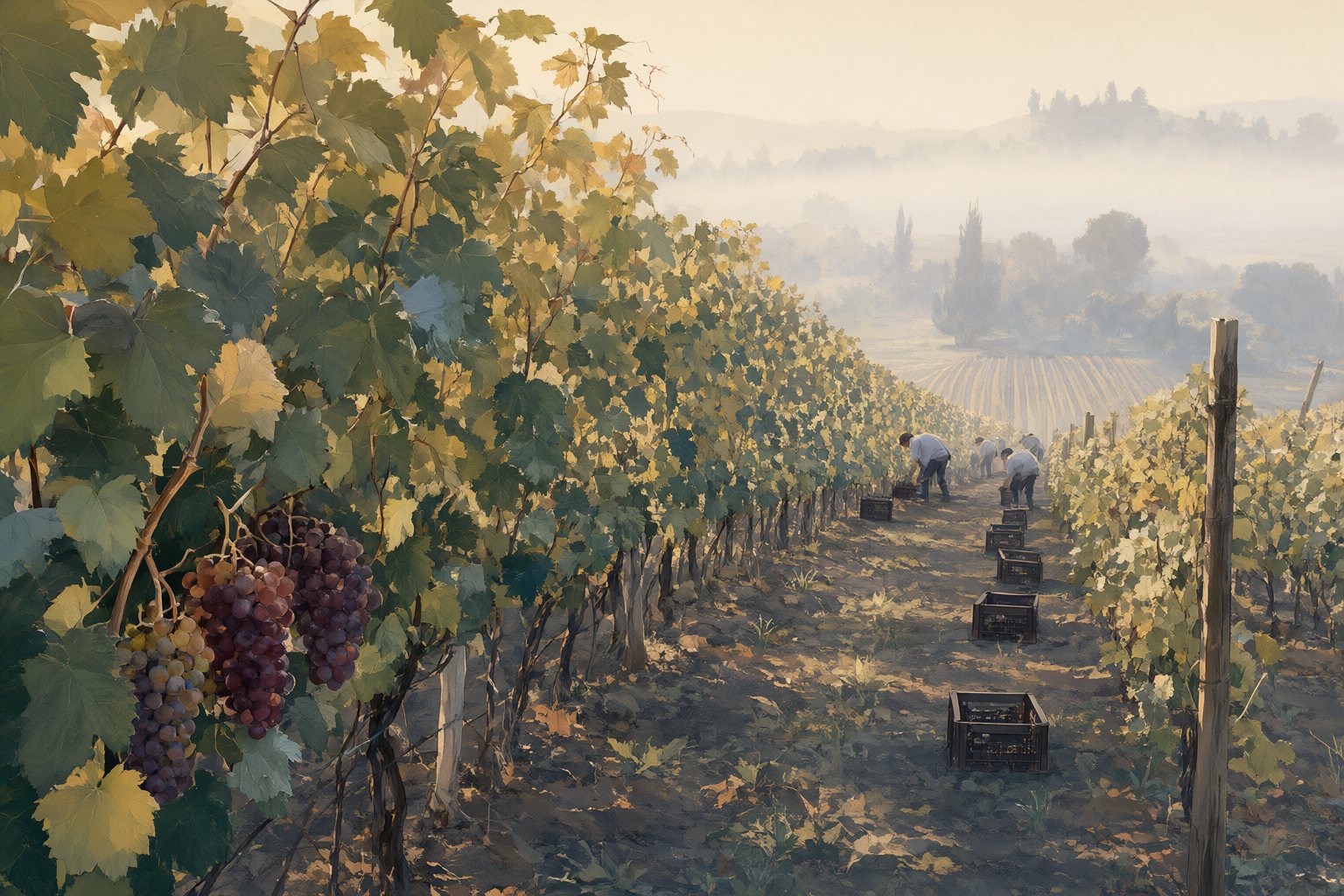
The day of the harvest is not decided by the calendar, nor by village tradition. It is decided by a bunch of grapes, or rather by a few thousand bunches that no one will ever see in the glass, watched for weeks by people who know that being four days out can cost more than a year of pruning. Pick too early and the wine is lean and green; too late and it is heavy and tired. In between lies a window that sometimes lasts two weeks, sometimes a few days, and that no one can draw in advance.
The numbers, which are only the beginning
It starts with the refractometer, a tiny instrument: one drop of juice and you read the sugar level. Sugar matters because it will become alcohol: roughly 17 grams per litre of must are needed for one degree of alcohol, and from there you see where you are heading. But sugar is the easiest thing to measure and the least interesting, because it rises almost linearly, while acidity falls. Malic acid is burned off by heat and by the berry’s own respiration, while tartaric holds up better. The pH climbs, and a pH that is too high means unstable, less fresh wines.
What growers look for, in short, is a crossing of curves. Sugars going up, acidity going down, and the point where the ratio between the two is the one the wine in their head requires. For a sparkling base that point arrives early, with high acidity and restrained alcohol. For a structured red it comes much later. There is no right date in absolute terms: there is the right one for a style.
The ripeness sugar cannot measure
Then there is phenolic ripeness, the part that sends technicians into crisis. A grape can have its sugars in order and its tannins still unripe, those of the skin and above all of the seeds: astringent, dry, vegetal. As ripening goes on the molecules transform, the tannins soften, the anthocyanins build up in the skin. These processes do not follow sugar, and in warm vintages they can even come unstuck from it: the alcohol is already high and the tannins are not yet ready. It is the dilemma of our times.
That is why people taste. They go into the vineyard, take berries from different points along the row, from the sunny side and the shaded one, and chew them. They see whether the pulp comes away from the seed, whether the seed has turned brown and crunchy instead of green and bitter, whether the skin gives way or stays rubbery. The laboratory supplies the numbers, the palate delivers the verdict. Anyone who harvests on data alone has already decided not to look at the grapes.
By hand or by machine
The hand remains the choice when the vineyard is steep, when working with whole bunches, when selection in the crate matters as much as selection in the vineyard. On terraces and slopes the machine simply cannot pass. For methods that require whole bunches, such as many sparkling bases, it is the only road. And a small crate stops the fruit crushing under its own weight.
The machine, though, has arguments that hand-picking enthusiasts tend to ignore. It gathers in a few hours what a crew needs days to do, and when the weather turns, speed is quality. It can work at night, at far lower cost. In a well-designed vineyard on flat ground, with a good operator, the results can be excellent, especially for whites and rosés made with rapid pressing. The machine’s real fault lies in the wrong vineyards, not in itself. Hand harvesting is not a title of nobility: it is an option that is worth it when it is truly needed.
Ever earlier, often at night
Then there is the theme that changes the rules: grapes ripen sooner. Reports from recent seasons speak of harvests starting early, in some areas by weeks compared with a few decades ago. I could not verify the individual figures for this year, so I do not quote them, but the direction is clear, and it is documented by those who have kept harvest-date records for generations. With the heat, sugars race ahead and acidity evaporates, and the wine risks losing its balance.
One response is to pick at night or at dawn. With cold fruit, oxidation and spontaneous fermentation before it reaches the cellar are limited, aromas are better preserved, less energy is needed for cooling. It is common above all for whites, and it has a romantic side (the head torches, the silence) and a very practical one: working when it is cooler, for people too.
But earlier picking has a less visible price. If the fruit is harvested when it is still very hot, with the long days of August, ripening is compressed and phenolic ripeness struggles to catch up. Growers race the climate with altitude, different exposures, later varieties, fuller canopies that shade the bunches.
An opinion
I believe the harvest is the last trade in which intuition beats data, and that this is a good thing. Numbers are there to stop you being fooled, but the decision remains an act of judgement, and like any judgement it can be wrong. The real challenge of the coming years will not be picking earlier or later, by hand or by machine, by day or by night. It will be learning to read a grape that no longer behaves like our grandparents’ grapes, without disowning what our grandparents knew from looking at a single berry.
❦