Amarone, the wine born of waiting: appassimento, Recioto and Ripasso
How drying grapes in Valpolicella’s fruttai creates Amarone, what links it to Recioto and Ripasso, and why its style is up for debate today.
Almost all the world’s great reds are born of a race: pick at the right moment, crush quickly, protect the fruit. Amarone is born of the opposite. Once cut from the vine, the grapes don’t go straight to the winery: they are set aside and left to lose water for months, while outside autumn turns to winter. It is a wine that asks for patience before it is even wine, and perhaps that’s why those who make it tend to speak of it in the tone reserved for things that cannot be hurried.
The time of the fruttai
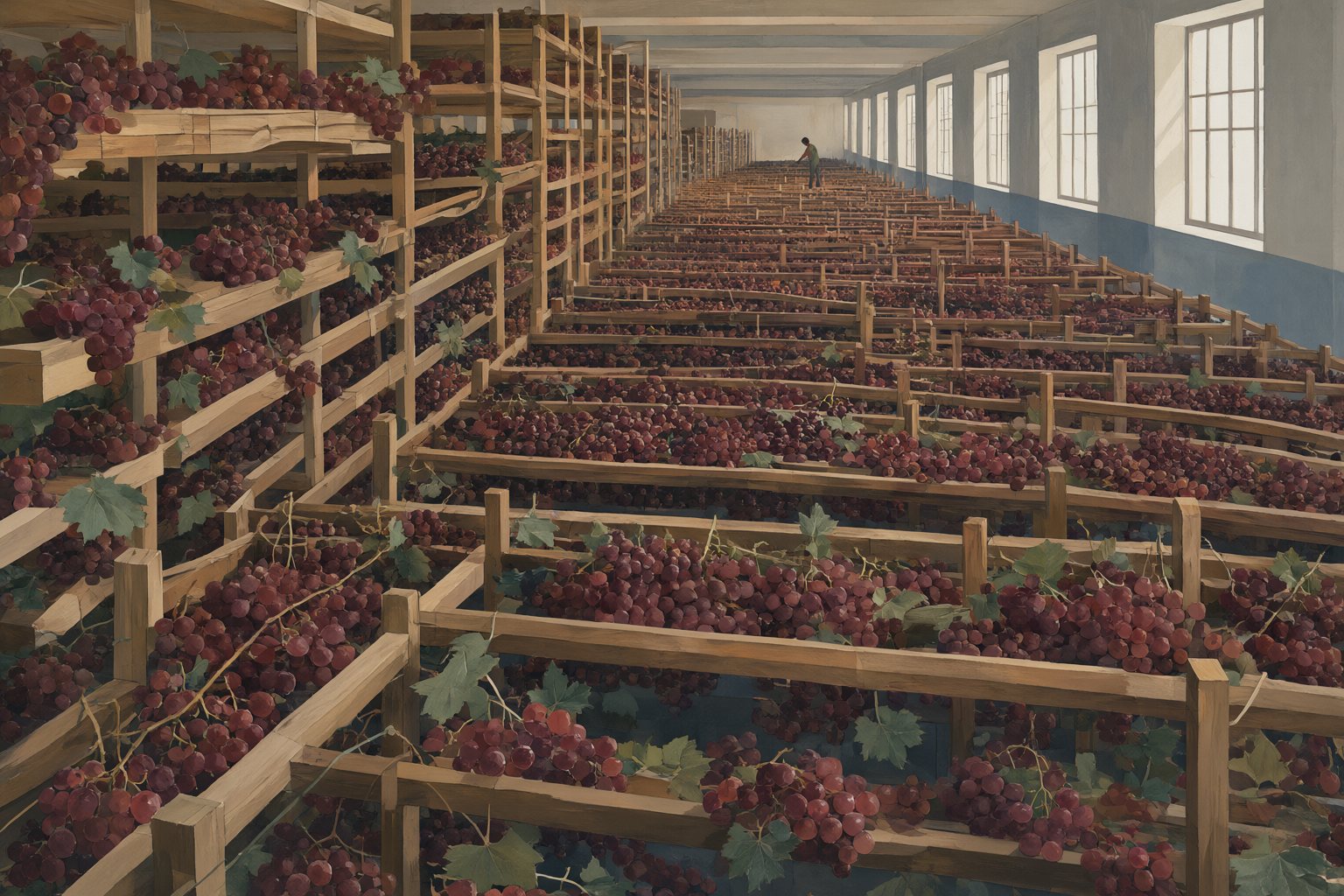
The heart of Amarone is appassimento, the drying of the grapes. After the harvest, the best bunches, chosen one by one for being loose and healthy, are laid out on racks or in crates, or hung up, inside ventilated lofts that in Valpolicella are called fruttai. There they stay for a long time: generally three or four months, often quoted at around one hundred and twenty days. The production rules set a precise marker, at least as a rule: the grapes may not be crushed before 1 December following the harvest.
During that period the berry loses a considerable part of its weight, in the order of a third and sometimes more depending on the variety and the vintage. But reducing it all to simple concentration would sell it short. While it waits, the grape is not inert: its chemistry changes, acids and aromas shift, the skin becomes more fragile and gives up its colour and tannins in a different way. The fruttaio, in short, is not a warehouse: it is already a place of transformation.
Once, growers relied solely on the hillside air, opening and closing the windows according to the wind and the humidity. Today many wineries supplement or replace the traditional fruttai with rooms where ventilation and humidity are controlled, reducing the risk of unwanted moulds. It’s a choice that divides opinion: some see technology as a guarantee of cleanliness, while others fear that an over-managed appassimento strips the wine of part of its vintage voice.
Corvina, Corvinone, Rondinella
The grapes are those of Valpolicella, and none of them is famous anywhere else. Corvina is the lead: thick skin, gentle tannin, aromas of cherry and spice, and above all a great aptitude for drying without falling apart. Corvinone, long mistaken for a close relative, has larger bunches and berries and brings structure. Rondinella is the reliable supporting player: hardy, productive, useful for colour and balance.
The production rules for Amarone della Valpolicella DOCG stipulate that Corvina and Corvinone together make up between 45 and 95% of the blend, with Rondinella between 5 and 30%. The rest may come from other red grapes authorised in the province, up to a maximum of 25%. The minimum alcohol level is 14%, but in practice it often goes well beyond that. Before release, the wine needs at least two years of ageing, counted from 1 January following the harvest; for the Riserva the years become four. DOCG status came with a decree at the end of 2009, in force from 2010, together with that of Recioto della Valpolicella.
The sweet sibling and the legend of the forgotten cask
To understand Amarone you have to start with Recioto, which is older. In Valpolicella, dried grapes had been used for centuries to make a sweet, dense, precious wine: Recioto, in which fermentation stops while leaving a good amount of sugar behind. Stopping a fermentation, however, was not always easy. When the yeasts carried on to the end, the wine came out dry and “amaro”, bitter, in the sense of not sweet, and for a long time this was considered a fault.
This is where the story everyone tells comes in. According to a widely repeated version, in 1936 Adelino Lucchese, at the Cantina Sociale della Valpolicella, tasted a cask of Recioto that had been left aside too long and had fermented all the way to dryness, finding it not unpleasant but surprising, and from that tasting came the name “Amarone”, amaro with an augmentative suffix: the big bitter one. It’s a charming tale, but it should be taken for what it is: a founding legend, handed down more than documented, and the versions differ in the details. The commercial facts are more solid: Amarone as a deliberately dry wine began circulating in bottle under this name in the 1950s, with the house of Bolla often cited among the first to offer it, from the 1950 vintage.
The truth is probably less romantic and more interesting: the “mistake” had always been happening in every cellar in the valley. At a certain point, someone stopped regarding it as a mistake.
Ripasso, the offspring that carries the name around
Another wine is born from Amarone’s pomace. Valpolicella Ripasso is made by refermenting an already finished Valpolicella on the still-rich skins of Amarone or Recioto. The base wine comes out with more colour, more extract, more alcohol and a more noticeable tannin: a sort of Amarone in miniature, without the wait in the fruttai. The technique has old roots in the area, while its modern commercial version is traced back to the 1960s. Since 2010 Ripasso has had its own DOC, and today it accounts for a very large share of Valpolicella’s production.
It’s a useful and often enjoyable wine, but its success raises an awkward question: if the image of the territory is carried above all by a “reflected” wine, how much room is left for the simpler, fresher, more gluggable Valpolicella that for centuries was the everyday wine of these hills?
Power or freshness
The real debate today is about style. On one side there is monumental Amarone: alcohol well above fifteen degrees, fruit preserved in spirit, sometimes perceptible residual sugar, new oak, a mass that fills the mouth and occupies it for a long time. It’s the style that built the wine’s fame around the world and that still has many devoted admirers.
On the other side, a growing number of producers are looking for a leaner Amarone: shorter drying periods, less residual sugar, higher vineyards, large and used casks, attention to acidity. The climate is pushing in the same direction: harvests come earlier than they used to, hot vintages produce grapes that are already rich, and insisting on concentration risks leading to wines that are heavier and more alcoholic than they need to be. The opposite danger exists and is just as real: an Amarone that has been lightened too much ends up resembling a good Ripasso, and loses the very reason for waiting months before crushing.
An opinion, to close
Amarone has no need to apologise for being powerful. It was born to be so, and anyone who wants it slender already has plenty of other wines to choose from. But power alone is not enough to justify so much waiting. The bottles that stay in the mind are those in which the concentration of the fruttai comes across as depth, not weight: where beneath the alcohol you can still sense Corvina’s cherry, a seam of acidity, a trace of earth and hillside. The future of this wine, I believe, lies not in choosing between muscle and freshness, but in remembering that appassimento is a means and not an end. You wait in order to understand the grape better, not to erase it.
❦