Drinking in Ancient Rome: Water, Honey, Pitch and Falernian
How wine was drunk in ancient Rome, from Falernian and watered wine to mulsum and resin, amphorae and dolia, with Pliny, Cato, Columella and Pompeii.
A Roman who walked into a tavern in Pompeii and asked for wine almost certainly did not want it neat. Quite the contrary: asking for wine without water was thought barbarian, the habit of peoples who had never learned to sit at table. The glass of ancient Rome was born already mixed, and above all already modified: sweetened, spiced, smoked, boiled, resinated. If today’s sommelier swoons before a “clean” wine, a Roman winemaker would have raised an eyebrow. Clean compared with what?
Water in the wine, not the other way round
The rule was to dilute. Wine reached the table in a large bowl, the krater, where it was blended with water (sometimes warm, sometimes chilled with snow) and served from there. Proportions varied with company and hour; at symposia and long dinners someone even set the measure for everyone, the so-called arbiter bibendi. The sources give us no single recipe, and it pays to distrust anyone who quotes one as if it were a disciplinare.
Decorum was not the only reason. These wines were often concentrated, rich in sugar, lacking the fresh acidity we associate with today’s whites, and sometimes aged until they turned to syrup. Stretching them made them drinkable for a whole evening. This is not a habit to pity: it is serving technique, and it works.
Falernian, the legend with a birth certificate
The name that dominates every account is Falernian, produced on the slopes of Monte Massico, between southern Lazio and Campania. Pliny the Elder, in the Naturalis historia, puts it at the top of the ranking of Italian wines and distinguishes three types: one harsh, one sweet, one light. He adds a remark that is both amusing and unsettling: it was supposedly the only wine that catches fire when a flame is held to it. Read it as Pliny’s claim, not as a laboratory finding.
The most famous Falernian came from the vintage of 121 BC, the year of the consul Opimius, so much so that “Opimian wine” became shorthand for a mythical bottle. Even Petronius, in the Satyricon, has Trimalchio boast of a hundred-year-old Opimian Falernian: it is a comic scene, but it assumes the audience got the joke. Again if we trust Pliny, two centuries after the harvest those wines had shrunk to a kind of bitter honey, no longer drinkable on their own. The glory of old wine, in other words, has always had a ridiculous side.
Which grapes made it, nobody knows for certain. The name survives today in the Falerno del Massico denomination, in Campania, but between the wine of then and the wine of now lies a gulf of almost two thousand years, and identifications of ancient grape varieties remain hypotheses.
Honey, resin and other touch-ups
Mulsum, wine sweetened with honey, opened the meal: it was the Romans’ aperitif. Horace, in the Satires, mocks those who blend honey into a robust Falernian, because wasting a great wine on a starter drink was an error of taste. For mulsum you used good wine, but not the best, a principle some bartenders today would recognise at once.
The techniques for fixing an unstable wine were many. The Latin agronomists, Cato in De agri cultura and Columella in De re rustica, fill pages with recipes: cooked must to sweeten and preserve, seawater added in certain preparations, resins and pitch to seal and perfume. The taste of resin was no accident: containers and stoppers were smeared with pitch, and the wine took on its flavour. A distant relative of that taste survives in Greek retsina, which is, culturally, the Romans’ cousin.
Cato, incidentally, reminds us that not everyone drank Falernian: he speaks of wine for the estate’s labourers, a second-rate product, and of diluted drinks for those lower down the social ladder. Rome’s wine, like today’s, came in tiers and classes.
Amphorae, dolia and stoppers
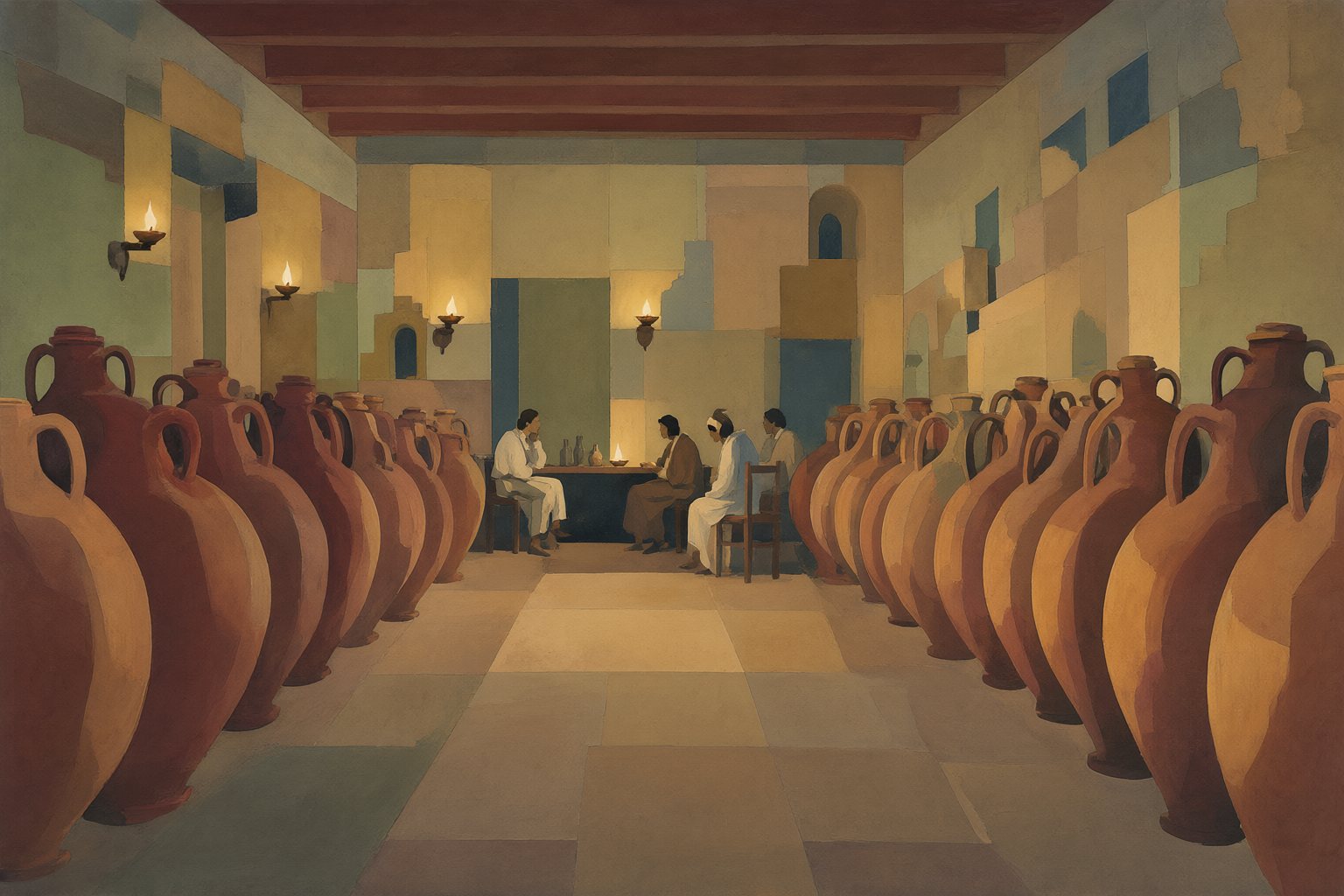
Wine was fermented and stored in large terracotta jars, the dolia, often lined with pitch and partly buried to keep them cool, as the agricultural writers describe. At Villa Regina, in Boscoreale, a stone’s throw from Pompeii, the villa’s cellar preserved eighteen dolia; beside it, the vineyards have been replanted from casts of the ancient roots.
For transport, wine moved into amphorae: sealed with pitch and stoppers, filled at destination, often marked with the producer’s name or with the serving consul, that is, the vintage. A real label, written by brush, long before back labels.
Pompeii, or wine at the counter
Pompeii is where all this stops being theory. Along its streets open dozens of counters with sunken jars, the thermopolia, where wine was poured and people ate standing up. A graffito attributed to an innkeeper named Hedone promised, depending on how much you spent, ordinary wine or even Falernian: in effect, a wine list with three price bands. Pliny, speaking of Pompeian wines, writes that they matured in about ten years and then improved no further with age: a severe critic’s verdict on an area that sold well all the same.
What is left of all this
It seems to me the Romans left us an uncomfortable lesson: wine was never a “natural” product to be shielded from human hands, but a trade of adjustments, blends and cunning in the service of pleasure. We judge them with the mouth of an age that discovered preservation, clean cellars and glass. They, with what they had, drank very well, in their own way. Worth remembering the next time someone takes offence at a splash of water in the glass.
❦