Brunello di Montalcino, a legend younger than it looks
From the Biondi Santi family’s nineteenth-century insight to Italy’s first DOCG and the Brunellopoli scandal: the short, intense story of a wine that seems ancient.
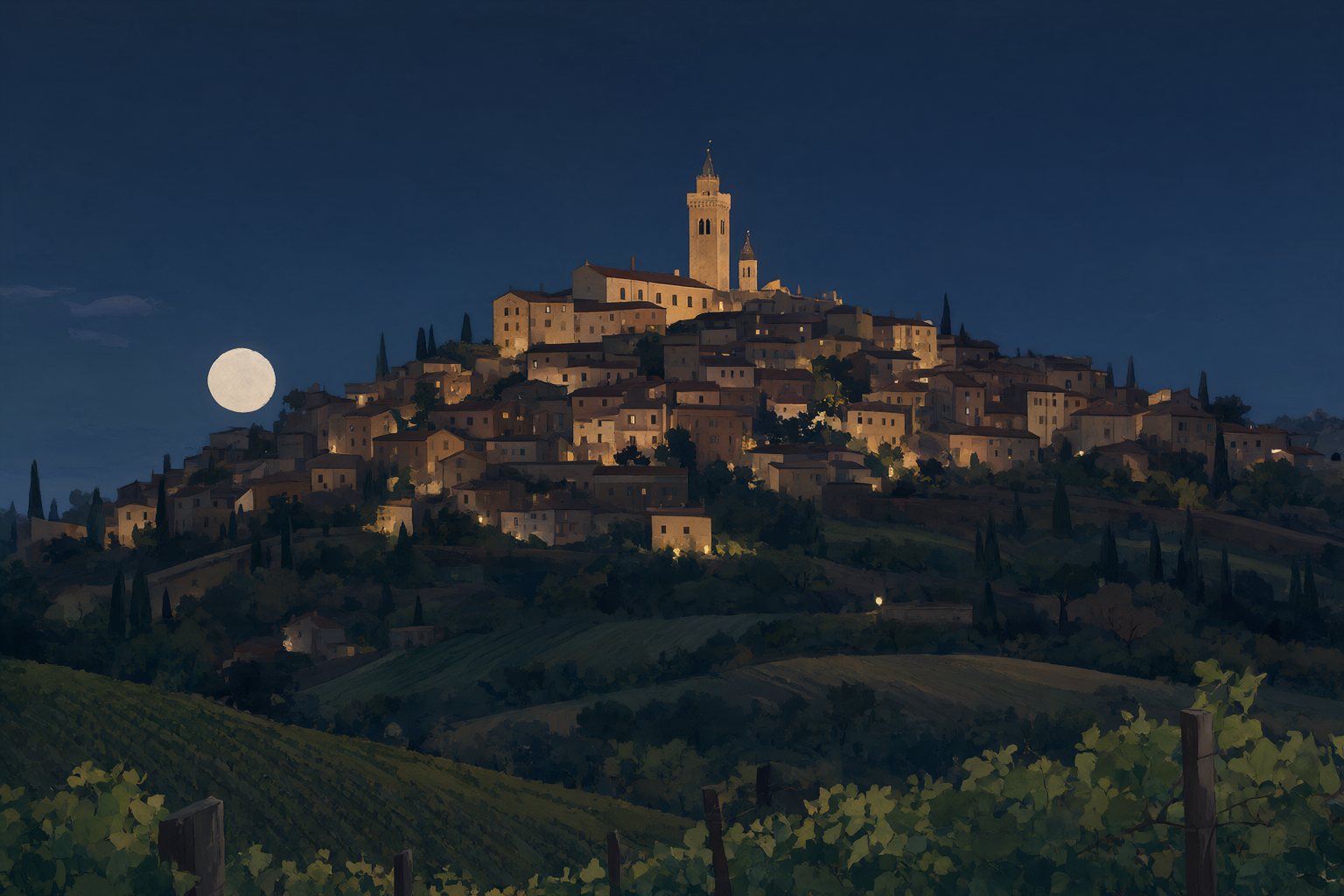
Some wines wear the centuries like a cloak, and others stitched their cloak together quickly, with skill, and wear it so well that nobody asks any more when it was tailored. Brunello di Montalcino belongs to the second kind. It is served with the solemnity reserved for relics, named in the same breath as Barolo and Burgundy, and yet its worldwide fame is the age of a retired executive, not of a cathedral. That is no flaw. On the contrary, it is the most interesting part of the story.
A family idea
In the nineteenth century Montalcino was a poor farming village, known more for its sweet Moscadello than for its reds. The man who changed the perspective was Clemente Santi, owner of the Il Greppo estate, who began selecting the local Sangiovese, called “brunello” here for the dark colour of its berries, and vinifying it on its own with ageing in mind. The Consorzio recalls that his 1865 vintage won a silver medal in 1869 from an agricultural committee in Montepulciano: a local accolade, not yet a consecration.
The decisive step was taken by his grandson, Ferruccio Biondi Santi, to whom tradition attributes the first bottle of Brunello in the modern sense, from the 1888 vintage: Sangiovese alone, long ageing in large casks, a wine conceived to last decades at a time when red Tuscany meant mostly blends and wine for drinking young. For a good half of the twentieth century, however, Brunello remained the business of a very few families. It was a wine spoken of with respect in Siena and almost nowhere else.
From depopulated village to boom
The paradox is that glory arrived just as Montalcino was emptying. In the 1960s the end of sharecropping and emigration to the cities left farms abandoned and land at prices that today look like a misprint. The DOC came in 1966, the Consorzio was founded in 1967, but the numbers stayed tiny: sources speak of around ten producers at the start of the decade and a few dozen hectares declared as Brunello.
Then the wind changed. In the 1970s the producers grew to several dozen, new wineries were founded and outside capital arrived, including a major American investment launched at the end of the decade that brought vineyards, modern wineries and, above all, a sales network across the Atlantic. The 1980s and 1990s did the rest: the English-speaking critics fell in love, the scores climbed, and land prices followed a curve that Montalcino still remembers with a mixture of pride and vertigo.
The institutional seal came on 1 July 1980, when Brunello became the first Italian wine to be granted DOCG status. A formal primacy, partly disputed with the other appellations promoted in the same few years, but one that Montalcino claims and has managed to turn into identity. Today the production rules require that the wine be released no earlier than 1 January of the fifth year after the harvest, with at least two years in wood; the member producers number more than two hundred and the hectares registered as Brunello are about 2,100, capped since the late 1990s. From a handful of families to more than eleven million bottles a year, in less than half a century.
Brunellopoli, the fever of success
Growth so rapid brings a temptation with it: to give the market the wine it seems to be asking for. In the spring of 2008, on the eve of Vinitaly, the Siena public prosecutor’s investigation broke, promptly christened “Brunellopoli” by the press. The suspicion was that some estates, including leading names, had cut their Sangiovese with international varieties such as Merlot and Cabernet, producing darker, softer, more ingratiating wines that appealed to certain critics of the day. Seizures followed, the 2003 vintage above all was discussed, and the United States threatened to block imports without guarantees that the wine was pure Sangiovese.
The judicial outcome was less spectacular than the headlines: several plea bargains, more than a million litres declassified to plain Tuscan red, a few acquittals, and laboratory analyses of the time that could not always give clear-cut answers. But the real verdict was delivered by the producers. In October 2008, called to vote on a possible opening of the production rules to other varieties, they rejected it almost unanimously. In 2011 the same temptation resurfaced for Rosso di Montalcino, and there too it ended with Sangiovese alone being confirmed. Montalcino, held up to the mirror, chose to remain itself.
The younger brother who works for two
It is easy to call it “little Brunello”, but Rosso di Montalcino, a DOC from the 1984 vintage, has been one of the appellation’s smartest moves. Same grape, same area, slightly higher yields, released on the market as early as the September after the harvest. It allows producers to declassify the lots less suited to long ageing without diluting their flagship wine, and it allows drinkers to understand Montalcino Sangiovese without waiting five years. In the right hands it is a more nervous, immediate wine, one that speaks of fruit before structure. That so many still treat it as a fallback says more about our prejudices than about the wine.
One hill, many Brunellos
The last thing the legend tends to hide is that “Montalcino” is not a single place. The production rules stop at the boundaries of the commune, but within those boundaries very different situations coexist. The northern slope, towards the town and the higher altitudes, often has soils rich in galestro, the local flaky marl, and slower ripening, and tends to give tauter, more perfumed wines. The southern and south-western slopes, warmer, open to the influence of the sea and sheltered by the Amiata massif, usually give broader, more powerful Brunellos. In between, east and west, a thousand nuances of altitude, exposure and soil, from clays to limestones to sands.
Generalisations should be handled with tongs, because vintage and the producer’s hand weigh as much as geography. But it is precisely here that the future will be played out: a wine born as a family idea and grown into a collective brand will have to decide how far to tell of its internal differences, following the model of other great appellations that have made the vineyard map their strongest argument.
Brunello has no need to pretend to be ancient. Its true story, made of a few pioneers, a village reborn almost by chance and a scandal overcome with a vote for consistency, is finer than the legend. The next step is not to add centuries to the myth, but to learn to say that there are many Montalcinos, and that this is its wealth.
❦