Corked wine: cork, screwcap and the molecule that steals wine’s aroma
Natural cork, technical cork, synthetic, screwcap and glass: what TCA really is, how common it is, and how to spot a faulty bottle in a restaurant.
There is a moment, in a restaurant, when the waiter pours a finger or two into the glass and waits. At that point almost everyone performs a little piece of theatre: a distracted sniff, a sip, a nod. Yet that gesture is not a ritual of politeness, nor a test of whether you like the wine. It is a quality check. And the main fault it is looking for has a precise name and a chemical formula.
A molecule, not a feeling
“Corked” is not a figure of speech for a wine you don’t like. It is the signature of 2,4,6-trichloroanisole, TCA to its friends. The link between this molecule and the fault in wine was established in 1982 by a group of Swiss researchers, Buser, Zanier and Tanner, although TCA was already known as a contaminant of other foods.
This is how it comes about: certain fungi and microorganisms, in contact with chlorinated compounds (chlorophenols, once common in pesticides, wood preservatives and chlorine-based cleaning products), turn them into anisoles. Cork, a porous plant material, is an ideal setting for this unwelcome alchemy. But it is not the only one: barrels, wooden beams, pipes, seals, even the cardboard of cases can harbour TCA or its cousins, such as TBA (tribromoanisole). When the contamination lies in the winery rather than in a single cork, it is called systemic TCA, and then it can strike whole batches, even those sealed with screwcaps.
The doses involved are absurdly small: the most sensitive tasters detect it at a few nanograms per litre, sometimes even less. Billionths of a gram. But sensitivity varies enormously, and some people fail to recognise it at concentrations dozens of times higher: which is why one person at the table wrinkles their nose and the others are baffled.
The most interesting discovery came in 2013, from a group at Osaka University led by Yuko Takeuchi and Takashi Kurahashi, published in the Proceedings of the National Academy of Sciences. TCA, it seems, does not merely add an unpleasant smell: it blocks the ion channels of the olfactory cells that transmit the signal to the brain, and does so at infinitesimal concentrations. In practice it is not so much that the wine stinks; it is that TCA partly switches off our nose. Hence the classic description: wet cardboard, damp cellar, old newspaper, and above all a mute, flattened wine, stripped of fruit.
How many bottles, really?
Caution is needed here, because figures circulate without a date or a source. One of the most quoted, and most transparent, sets of data is the one published by the American magazine Wine Spectator, which for years counted the cork-sealed bottles judged to be TCA-tainted at its tasting office in Napa. In 2005 the share was 7.5%, in 2007 it reached 9.5%; by 2016 it had fallen to 3.27%, close to the lowest point in the series. A specific sample, judged by tasters more sensitive than average.
The cork industry cites lower rates, around 1% or less, and attributes the decline to the investment of the past two decades: steam cleaning, screening of individual corks, the abandonment of chlorine in processing. What can be said with reasonable certainty is that the problem has shrunk considerably since the early 2000s, but has not disappeared, and that an up-to-date, independent, large-scale percentage does not exist today.
Five ways to close a bottle
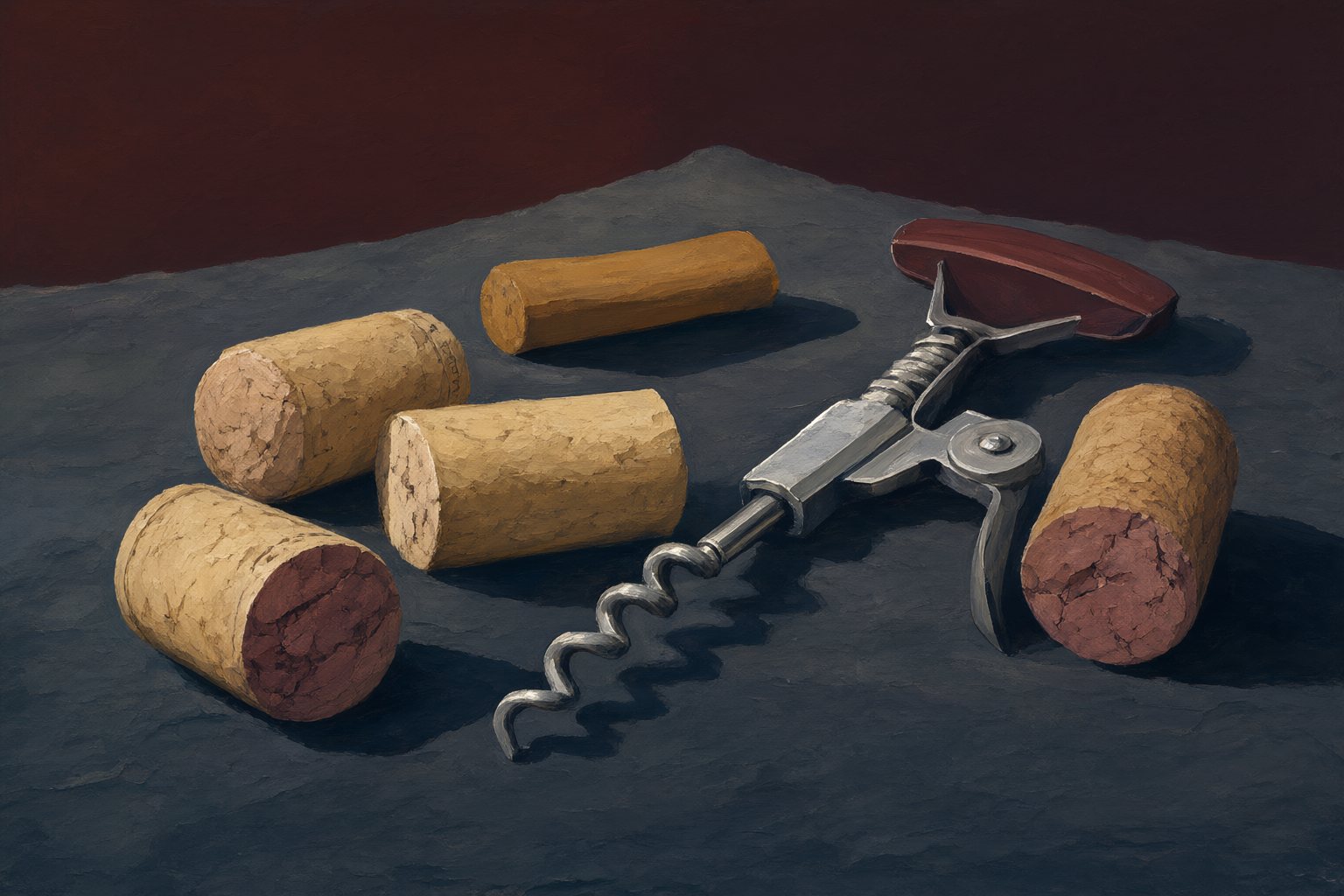
Natural cork, punched in a single piece from the bark of the cork oak, remains the benchmark for wines built for long ageing: it is elastic, it lets through minimal and variable amounts of oxygen, and it has centuries of experience on its side. Its limitation is precisely that variability: no two corks from the same batch are ever identical, and neither are two bottles of the same wine after twenty years.
Technical corks are made from agglomerated cork granules, sometimes with discs of natural cork at either end. The most advanced versions subject the granules to cleaning treatments, for instance with supercritical carbon dioxide, designed to extract TCA before the cork even exists. The result is a more consistent closure and, if the treatment is serious, a far more reliable one where the fault is concerned.
Synthetics, made of plastic polymers, carry no TCA, but the first generations handled oxygen poorly; current versions have calibrated permeability and work above all for wines meant to be drunk young.
The glass stopper, elegant and inert, with a seal to keep it tight, remains a niche: it is expensive and requires dedicated bottles.
And then there is the screwcap.
The screwcap is nothing to be ashamed of
The modern screwcap was born between the late 1960s and the early 1970s, developed in France at the urging of an Australian producer, and registered under the Stelvin trademark in 1975. For decades it was associated with supermarket wine. The turning point came from the southern hemisphere: in July 2000 a group of Riesling producers in Australia’s Clare Valley, led by Jeffrey Grosset, decided to switch en masse to screwcaps, tired of seeing fine wines ruined by cork. In New Zealand the change was lightning-fast: from 1% of bottles in 2001 to 70% in 2004, and today there, as in Australia, the screwcap is the most widespread closure.
The reason is simple: no cork, no TCA from the closure, and an extremely consistent seal. For fresh, aromatic wines, Riesling and Sauvignon above all, it is often the most logical choice, and the Australian Rieslings sealed under screwcap at the turn of the century have shown that bottle ageing is possible too.
It is not a magic wand. A very airtight closure can, in some wines, encourage reductive notes (sulphurous whiffs of struck match or egg) if the winemaking does not take it into account. And, as already said, if the TCA is in the winery, no closure will stop it. But the equation screwcap equals poor wine is a prejudice, not a fact. In Italy, moreover, some appellation rules still exclude it, and this keeps it away from the most ambitious bottles through regulation and habit rather than for technical reasons.
At the restaurant: what to smell, what to say
When they pour you the taste, smell before you drink. TCA shows itself above all on the nose: damp cellar, wet cardboard, mould, or simply an inexplicable absence of aroma. If in doubt, swirl the glass and try again. Sniffing the cork is of little use: a cork can smell of cork without the wine being faulty, and vice versa.
If you think the wine is corked, say so simply. A good sommelier will taste it and, in the great majority of cases, replace the bottle without argument. TCA is not a health hazard: it is a sensory fault, not a toxic contamination at the doses found in wine. But it is a real fault, and you are not obliged to pay for it.
Do not, however, confuse a fault with taste: a wine that is too tannic, or different from what you imagined, is not faulty. The tasting pour is there to rule out a defect, not to let you change your mind. Other genuine faults do exist, such as oxidation (baked apple, dull colour) or excessive volatile acidity (nail varnish, vinegar).
The moral, if there is one, is that a closure should be judged by what it does and not by how it looks. Natural cork still makes sense for certain wines, a well-made technical cork has made the problem much rarer, and the screwcap is often the most honest solution. The real snobbery today is not turning up your nose at the screwcap: it is failing to notice a wine that has lost its voice, and nodding along all the same.
❦