Barrique, large cask, concrete or steel: the home where wine grows up
The 225-litre barrique, the large cask, concrete and steel: how the vessel shapes the wine in your glass, from the Barolo wars to the return of concrete.
In 1983, in La Morra, a young grower took a chainsaw to his family’s old casks. In their place came French barriques. His father, Giuseppe, took it as a personal insult and, according to Decanter, cut him out of his will. The grower was Elio Altare, and that scene (told so many times that it has become something of a founding myth) says something simple: the vessel in which a wine matures is not a cellarhand’s detail. It is a statement of identity, sometimes a declaration of war.
Small wood, large wood, concrete, steel. Each material does something different to the wine, and the glass notices.
The barrique, or the wood that talks
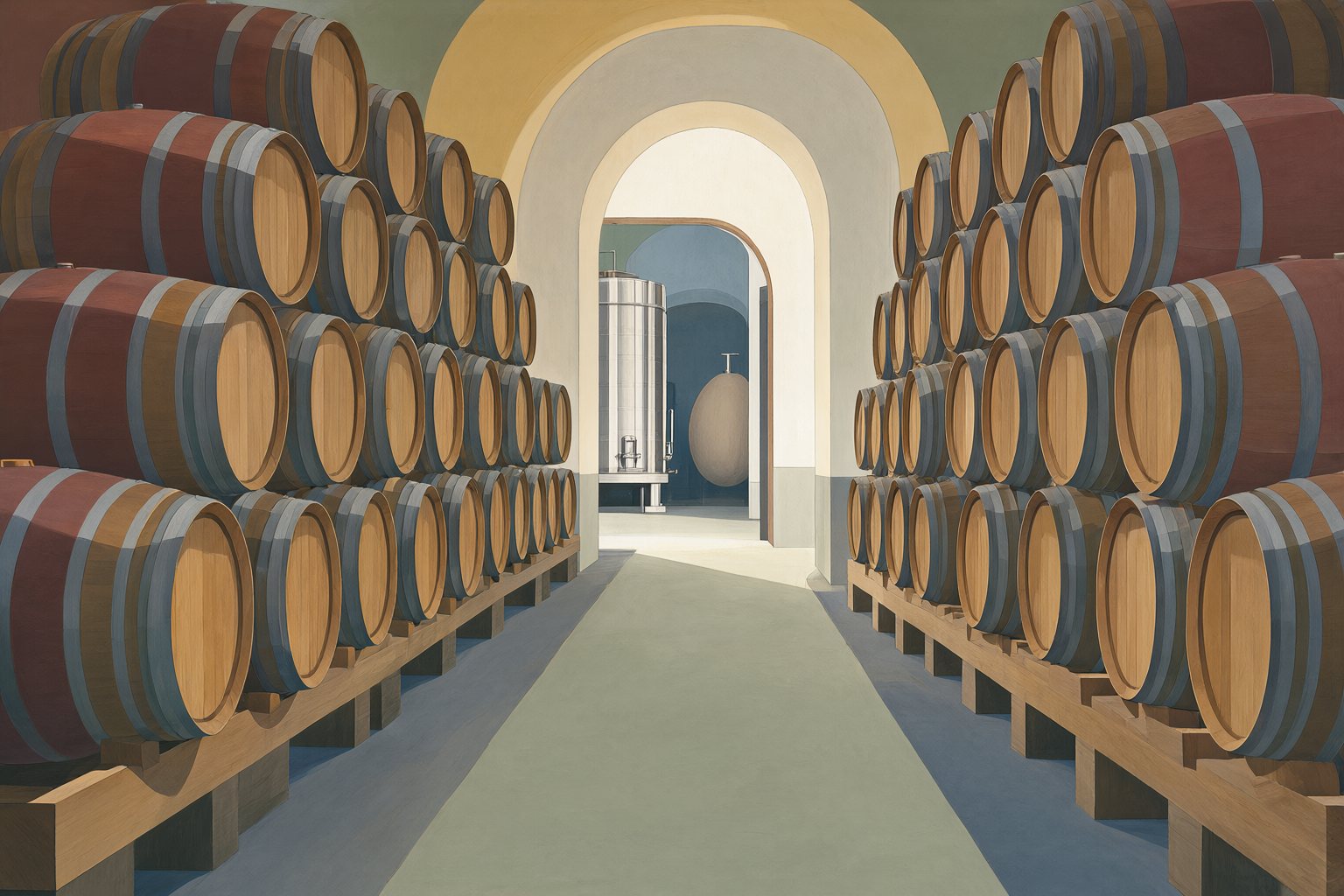
The Bordeaux barrique holds 225 litres; its Burgundian cousin, the pièce, holds 228. Three litres of difference that may look like pedantry to the uninitiated but in fact speak of two distinct coopering traditions. What really matters, though, is proportion: the smaller the vessel, the greater the surface of wood in contact with each litre of wine. In a barrique the wine “feels” the oak far more than it does in a fifty-hectolitre cask.
What, exactly, does it feel? A new barrique gives up wood tannins, aromatic compounds and a small, steady dose of oxygen that seeps through the staves and softens the wine. Much depends on the toast, that is, how long and how intensely the inside of the barrel is exposed to fire during its making. A light toast lets through more “raw” wood and more tannin; a heavy toast reduces the lactones, the ones behind the coconut notes, and develops aldehydes and compounds such as vanillin and eugenol, responsible for toasty, smoky, spicy aromas, sometimes clove. When a wine smells of coffee and burnt toast, it is often not the grape doing the talking.
The detail many forget is that a barrique ages quickly. After three to five vintages its aromatic contribution is all but spent, and the exchange of oxygen drops considerably too. That is why “barrique” does not always mean the same thing: a wine aged in new wood and one aged in third- or fourth-fill barriques may have very little in common.
French oak, Slavonian oak
Not all wood is alike. In France coopers work mainly with two oaks, Quercus petraea and Quercus robur; the former is generally preferred for its fine grain and more delicate aromatic contribution. The forests have names that coopers pronounce as though they were appellations: Allier, Tronçais, Nevers, Vosges, Limousin. French wood is split along the grain and seasoned outdoors for two or three years, so that rain and wind can wash out its harshest tannins. American oak, by comparison, contains two to four times more lactones and gives more obvious notes of vanilla and coconut.
Then there is Slavonia, a region now in Croatia, which for generations supplied the oak for Italy’s large casks. Here too the species is Quercus robur, prized for its tight grain and low aromatic impact. And that is precisely the point: the large Slavonian cask, holding tens of hectolitres and used for decades, has no wish to add aromas. It wants to let the wine breathe slowly, settle down, round off its tannins without dressing it up. It is a vessel that works by subtraction, which is why in the Langhe, in Tuscany and elsewhere it was long regarded as the natural guardian of Nebbiolo and Sangiovese.
The barrique wars
In the 1980s and 1990s, in Piedmont, that guardian was put on trial. A group of young producers, inspired by Burgundy and by an international press that rewarded darker, softer, more immediate wines, began using barriques, shorter macerations and new wood. Barolo, a wine notoriously austere and tannic in its youth, became approachable sooner, and the scores rolled in. On the other side, the traditionalists accused the modernists of turning Nebbiolo into just another well-dressed red.
The most famous symbol of that resistance is Bartolo Mascarello, who died in 2005 and who hand-drew a label bearing the words “No Barrique, No Berlusconi”. He explained that he was against barriques because he was a traditional producer, and against the then prime minister for political reasons. That label, which ended up at the centre of a police intervention at a wine shop that had displayed it, has become a collector’s item. The modernists’ story was also told in the 2014 documentary “Barolo Boys”.
As so often happens, the war ended without clear winners. Many modernists cut back on new wood or returned to larger casks; many traditionalists learned to manage hygiene, temperatures and timing better. Today in the Langhe the question is no longer “barrique, yes or no”, but how much wood, of what age, and for which vineyard.
Steel: the vessel that keeps quiet
At the opposite extreme stands stainless steel. It is practically inert: it imparts no aromas, lets no oxygen through, is easy to clean and allows precise temperature control. In the second half of the twentieth century it replaced many older vessels for exactly these reasons, keeping pace with the demand for fresh, fruity, taut white wines.
In the glass, steel announces itself by absence: no vanilla, no toast, clean fruit, acidity to the fore. It is the ideal vessel for anyone who wants the grape alone to speak, but it is also merciless. A thin wine raised in steel stays thin, with nothing to dress it.
The return of concrete
For much of the twentieth century concrete was the cellar material par excellence; then it was ousted by fibreglass and steel, which seemed more modern and easier to manage. In recent years it has come back, often in an unexpected shape: the egg. The first ovoid concrete vessel was made by the French firm Nomblot at the request of Michel Chapoutier, in the Rhône. The exact date varies from source to source, and Chapoutier’s explanation, rooted in his biodynamic convictions, spoke of a shape capable of encouraging natural convective currents in the liquid.
Leaving the romance aside, concrete has tangible qualities: its porosity allows a gentle micro-oxygenation, as wood does but without imparting aromas, and its thermal mass cushions swings in temperature. Those who use it describe it as a middle way: livelier than steel, more neutral than oak. That the egg shape genuinely produces continuous convection in the wine is a claim producers often repeat but which does not appear to be solidly proven; it is worth taking with caution. Alongside concrete, the terracotta amphora has also returned, but that is another story, and one we have already told when writing about orange wines.
Which home, then?
There is no absolutely right vessel, only the right one for a grape, a vineyard, an idea of wine. But if the barrique wars taught us anything, it is that the vessel should serve the wine, not sign it. New wood wielded as a badge of quality produced too many reds that tasted more of the cooper than of the hillside. The return of the large cask, of concrete and of a more discreet use of the barrique strikes us, quite simply, as a return to common sense: let the wine do the talking, and let the home in which it grows up confine itself to not disturbing it.
❦