Wine and cheese: the pairings that really work
Fresh, aged, blue, goat’s and washed-rind: how to pair wine with Italian cheeses, starting from the interplay of fat, salt, acidity and sweetness.
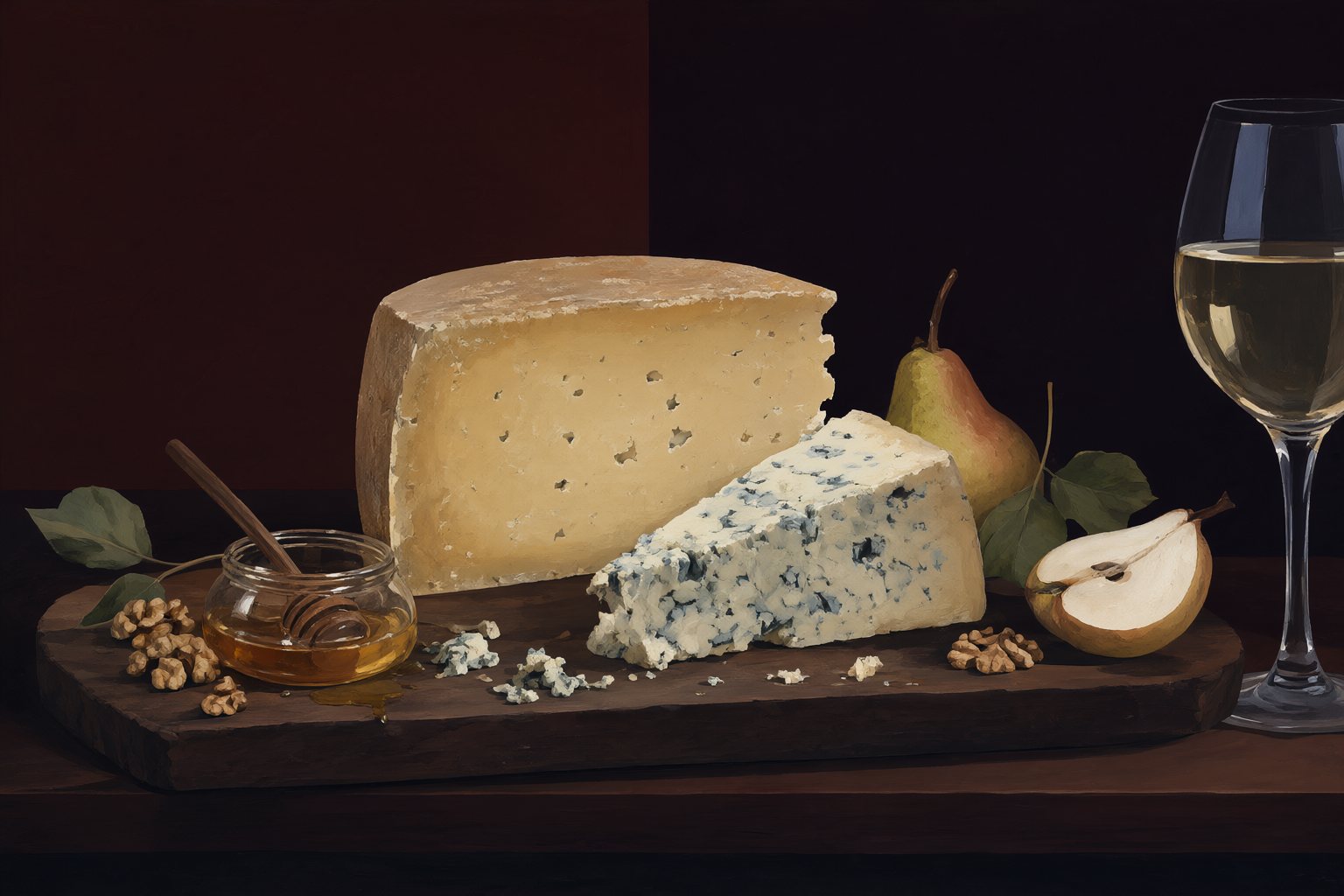
The cheese board arrives, someone uncorks the evening’s grandest red and pours it next to the Gorgonzola. A few minutes later the wine tastes bitter, metallic, tired. It is not the bottle’s fault, nor the cheese’s: the blame lies with a commonplace, the one that casts a structured red as the natural companion to every cheese. The marriage exists, of course, but it is far more temperamental than trattoria tradition would have it. And Italy, which has one of the richest cheese-making geographies in Europe, deserves something better than a single, mistaken rule.
Four forces at play
Before the recipes, the mechanics. A cheese speaks to wine in four voices: fat, salt, acidity and aromatic intensity. Fat coats the palate and dulls perception; that is why you need a wine capable of “washing” it away, that is, one with lively acidity or with bubbles that cut through the richness. Salt is the most underrated ally: it heightens fruit and softens the perception of tannins, but it clashes with high alcohol, which turns burning. The acidity of the cheese, typical of fresh and goat’s cheeses, calls for a wine at least as acidic, otherwise the wine seems flat and flabby.
Then there is sweetness, which has an almost mathematical rule of its own: a sweet wine next to a salty, piquant cheese does not cancel out, it multiplies. This is the principle of contrast, and it is the reason why a blue cheese with a passito is one of the most solid pairings there is.
The enemy, on the other hand, is excess tannin. The young, drying tannins of many reds built for ageing, on meeting the proteins and fats of certain cheeses (and the moulds of blue cheeses in particular), tend to stiffen and leave a bitter trail. This does not mean red is forbidden. It means it has to be chosen.
Fresh and soft cheeses: acidity and lightness
Mozzarella, burrata, stracciatella, ricotta, crescenza: milky, delicate, moist cheeses, with a sweetness of milk that breaks at the first excess. The watchword here is subtraction. Young whites, unoaked, with clean acidity and moderate alcohol: a current-vintage Verdicchio dei Castelli di Jesi, a Soave, a Greco di Tufo or a Falanghina alongside buffalo mozzarella, which has a more decided fat and a slightly sour note that these wines mirror well.
Bubbles work just as well, especially with burrata, where the creaminess calls for a brush: a zero-dosage or extra brut traditional-method sparkler, or a light, lightly sparkling rosé. With sheep’s milk ricotta, which is more savoury, you can risk a white with a few herbaceous notes, such as a Vermentino.
The typical mistake: the opulent, barrique-aged white. The oak and the butteriness of the wine smother the milk, and the cheese disappears.
Hard aged cheeses: Parmigiano Reggiano and its family
Parmigiano Reggiano, under its production rules, cannot be sold under the designation before twelve months of ageing, and the oldest wheels go well beyond two or three years. With time, everything changes: the paste becomes crumbly, tyrosine crystals appear, and the salt and the notes of broth, nuts and spice grow. A cheese like this is savoury, umami, low in acidity: the ideal partner for a wine that brings freshness and fruit without aggressive tannins.
The most convincing answer comes from its own land. A dry Lambrusco, red or rosé, with its fizz and its acidity, cleans the fat from the palate and turns the salt into a craving for another bite. It is a regional pairing that works for chemical reasons, not sentimental ones. With younger ages a traditional-method blanc de blancs also works; with the longest, beyond thirty months, you can move up towards medium-bodied reds with ripe tannin, such as a Sangiovese with a few years under its belt, or towards oxidative wines: a dry Marsala or a skin-macerated white holds up to the complexity without succumbing.
The same reasoning applies to Grana Padano, aged pecorinos and old Montasio: more salt and more age call for more structure, but never more tannin than the cheese can soften. Pecorino Romano, intensely salty, is one of the few cases in which a young, juicy red from central and southern Italy, a Cesanese or a Montepulciano d’Abruzzo that is not over-extracted, finds a companion that rounds off its edges.
Blue cheeses: the sweetness that saves everything
Gorgonzola DOP comes in two versions: dolce, aged for at least 50 days, creamy and almost runny; and piccante, firmer and more pronounced, with a minimum of 80 days for large wheels and 60 for small ones. Both have salt, fat and the pungent character of the moulds: three reasons to keep tannic reds well away.
This is where sweet wine takes the stage. A passito, a wine from overripe grapes or a fortified wine builds a contrast in which the sugar tames the piquancy and the salt makes the wine seem less cloying. With Gorgonzola piccante the great structured sweet wines work: a Recioto della Valpolicella, a Passito di Pantelleria, a sweet Marsala Superiore. With the dolce, more delicate, less weight is needed: a Moscato d’Asti, with its low alcohol and light froth, creates a sort of savoury dessert. Those who do not care for sweet wines can fall back on a soft, aromatic white, a late-picked Gewürztraminer from Alto Adige, but it is a compromise, not a victory.
Goat’s cheeses and washed rinds: two extremes to handle with care
Fresh goat’s cheeses are acidic, chalky, with a light animal aroma. The logic is the same as for fresh cheeses, but pushed further: you need a taut, aromatic white. A Sauvignon from Friuli or Alto Adige, with its green notes, is almost a conditioned reflex; a Ligurian Vermentino or a Pigato work equally well. When the goat’s cheese ages and becomes firmer and nuttier, it can take a white with more structure, a Fiano d’Avellino with a few years behind it.
Washed-rind cheeses are the most treacherous territory. Taleggio DOP, aged for at least 35 days under its production rules, has a rind treated only with water and salt that develops intense aromas, sometimes almost farmyard-like, while the paste stays sweet and buttery. The same goes, with different accents, for aged Quartirolo, Fontina or malga cheeses from alpine summer pastures. Strong smell, often gentler flavour: whoever pairs with the smell errs on the side of excess.
The best solution is often a white with body and a touch of softness, or a light, fresh red with little tannin. Alongside Taleggio, a Valtellina Rosso or an Oltrepò Pavese based on Pinot Nero has just the right finesse; with Fontina, the Valle d’Aosta choice is almost obvious, a nimble alpine red or a white such as Petite Arvine. Here too bubbles are a safety net: a traditional-method wine with a few years on its lees stands up to the aromas of the rind without colliding with them.
The rule that counts
If there is one lesson to take home, it is that the grand red, served on instinct at the end of the meal with the mixed cheese board, is almost always the worst choice. Cheeses call for acidity, bubbles and, when they are blue, sugar. Everything else comes after. Our advice, a little provocative: next time you put together a cheese board, set three bottles on the table, a dry sparkler, a fresh white and a passito, and leave the great red in the cellar. You will find that the cheese, and the wine, come out of it better.
❦