Buying wine at the supermarket: how to choose without guessing
Appellation, vintage, bottler, codes, alcohol and medals: how to read the label and the shelf so you can choose well when buying wine at the supermarket.
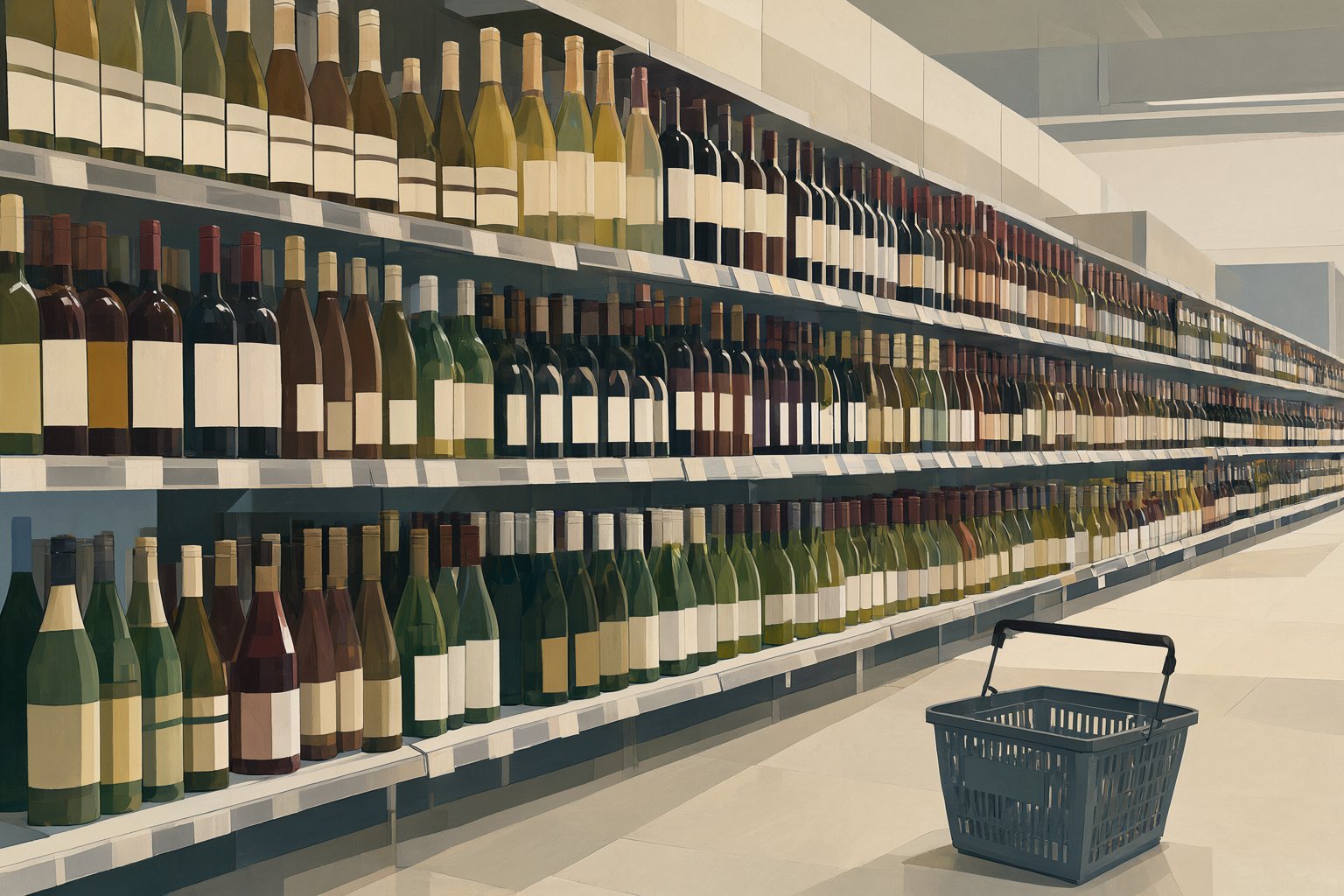
The wine aisle at the supermarket is the only place where people capable of comparing three mortgages in an afternoon give up and choose by the colour of the label. Two hundred bottles in a row, nobody to ask, a trolley blocking the way. And yet the shelf speaks, and it has quite a lot to say: you just need to know where to look. You don’t need a competition palate, you need a habit. The habit of turning the bottle round.
Start from the appellation, not the artwork
The first useful piece of information is the category: DOCG, DOC, IGT (the Italian acronyms that correspond to the European PDO and PGI) or plain “wine”. It is not a ranking of quality, and anyone who claims otherwise has never tasted an ambitious IGT or a lacklustre DOC. It is, however, a ranking of constraints: a designation of origin comes with a disciplinare, the production rulebook that sets out the area, grape varieties, yields and winemaking rules. Buying inside a known enclosure means narrowing the margin for surprise, for better and for worse.
Here lies the first trick, and it is no secret: famous appellations charge for their name as well. Next to the usual suspects, on the same shelf, there are often minor DOCs, provincial areas, grapes that never make the headlines. That is where value for money tends to sit more comfortably, because the price does not include a reputation built over decades of wine lists. A red from a DOC you have never heard of is not a riskier bet than a famous name at the lowest possible price for that name; often it is the opposite. The famous name sold cheaply has had to cut corners somewhere.
The vintage: who should be young, and who need not
The year on the label indicates the harvest, and by law (in the European Union) at least 85% of the grapes must come from that year. For most supermarket whites and rosés the practical rule is simple: younger is better. These are wines made for freshness and fruit, and they have nothing to gain from spending two summers under fluorescent lights. If you find a rosé three vintages old next to the latest one, it is not a bargain: it is a leftover.
With reds the picture is less clear-cut. Some hold up and improve for a few years; many everyday reds do not. But a slightly older vintage on a structured red is not in itself a warning sign, as it is on a light white. Non-vintage sparkling wines (the majority) will tell you nothing: there, who made them and how they have been stored matter more.
Who bottled it, and what a code conceals
This is where the most interesting game is played. Every bottle must name the bottler, and the wording is not interchangeable. “Imbottigliato da” (“bottled by”) tells you only who put the wine in the bottle, not who made it: the wine may have been bought elsewhere. “Prodotto e imbottigliato da” (“produced and bottled by”) describes a shorter supply chain. “Imbottigliato all’origine” (“estate bottled”) and “integralmente prodotto” (“wholly produced”) are the formulas that tie the wine most closely to the farm, because they require grapes or wine mainly (or, in the second case, entirely) of the estate’s own production.
Then there is the case in which an abbreviation appears instead of the name. Many people still call it the “EMB code”, after French usage; in Italy it is the ICQRF code, assigned by the ministry’s fraud-prevention inspectorate: the province abbreviation, a number, and the country abbreviation. It identifies the operator’s registered office and allows its name and address to be left off, provided that another party in the supply chain, usually the distributor, appears on the label in full. There is also the ISTAT code of the municipality, which instead indicates where the bottling plant is located and is used, among other things, when the name of that municipality coincides with an appellation.
There is nothing illegal or shady about it: the authorities know perfectly well who is behind that code. But the code is information meant for inspectors, not for you. When a wine carries the full name and address of whoever produced it, someone has chosen to put their face to it. When you find only a code and the name of a chain, you know you are buying a label built for the shelf. It may be good; it is not necessarily the place to start.
Alcohol, medals and other baubles
The alcohol content stated on the label allows a tolerance of half a degree either way for still wines. It is not an index of quality, but it is a clue to style. A white at 11.5% promises lightness; a red from the South at 15% promises warmth, and if you were looking for something to drink in quantity with a pizza in August it will be a casting error, not a fault in the wine. Reading it helps above all to avoid asking the bottle for something it cannot give.
Medals deserve more scepticism. In Italy, the distinctions that may be displayed on the packaging of appellation wines can only be awarded by competitions authorised by the ministry, but the competition world is vast and of very variable seriousness, and some award a generous share of the wines entered. A gold sticker with no recognisable name, no year and no category mostly tells you that someone paid an entry fee. If you want to trust an award, let it be one where you can say who gives it and how. Otherwise, treat it as a bow on the packaging.
The shelf as a (terrible) cellar
Finally, look at where the bottle lives. Light is the most underrated enemy: in whites and sparkling wines, especially in clear glass, certain components of the wine react to visible and ultraviolet light, including that of shop lamps, and produce sulphur compounds smelling of boiled cabbage or onion. Oenologists call it “light-struck” taste, and studies indicate that it can appear quickly, after anything from a few hours to a few days of exposure. In other words: the white in clear glass at the front, under the spotlight, is the worst choice in the row. Better to reach to the back, or into a box that has not yet been opened, or to favour dark glass.
Bottles standing upright for weeks are less of a problem for wines with screw caps or synthetic closures, and for those meant to be drunk soon. For a cork-sealed wine that ought to last a few years, months upright near a heat source are not a good start: the cork dries out, and air finds its way in. A warm shelf, next to a chiller cabinet blowing out exhaust air or under a display window in the sun, ages wine faster than you would like.
The supermarket is not the place for romantic discovery, and there is no point pretending it is. But it is where most Italian wine is actually bought, and treating it with disdain is a snobbery that helps no one. My rule, at the risk of sounding pedantic: a little-known appellation, a recent vintage if white or rosé, a real name on the back label, no faith in stickers, and the bottle taken from the back. It does not guarantee love at first sight. It does guarantee that, if the evening goes badly, it will not have been down to luck.
❦