World wine production 2026: fewer vines, fewer drinkers, the same leaders
Production, consumption and vineyard area according to the OIV: why the world is making and drinking less wine, and where Italy, France and Spain stand.
Every November, from Dijon, comes the number the wine world waits for and slightly dreads. The OIV, the International Organisation of Vine and Wine, an intergovernmental body that gathers data from producing countries, publishes its first estimates of the harvest just completed. It is not a horoscope: it is the balance sheet of a sector that has spent the past few years coming to terms with an uncomfortable truth. The world is producing less, planting less and, above all, drinking less. The interesting question is no longer who tops the table, but how long the slide will last.
Waiting for Dijon
An honest preamble: this piece went to press before the OIV released its 2026 estimates, which usually arrive in mid-November. The figures below are therefore the ones already in the public domain, and we will update them once the global picture is official. A few national signals, however, are already in.
France has numbers. According to Agreste, the statistics service of the French agriculture ministry, the 2026 harvest was estimated at around 35 million hectolitres as of 1 October: roughly 2% down on 2025, itself a short year, and 14% below the 2021–2025 average. The culprits were heat, summer drought and vineyard grubbing-up schemes, only partly offset by better-than-expected yields in Languedoc-Roussillon.
Italy, by contrast, gave no figure in September. Every September Assoenologi, Ismea and Unione Italiana Vini (respectively the winemakers’ association, the public agency for agricultural markets and the main wine-business federation) normally present a joint national forecast. In 2026, as we reported in our region-by-region harvest round-up, they declined to do so: the weather had been too erratic to risk a number. A first indication came in October: according to European Commission data reported by Il Sole 24 Ore, Italian output would stop at 41.1 million hectolitres, 7.2% down on the previous year. For Spain, Cooperativas Agro-alimentarias, the cooperatives’ federation that says it represents about 70% of national production, spoke in early October of around 34 million hectolitres of wine and must: a preliminary estimate, and not directly comparable with OIV figures, which count wine only.
2025, by the numbers
The starting point is last year, and it pays to look at it twice. In its first estimates of November 2025 the OIV put world production at 232 million hectolitres. In the report on the state of the sector presented on 12 May 2026 the figure fell to 227 million, just 0.6% above 2024, which had been a historic low. Five million hectolitres between the first snapshot and the second: a useful reminder for anyone tempted to read this month’s estimates with too much faith.
The ranking, on the other hand, does not budge. Italy remains the largest producer with 44.4 million hectolitres, against the 47.3 announced in November. France follows with 36.1 and Spain with 28.7. Then, some way behind, come the United States with 20 million, Australia with 11.3, Argentina with 10.8, South Africa with 10.2 and Chile with 8.4. Between them, three European countries make almost half the planet’s wine. That concentration explains why every bad summer between the Mediterranean and the Atlantic is felt on price lists across half the world.
Drinking less, almost everywhere
The figure that really matters is another one. In 2025 world consumption was estimated at 208 million hectolitres, 2.7% less than the year before. In the OIV’s series, the five preceding years read 232, 234, 228, 220 and 214: a staircase going down without a landing. Compared with 2018, again according to the OIV, the decline is 14%.
None of the major markets has been spared. The United States, the largest consuming country, fell to 31.9 million hectolitres (down 4.3%). France dropped to 22, Germany to 17.8, the United Kingdom to 12.3. Italy, where wine at the table was a daily habit for generations, stopped at 20.2 million, a fall of 9.4% that, if confirmed, is among the steepest in Europe. China, for a decade the great hope of the trade, slipped to 4.8 million, down 13%. Some markets are growing, and the OIV cites Portugal, Brazil and Japan, but not enough to turn the tide.
Trade has shrunk too: 94.8 million hectolitres exported worldwide, down 4.7%, worth 33.8 billion euros, down 6.7%. On top of weak demand, trade tensions over tariffs, starting with those imposed by the United States, are weighing on the market.
The result is an imbalance familiar to anyone who works in a cellar: in 2025 production exceeded consumption by about 18.7 million hectolitres. The OIV points out that some thirty million hectolitres a year go to industrial uses, from distillation to vinegar, so this is not a lake of unsold wine. But in Italy, where cellar stocks stood at about 42.6 million hectolitres at the end of July 2026 according to official registers, the consorzi, the producers’ bodies that run each denomination, have already responded by cutting permitted yields.
The vineyard retreats
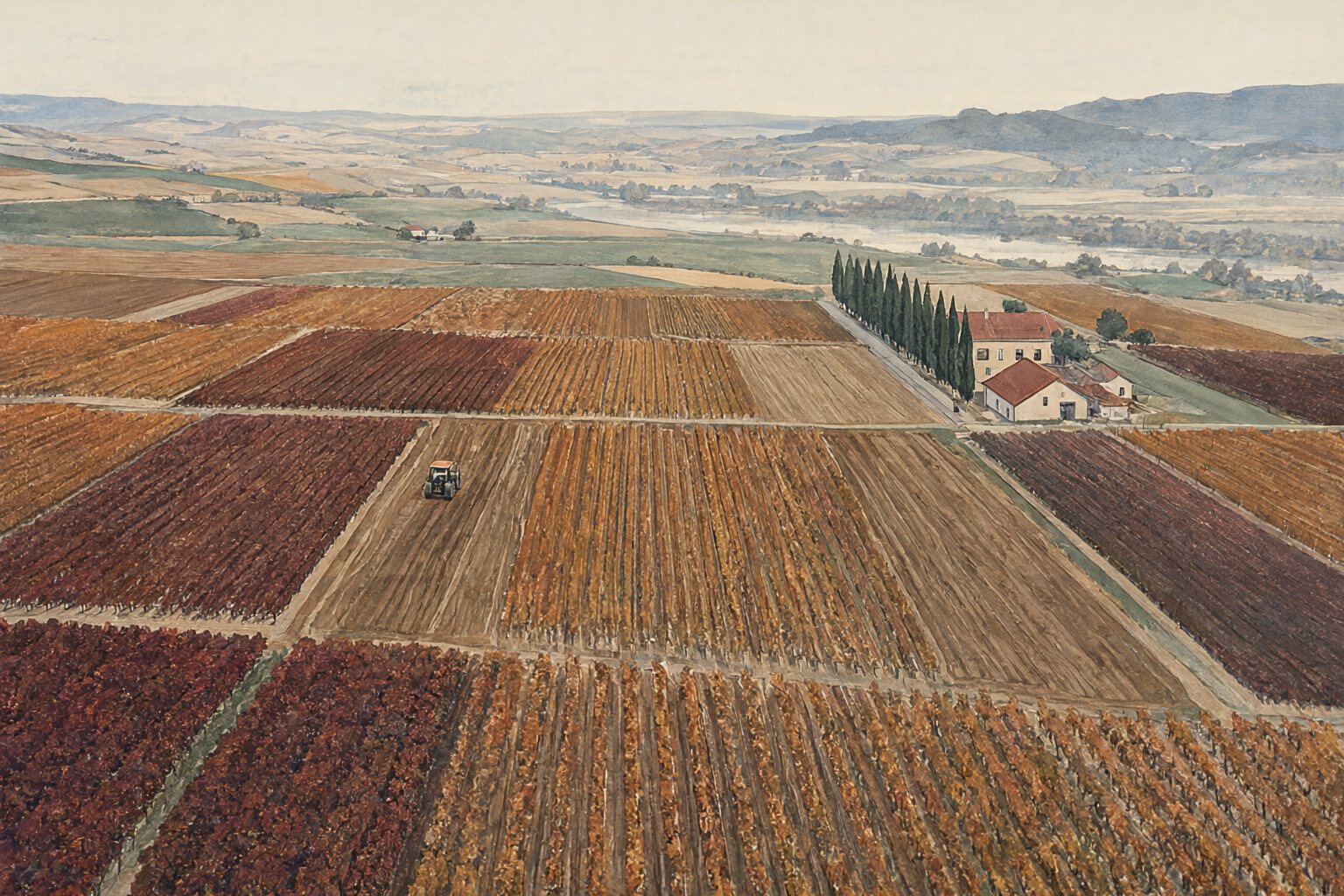
Fewer drinkers means, sooner or later, fewer vines. In 2025 the world’s vineyard area was estimated at 7 million hectares, 0.8% less than in 2024, and the OIV stresses that this is the sixth consecutive year of decline. The figure covers vines for all purposes, not just wine, and the ranking shows it: Spain remains the largest vineyard in the world with 919,000 hectares, followed by France with 740,000, China with 733,000 and Italy with 726,000. Yet China, with all those hectares, made a mere 2.2 million hectolitres of wine: much of its fruit ends up on the table or as raisins.
The Spanish case is the most instructive. It has more vineyard than anyone and produces less than Italy or France, because much of its vineyard, especially inland, works in dry conditions with low yields. In wine, acreage is not a measure of power.
A contraction that may do some good
The prevailing story in recent years has been one of crisis. And it is true that for many growing families the numbers mean full cellars, reduced yields and, in France, vines pulled up under public schemes. That should not be taken lightly.
But our view is that the world has not fallen out of love with wine: it is falling out of the habit of drinking it. What disappears first is the anonymous litre, the wine bought because it was there. A sector that chased volume for decades is now being forced to ask what is worth planting, and where. If November’s estimates confirm another short harvest, it will be bad news for a great many balance sheets. For those who drink, it may be the beginning of a world with less wine and more reasons to choose it.
❦