What wine to serve at Christmas, course by course and region by region
From tortellini in brodo to abbacchio, from cardone to family desserts: the right wines for Christmas Day lunch according to Italy’s regional traditions.
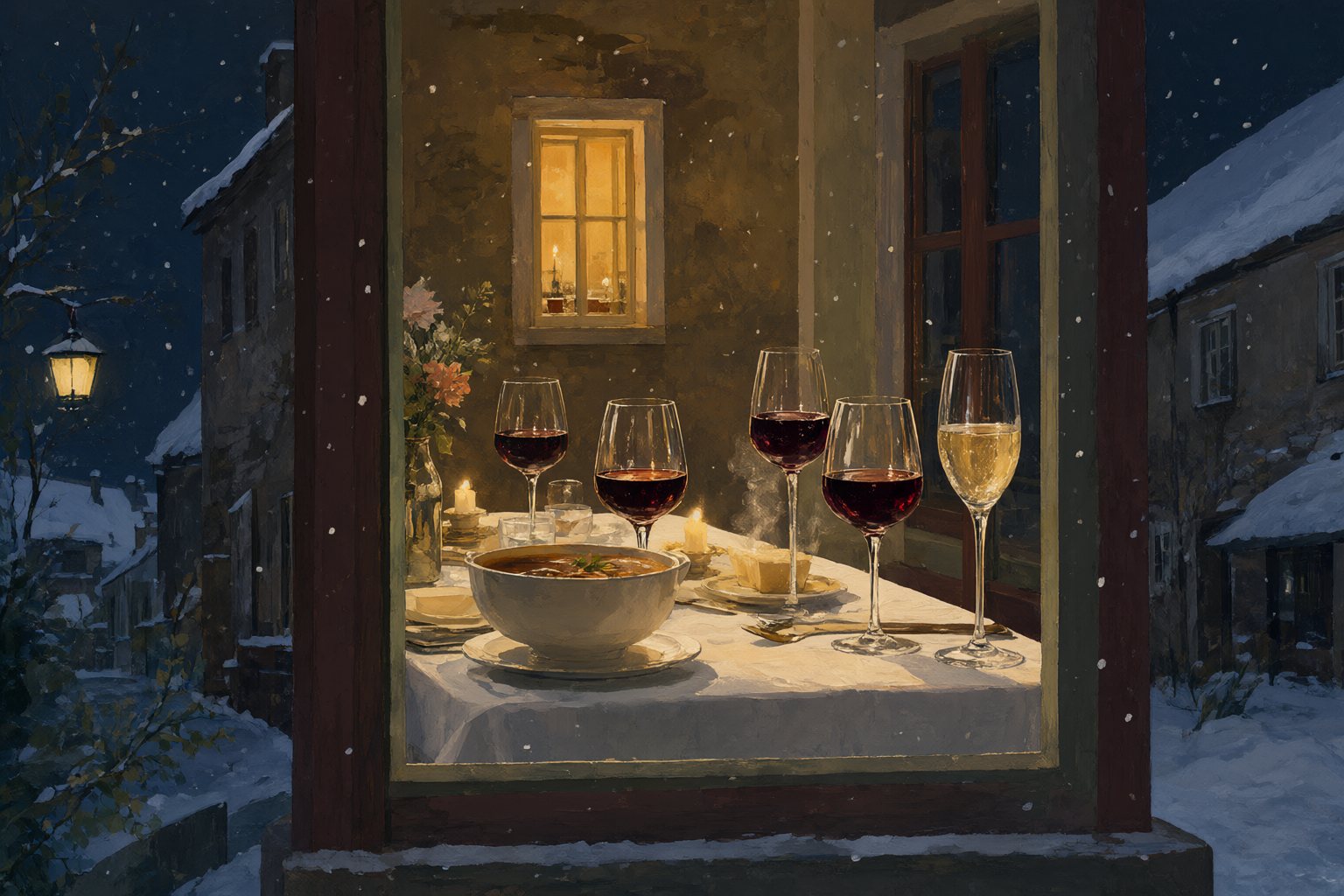
Christmas lunch is the one meal of the year when Italian cooking stops pretending to be a single cuisine. Sit down at table on 25 December in Bologna, in Lanciano and in Palermo and you realise that the unification of Italy, at table, never happened: the broth changes, the pasta, the roast, even the hour at which you get up. And yet almost everywhere the same mistake is made with the wine: one important bottle, bought for the occasion, opened at the start and dragged all the way to the coffee. Christmas deserves better, and above all it deserves more wines.
The antipasto, or the moment for bubbles
Christmas antipasti are a sampler of salt, fat and smoke: salumi, crostini, vegetables preserved in oil, young cheeses. In Tuscany come the crostini di fegatini, chicken-liver crostini, elsewhere canapés, Russian salad, home-made pickles. What is needed here is something that cleans the palate and whets the appetite, and the most sensible answer is an Italian traditional-method sparkling wine. Franciacorta, Trento DOC, Alta Langa, Oltrepò Pavese Metodo Classico: appellations differing in style and altitude, united by an acid backbone that cuts through the fat of the salame and stands up to the savouriness of Parmigiano.
Those who want to stay lighter can look to a Prosecco Superiore di Valdobbiadene in its less sweet version, Brut or Extra Brut, which does its job unpretentiously with fried food and battered vegetables. A practical tip: the antipasto bottle should not be the best of the day. It should be cold, plentiful and finished before the first course.
The first courses, between broth and oven
Here the map splits in two. In the north and part of the centre, broth reigns: tortellini in Bologna and Modena, cappelletti in Romagna, the Marche and Umbria, casoncelli or tortellini in Lombardy, agnolotti del plin in Piedmont, often served without broth too. In Abruzzo the king is cardone, a meat-broth soup with cardoons, tiny meatballs and eggs and pecorino stirred in: a ritual dish that alone is worth the trip to Chieti.
Broth is a sly enemy of wine. It is hot, liquid, savoury yet delicate, and a tannic red turns it into dishwater. The Emilian choice is also the most intelligent: a Lambrusco, ideally Sorbara, the palest and most acidic of the family, dry and lively. The bubbles and acidity rinse the palate of the fat from the capon broth, and the light red fruit doesn’t cover the filling. For cardone the logic is similar but with an Abruzzese accent: a Cerasuolo d’Abruzzo, a dark, juicy rosé from Montepulciano grapes, or a Trebbiano d’Abruzzo with a few years under its belt, able to keep pace with the pecorino. With Piedmontese agnolotti in roast-meat juices you can already move up to a Dolcetto or a Barbera d’Alba.
In the south, and in some parts of the centre, the first course is baked. The Marche respond with vincisgrassi, the lasagne rich in offal ragù which, in its Macerata version, has been a European Traditional Speciality Guaranteed since 2022; in Sicily anelletti al forno, baked pasta rings, appear, and in many southern homes lasagne or timballo. These are dense dishes, rich in meat, cheese and tomato, that call for reds with acidity and moderate tannin. With vincisgrassi, Rosso Conero or Lacrima di Morro d’Alba stay within the region and work; with anelletti, a Cerasuolo di Vittoria or an Etna Rosso, more agile than its volcanic reputation might suggest. Anywhere, a Chianti Classico Sangiovese or a Rosso di Montalcino is the choice that rarely goes wrong.
Naples is a story unto itself with minestra maritata, “married soup”, in which bitter greens and pork are “wed” in the broth. Here you need a light, fresh Campanian red, such as the fizzy reds of the Gragnano and Lettere subzones of the Sorrento Peninsula, or a Piedirosso from the Campi Flegrei.
The roast, at last the important red
This is when the bottle bought for the occasion finds its purpose. The Christmas main course is almost always meat, and almost always regional: bollito misto, mixed boiled meats, in Piedmont, abbacchio, milk-fed lamb, in Lazio, lamb in Sardinia, Puglia and Sicily, kid in Calabria. Stuffed capon, the star in Lombardy and Campania, has an article all of its own, as does turkey, so we leave it in peace here.
Piedmontese bollito, with its green sauces and mostarda, wants a medium-bodied red: a Barbera d’Asti or a young Langhe Nebbiolo, rather than a Barolo that would risk overwhelming the delicacy of the boiled meat. Barolo, Barbaresco, Brunello di Montalcino and Taurasi give their best with roast beef or pork, where fat and caramelised crust stand up to the tannin. Amarone della Valpolicella, with its high alcohol and dried fruit, is the most “Christmassy” roast wine by temperament, but it must be served at cellar temperature and in generous glasses, or it turns heavy by the second sip.
Then there is lamb. In Lazio, roast abbacchio finds a natural companion in Cesanese del Piglio; in Sardinia, lamb with potatoes calls for Cannonau, warm and spicy; in Calabria, kid goes well with red Cirò, from Gaglioppo grapes, tannic and a little austere. In Puglia, a Negroamaro from the Salento or a Castel del Monte Nero di Troia. It is the oldest rule and still the most reliable: what grows close together understands each other at table.
Desserts, where nobody dares
Panettone and pandoro deserve a discussion of their own, and indeed they have had one. But the Italian Christmas is much broader: honeyed struffoli in Campania, cartellate with vincotto in Puglia, panforte and ricciarelli in Siena, torroni, mostaccioli, Roman pangiallo, Sicilian buccellati packed with dried figs. Spiced, honeyed, fruity desserts, almost all of them fiendishly difficult to pair.
There is only one useful rule: the wine must be at least as sweet as the dessert, or it turns bitter and metallic. With light, fried pastries, Moscato d’Asti: low alcohol, fine bubbles, perfect for those who can’t manage anything more at the end of the meal. With cartellate and struffoli, a Moscato di Trani or a Primitivo di Manduria Dolce Naturale. With panforte and buccellati, wines from dried grapes: Passito di Pantelleria, Vin Santo del Chianti, Recioto di Soave, the sweet version of Garganega that became a DOCG in 1998. These are wines that cost toil to those who make them and patience to those who drink them, and the afternoon of 25 December is one of the few moments of the year when there is time for both.
One bottle per course, not one per family
The fact remains that Christmas is a long lunch, and long lunches punish anyone who drinks a single thing for four hours. Better to open more bottles and pour less, start light and climb with the courses, keep the big red for the roast and finish with a proper sweet wine. But our real opinion is another, and it is simpler: the best Christmas wine is the one that comes from the same land as the dish your grandmother cooked. Lambrusco with tortellini, Cerasuolo with cardone, Cannonau with lamb. These are not textbook pairings, they are family pairings, and that is why they work. The rest of the year you can experiment. On 25 December, let the campanile, the home-town bell tower, do the talking.
❦