Metodo Classico or Charmat: what really changes in the glass
Second fermentation in bottle or in tank, months on the lees, bubbles and aromas: Franciacorta, Trento DOC and Prosecco, without the snobbery.
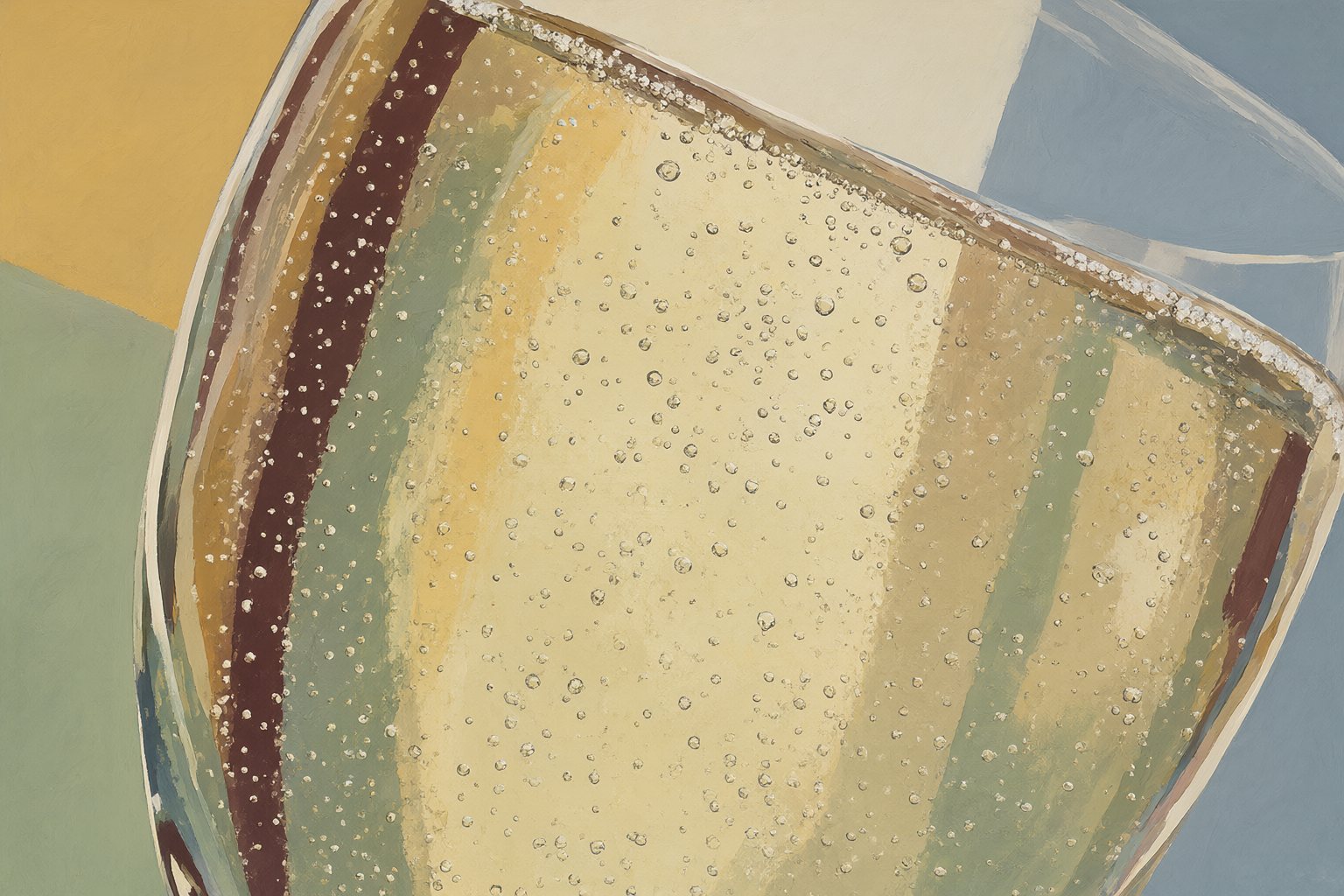
Every sparkling wine is born of a small, controlled accident: a finished wine is given back some sugar and yeast, then sealed in a container from which the carbon dioxide cannot escape. The gas stays trapped, dissolves into the liquid and waits for the cork to come out. So far, Franciacorta and Prosecco tell the same story. The whole difference lies in the container, and in how much time the wine is allowed to spend inside it.
It sounds like a cellar technicality. It is in fact the reason why two glasses of sparkling wine, poured side by side, can seem like two almost unrelated drinks.
Two vessels, two philosophies
In the Metodo Classico, Italy’s name for the traditional method, the second fermentation happens in the very bottle that will reach the table. Each bottle is, quite literally, a tiny winery: it receives the base wine with the tirage syrup and the yeasts, is sealed with a crown cap and left to rest on its side. When fermentation is over, the dead yeast cells settle and stay there, in contact with the wine, for months or years. Then comes remuage, which coaxes the sediment towards the neck, and disgorgement, which expels it. The bottle is topped up with the liqueur d’expédition, which sets the final dosage, from Pas Dosé upwards.
The method we call Martinotti in Italy, and Charmat elsewhere, does everything on a large scale: the prise de mousse takes place in an autoclave, a pressure-tight steel tank holding thousands of litres. The wine referments, is filtered and bottled isobarically, that is, without losing the pressure it has built up. The first to describe the process was Federico Martinotti, a Piedmontese oenologist, in 1895; the Frenchman Eugène Charmat refined and patented it a few years later, at the start of the twentieth century (sources waver on the exact date). That the world knows it by the second man’s name is a small historical injustice that Italians have never tired of pointing out.
Time on the lees, or the real difference
The heart of the matter is not bottle versus tank. It is what happens to the yeasts once they have finished their work.
When they stay in the wine for a long time, their cells slowly break down in a process called autolysis. They release mannoproteins, amino acids and compounds that round out the palate and change the aromatic profile. This is where the notes of bread crust, brioche, toasted hazelnut and sometimes a hint of butter come from, the ones we associate with long-aged sparkling wines. There is no shortcut: autolysis demands time, and time costs money.
Italian rulebooks set it down precisely. Franciacorta, the first Italian DOCG devoted exclusively to the Metodo Classico, requires at least 18 months on the lees for the basic version, 24 for Satèn and Rosé, 30 for Millesimato (vintage) and 60 for Riserva. Trento DOC, created in 1993 as the first Italian designation reserved for this method, asks for a minimum of 15 months for non-vintage, 24 for vintage and 36 for Riserva. Many houses go well beyond the minimums, and that is exactly where differences in style are decided.
Prosecco takes the opposite road. Its stay in the autoclave is short: the minimum is in the order of a month, and even the most meticulous producers of Conegliano Valdobbiadene tend to stop at a few months. In a tank, contact with the yeasts is in any case less intimate than in a bottle, because the volume is enormous and the ratio of yeast to wine is different. The result is a wine in which autolysis stays in the background, if it is there at all.
Bubbles and aromas: what you actually taste
Anyone drinking a well-aged Metodo Classico often notices a finer bead and a mousse that melts into the wine rather than assaulting the palate. The reason is not romantic: the long time on the lees and the slow integration of carbon dioxide make the mouthfeel creamier. Satèn, which in Franciacorta is made only from white grapes and at a lower pressure than usual, takes the idea to its extreme, almost silky.
Aromatically, the Metodo Classico tends to move away from fruit towards transformation: candied citrus, pastry, dried fruit and nuts, and with age, more evolved notes. Chardonnay and Pinot Nero, the pillars of Franciacorta and Trento, are grapes of measured character that take this treatment well, and indeed call for it.
Martinotti does the exact opposite: it protects the fruit. Glera, the main grape of Prosecco, has a delicate aromatic profile of green apple, pear, white flowers and wisteria. Long ageing on the lees would smother it. The autoclave, quick and closed, keeps it intact. The bubbles are generally livelier and the wine more immediate, and that is not a flaw: it is the whole point.
Italian examples, without league tables
It is easy to slip into a hierarchy: the Metodo Classico as the “serious” wine, the Charmat as an aperitivo wine. But the right technique depends on the grape and the idea of the wine, not on prestige.
Franciacorta works on morainic hills near Lago d’Iseo, with Chardonnay predominant, Pinot Nero, Pinot Bianco and, more recently, the native Erbamat, revived partly to bring acidity in a warming climate. The results are wines of structure, often designed to accompany a meal from start to finish.
Trento DOC, by contrast, is a mountain wine, from vineyards climbing the valleys of Trentino. Altitude brings wide swings between day and night temperatures and nervy acidity, and its sparklers often have a more vertical, almost alpine tension.
Prosecco, above all in the hills of Conegliano and Valdobbiadene, a DOCG since the 2009 vintage, has built its identity on the autoclave. Yet there is also a Prosecco refermented in bottle and left undisgorged, the so-called col fondo, cloudy and rustic, a reminder that bottle refermentation belonged to local peasant tradition long before steel tanks. The best proof that method is not a caste.
A question of intent
The right question to ask of a sparkling wine is not “which method is better” but “what did the person who made it want to achieve”. A Franciacorta Riserva and a Valdobbiadene Superiore are not running in the same race: one seeks depth and time, the other freshness and transparency of fruit. Judging the second by the criteria of the first means not having understood it.
If anything deserves a reproach, it is the habit of choosing bubbles for the prestige of the label rather than for the occasion. A long-aged Metodo Classico served ice-cold as a mass aperitivo is as wasted as an elegant Prosecco dismissed as spritz wine. The method tells you how the wine was made. How to drink it remains our responsibility.
❦