Orange wines: the white that behaves like a red (and divides the table)
What orange wines are, why they are not the same as natural wine, from Georgian amphorae to Oslavia, and how to pair them with food without fear.
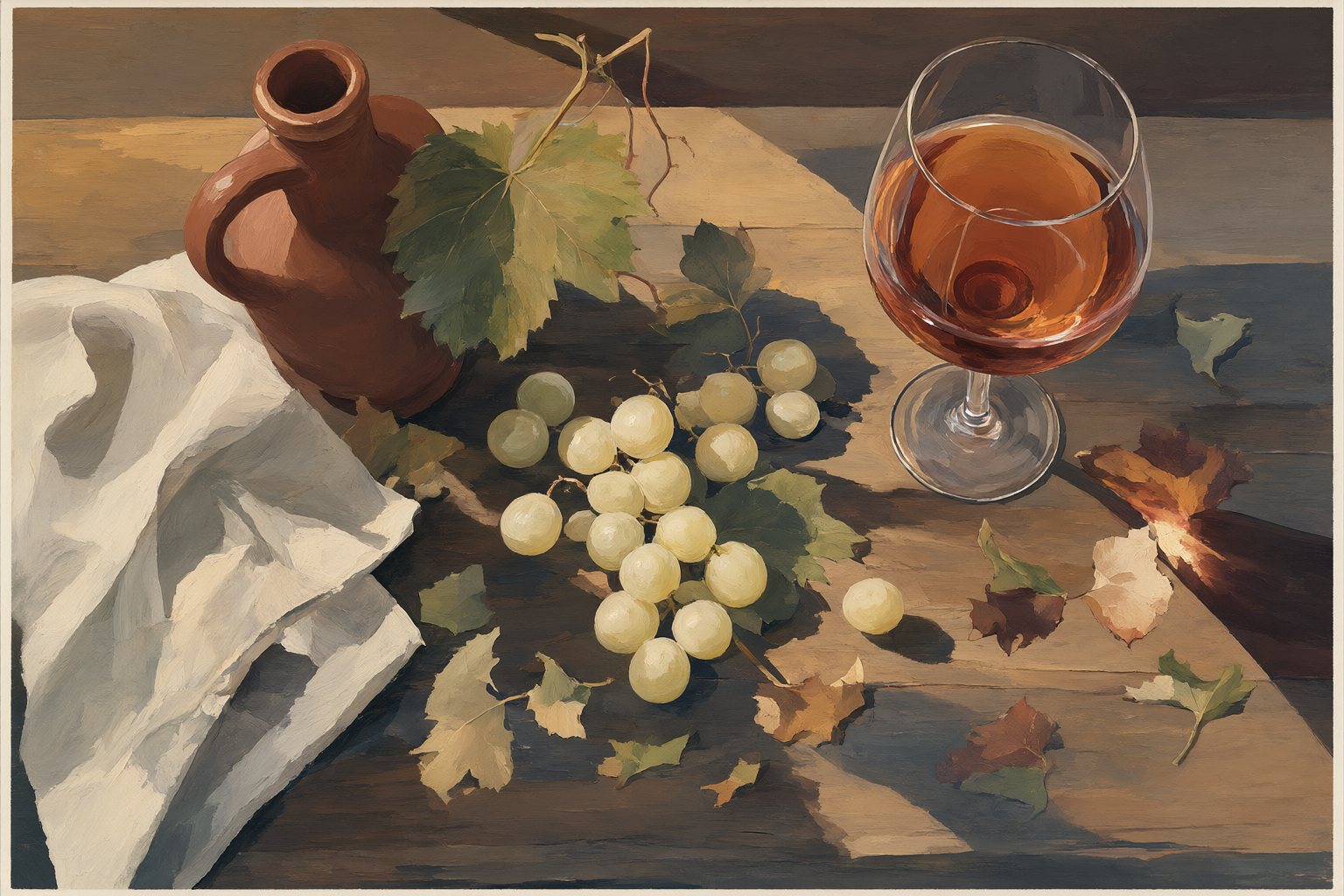
Pour an orange wine at a table of enthusiasts and the same thing always happens: half the glasses rise with curiosity, the other half stay put, suspicious. The amber colour, the occasional haziness, that tannic grip nobody expects from a white. Few wines have the same knack for splitting a room in two. And that is precisely why they are worth understanding before they are judged.
A white made like a red
The definition is simpler than its reputation. An orange wine, or skin-macerated white, is a wine made from white grapes by leaving the must in contact with the skins during fermentation, exactly as is done for reds. In classic white winemaking the skins are separated immediately after pressing: the aim is a clear, fresh, aromatic wine. Here, instead, the skins stay, sometimes for days, more often for weeks or months.
From that contact the wine inherits three things. Colour, ranging from deep gold to amber and even copper. Tannins, which are almost absent in a white and here lend a dry, almost chewable texture. And a different constellation of aromas: less fresh fruit, more dried fruit, citrus peel, herbs, tea, sweet spices. There is no canonical duration. The International Organisation of Vine and Wine, in defining the category of skin-macerated whites, set a minimum threshold of one month of skin contact; but in everyday language the word “orange” also covers much shorter macerations, and therein lies one of the first sources of confusion.
The name itself is recent. It is traced back to a British importer, David A. Harvey, who is said to have proposed it in 2004 to give an intelligible label to wines that sat comfortably neither among the whites nor among the reds.
The roots: Georgia and its amphorae
Look for a place of origin and almost everyone points to Georgia, where winemaking in buried terracotta amphorae, the qvevri, has been documented for millennia. The method, in its most traditional form, involves pouring the must into the vessel together with skins, pips and sometimes stems, sealing it and leaving it underground for months. In 2013 UNESCO inscribed the “ancient Georgian traditional qvevri wine-making method” on the Representative List of the Intangible Cultural Heritage of Humanity, recognising not only a winemaking technique but a body of knowledge handed down through families and communities, from the building of the vessel to the shared harvest.
Even in Georgia, for that matter, there is no single way. In the Kakhetian tradition the time on the skins can stretch to months; in the Imeretian one it is shorter, in the order of a few weeks. Skin-macerated wine, in short, is a family with many dialects.
Oslavia, the Collio and the Carso: the European return
The reason an Italian reader should take more interest in orange wines than anyone else lies on the border between Friuli and Slovenia. Between the Collio around Gorizia, Slovenia’s Brda and the Carso above Trieste, macerating white grapes was a deep-rooted peasant practice, later set aside in the years when international taste demanded clean, technical whites fermented at controlled temperatures.
It was brought back to centre stage above all by two growers from Oslavia, a hamlet of Gorizia that many now consider the capital of Ribolla Gialla. Stanko Radikon went back to macerating his Ribolla in 1995, reviving his grandfather’s methods: at first a week on the skins, then progressively longer periods. Joško Gravner, after years as a leading figure in the modernisation of Friulian wine, changed course radically: his first macerated Ribollas arrived at the end of the 1990s; in 2000 he visited Georgia, and from 2001 he began vinifying in buried Georgian amphorae, eventually converting his entire production to this method in the first half of the 2000s. Later he would grub up the international varieties to keep only native grapes such as Ribolla and Pignolo.
The Carso followed a parallel path, with grapes such as Vitovska and Malvasia which, on limestone and under the bora wind, yield macerated whites of great saline tension. Together, these hills gave Europe a model: not Georgia transplanted, but a local tradition rediscovered and raised to a level of ambition that has influenced producers far beyond the region’s borders.
Orange does not mean natural
Here it pays to be precise, because the misunderstanding is stubborn. “Orange” describes a technique: macerating white grapes on their skins. “Natural” describes a philosophy, and one without a single legal definition at that: indigenous yeasts, minimal intervention in the cellar, little or no added sulphur, often no filtration.
The two often overlap, and understandably so. Many of the pioneers of maceration were also advocates of minimal intervention, and the tannic structure provided by the skins protects the wine from oxidation, making it more practicable to reduce sulphites. Radikon, for example, eventually stopped adding sulphur dioxide to his whites altogether. But overlap is not identity. You can make a macerated wine in a modern winery, with selected yeasts and filtration; and you can make a “natural” white without an hour of skin contact. Those who reject orange wines because they “taste faulty” are often rejecting something else: excessive oxidation or volatile drift that has nothing to do with maceration itself.
At the table: think red, serve white
The real talent of macerated wines emerges with food, and that is where they are best put to the test. The practical rule is simple: reason as you would for a light or medium-bodied red, because the tannin is there and it looks for fat, protein and savouriness. Serve them, however, at an intermediate temperature, neither fridge-cold nor cellar-cool: too cold and they turn hard and closed, too warm and they lose their drive. A large glass helps, and so do a few minutes of air.
The most convincing pairings follow this logic. Cured meats and aged cheeses, from prosciutto di San Daniele to alpine malga cheeses, find a natural counterpoint in the tannin. Roast white meats, pork, rabbit and offal stand up well even to the longest macerations. They work surprisingly well with spiced and fermented cuisines: Middle Eastern, Caucasian and Korean dishes, where a classic white would vanish and a red would come to blows with the chilli heat. And then the difficult vegetables, artichokes, asparagus, mushrooms, cabbages, which throw almost every other wine into disarray. Raw, delicate fish needs more careful handling: better to aim for oily fish, grilled preparations, robust fish soups.
Why they divide, and why that is a good thing
Orange wines divide because they ask you to suspend an expectation. Anyone tasting a white braces for freshness and fruit; instead they find a wine that speaks of texture before scent, of structure before immediate pleasure. The recent fashion has also produced bottles that confuse character with fault.
But reducing them to a trend would be a mistake. They are, to all intents and purposes, one of the few genuine stylistic novelties of contemporary wine, and paradoxically they are also the oldest. The point, I believe, is not to decide whether you like them or not, but to stop treating them as a single category. A Ribolla from Oslavia, a Vitovska from the Carso and a Georgian Rkatsiteli share a technique, not a taste. Judging them as a bloc is like saying you don’t like red wine. Better to taste them one by one, at the table, with patience: it is the only honest way to sit on one side of the table or the other.
❦