Alto Adige, Italy’s most precise mountain wine
Less than 1% of Italy’s vineyards, cooperatives that set the standard, vines up to a thousand metres: why Alto Adige is Italy’s most exacting mountain wine.
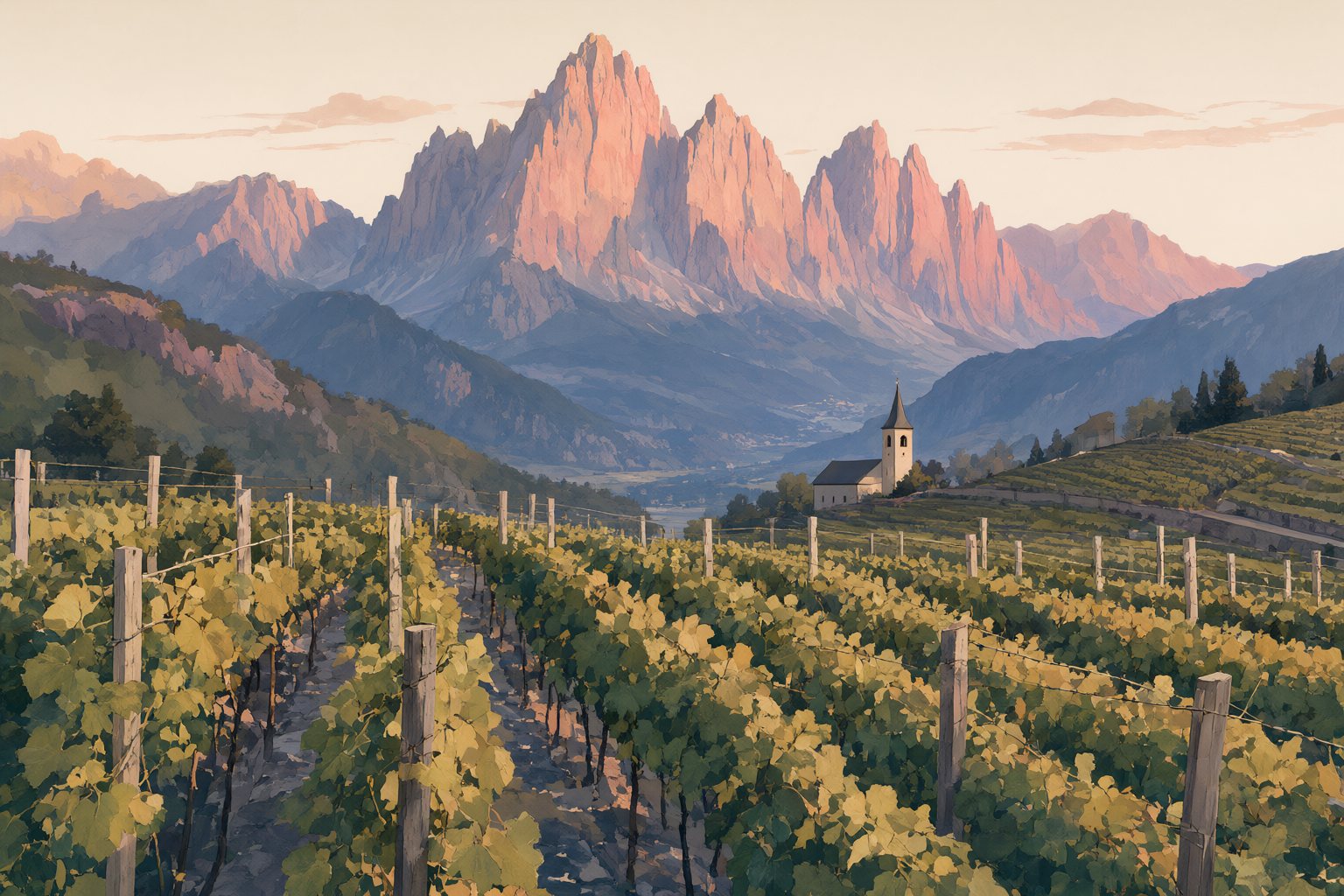
There is a corner of Italy with very little vineyard that still manages to turn up on wine lists across half the world. Alto Adige farms just under 5,900 hectares, according to the Consorzio Vini Alto Adige: less than one per cent of the country’s total vineyard area. In Tuscany or the Veneto a figure like that would pass for a footnote. Here it is everything. And the curious thing is that scarcity, rather than becoming a limitation, has turned into a method.
Few hectares, a great many hands
The numbers describe a landscape fragmented to the extreme: around 4,800 growers, with the average holding hovering at about one hectare. A pocket handkerchief. With properties that small, nobody on their own could have afforded a modern winery, a winemaker or a sales network. The answer, which came as early as the late nineteenth century, was cooperation: the Andriano winery, founded in 1893, is considered the oldest cooperative winery still in existence in the province (since 2008 it has been part of Cantina Terlano).
Today the cooperatives process around 70 per cent of Alto Adige’s grapes. Anyone who associates the words “cantina sociale” (cooperative winery) with bulk wine in demijohns should take a trip up here: it’s one of the very few places in the world where the cooperative is often the most ambitious producer in the village, not the most resigned. The model works because it pays its members according to quality and plot, not weight, and because the grower with one hectare knows that his grapes will end up in a selection with a name, not in an anonymous vat. The result is that 96-98 per cent of production, depending on the source and the vintage, is released under the Alto Adige DOC, established in 1975. In other Italian regions that percentage would be science fiction.
Altitude as an argument
The vines climb from around 200 metres on the floor of the Adige valley to a thousand metres and beyond, with the most extreme sites in the Val Venosta and the Valle Isarco. The point is not the elevation itself but what comes with it: sharp swings between day and night temperatures, slow ripening, acidity that stays upright even in hot vintages. The Alps to the north act as a wall against the cold, while currents rising from the south bring warmth. The result is a climate in which Bolzano is famous for its sweltering, bowl-trapped summer heat, while a few dozen kilometres away and a few hundred metres higher up, people are already talking the language of frontier viticulture.
It’s this verticality that allows Alto Adige to grow more than twenty varieties on a tiny surface without looking like a jumbled collection. Each grape, at least in theory, finds its band: the most demanding reds down low, in the Bolzano basin and around Lake Caldaro; the aromatic whites and Pinot Bianco halfway up the slopes; Riesling, Sylvaner and Kerner up where the air grows thin. The most recent reform of the production rules set this geography down in black and white with the Unità Geografiche Aggiuntive, the additional geographical units, more than eighty of them, which allow the precise place to be named on the label. Precision, in other words.
Schiava and Lagrein: the red that was ashamed and the one that won
For much of the twentieth century Alto Adige was, above all, Schiava country. Around 1970 this grape covered roughly two thirds of the vineyards; today it has dropped below ten per cent. It was the everyday red, pale and light, shipped in great quantities over the Brenner Pass, and it was precisely that reputation as an easy wine that sealed its fall when the markets started asking for something else. Many growers grubbed it up to plant whites, which earned more per hectare. It was a rational calculation, but it left a small wound: the best Schiava, from Santa Maddalena above Bolzano or from the old vineyards around Caldaro, is one of the few Italian reds you can drink cool from the cellar without feeling guilty. The producers of Santa Maddalena, after all, had set up one of Italy’s first protection consortia back in 1923, a sign that some people believed in it even then.
Lagrein has travelled the opposite road. Long used to give colour and backbone to Schiava or to make rosés, it has been rediscovered as the region’s serious red, with its heart in the Bolzano basin, at Gries, on warm, sandy soils. Deep colour, a rustic but not hard tannin, a bitter streak that keeps it stubbornly mountain-bred even when dressed up in new oak. Its precise origins are still debated, but its Alto Adige identity is not in question at all.
Termeno, Gewürztraminer and the Pinot Bianco that asks for no attention
The name Traminer comes from Tramin, that is Termeno, the village on the Wine Road where the grape is documented as early as the Middle Ages. The aromatic version, the one with the “Gewürz” prefix, established itself later and elsewhere, however: the compound name appears in Alsace in the nineteenth century, and the mutation that gave the grape its spicy perfumes has no certain date. Termeno, in other words, lent its surname to a wine that became famous far from home, and then took it back. The Gewürztraminers from these hills, when they come off, have the rose and lychee you would expect but also a tension that elsewhere gets lost along the way.
The region’s real secret, though, may well be Pinot Bianco. Hardly glamorous, a name that sets nobody’s pulse racing, and yet in Alto Adige it manages to be a taut, savoury white, capable of ageing with a dignity that surprises anyone who has only known it as an aperitif wine. Terlano has made it something of a flag. It’s the grape that explains better than any other what we mean by precision: no fireworks, just a straight line.
Two languages, one label
Turn a bottle round and you know where you are. Alto Adige and Südtirol, Schiava and Vernatsch, Pinot Bianco and Weißburgunder, Termeno and Tramin: in a province where Italian, German and Ladin live side by side, the bilingual label is not an affectation but an identity card. To a buyer abroad it may look like a puzzle; to those who live here it’s simply the normal way of naming things. There is something very Alto Adige about this double spelling: the sense that every detail has been considered, filed and made legible to everyone.
And that is also the limitation, if we want to say so. An Alto Adige that is too orderly risks becoming predictable, impeccable and a little cold, like a design hotel where nothing is out of place. The region’s best wines are those in which precision remains a means and does not become the end: an old-vine Schiava, a Pinot Bianco that has been given time, a Lagrein that doesn’t apologise for its tannin. The most precise in Italy, yes. But the day Alto Adige allows itself a little more imprecision, it might become the most thrilling as well.
❦