“Contains sulphites”: the two most misunderstood words on a wine label
What sulphites in wine are, why winemakers use them, the EU limits for reds and whites, and what we actually know about the wine headache.
They are the most read and least understood phrase on any back label. Two words in tiny type, often next to the pregnant-woman symbol and the recycling code, that have bred more suspicion than any bad review. “Contains sulphites” sounds like a confession. In reality it is little more than a technical notice, and for the vast majority of drinkers it says far less than people imagine.
What they are, and why they end up in the bottle
When people talk about sulphites in wine they almost always mean sulphur dioxide, SO2, and the forms in which it dissolves and binds in the liquid. Its use in the cellar is ancient: burning sulphur inside barrels to clean them is a practice historians trace back at least to classical antiquity, and over the centuries it became standard in every cellar.
The reason is simple: sulphur dioxide does two jobs that no other substance does as well, or as cheaply. The first is protecting wine from oxygen, which browns whites, flattens aromas and pushes everything towards tired, baked-apple notes. The second is keeping unwanted microorganisms in check: acetic bacteria, spoilage yeasts, fermentations that restart in the bottle when nobody invited them.
In wine, SO2 exists in two states. Part of it stays free, and that is the part that actually works as an antioxidant and antimicrobial; the rest binds to other molecules, above all acetaldehyde, and becomes largely inactive. The sum of the two is total sulphur dioxide, and that is the figure the law reasons with. Technical sources indicate that many wines are bottled with a free fraction in the order of a few dozen milligrams per litre, and a total roughly double that: rough guidance only, because every cellar and every vintage is a story of its own.
The paradox of the wine “without”
There is one detail that dismantles a good many convictions: sulphites form in wine all by themselves. During alcoholic fermentation, yeasts produce SO2 as a by-product of their sulphur metabolism. How much? That depends on the strain and the conditions. The technical documentation of a major producer of oenological yeasts speaks of a range running from a few milligrams per litre to more than 90 in particular cases. In short, there is no fixed “natural” level, nor any guarantee that a wine made without additions will stay below a given threshold.
That is why the correct expression is not “sulphite-free wine” but “wine with no added sulphites”. And it is why many natural wines, made without a single gram of sulphur dioxide in the cellar, must still carry “contains sulphites” on the label: all it takes is for the yeasts to have produced enough to cross the legal threshold.
The 10-milligram threshold
In Europe the obligation to declare sulphites arrived in the mid-2000s, with Directive 2003/89/EC, and today it sits within Regulation 1169/2011 on food information to consumers: sulphur dioxide and sulphites are on the list of substances that cause allergies or intolerances, and must be declared when they exceed 10 milligrams per kilo or per litre, expressed as total SO2. In the United States the 10 ppm rule has existed since the second half of the 1980s, when the FDA stepped in on the use of sulphites in food.
The point to bear in mind is that the threshold does not discriminate. A wine with 12 milligrams per litre and one with 180 carry exactly the same words. The label does not measure: it flags a presence. Anyone with a genuine sensitivity needs to know that; anyone trying to work out “how much” they are drinking will learn nothing from those two words.
How much the law allows
The European maximum limits are set by Delegated Regulation (EU) 2019/934. For still wines with less than 5 grams per litre of residual sugar, the ceiling is 150 milligrams per litre for reds and 200 for whites and rosés. Above that sugar threshold the limits rise to 200 and 250, and for some very sweet wines they reach 300 or more, with specific rules for the great late-harvest and noble-rot styles. In climatically difficult vintages, Member States may grant temporary derogations of up to 50 milligrams more, and they may also adopt stricter rules on their own territory.
Why can whites contain more? Because they have fewer defences of their own. A red carries tannins and polyphenols that protect it from oxidation; a white, and even more so a sweet wine, where sugar is an open invitation to microorganisms, is more vulnerable.
Organic wine has lower limits: 100 milligrams per litre for reds and 150 for whites and rosés, when residual sugar is below 2 grams per litre; for other styles the general ceiling is reduced by 30 milligrams. It should be said that these limits are maximums, not averages: many wineries, conventional ones included, sit well below them.
The headache, and the dried fruit in the pantry
Which brings us to the point that really matters to anyone turning the bottle round to read the back. Do sulphites give you a headache? The evidence, for now, does not show it. A genuine sensitivity to sulphites exists, but it concerns a minority: the FDA estimates roughly one person in a hundred, with a higher frequency among asthmatics, and the reactions described are mainly respiratory, not the classic morning-after headache. For these people the warning on the label makes complete sense, and it is right to take it seriously.
For everyone else there is a clue worth pondering. If sulphites caused headaches, whites, which by law can contain more of them, ought to be the prime suspects. Instead, the most common complaint is about reds. In 2023 a group of researchers from the University of California, Davis proposed another lead in Scientific Reports: quercetin, a flavonoid found in grape skins, which once metabolised might hinder the body’s disposal of the acetaldehyde derived from alcohol. It is a hypothesis born of laboratory experiments and still to be confirmed in humans, not a verdict. The fact remains that the possible causes are many, starting with the most obvious: alcohol itself, and the quantity.
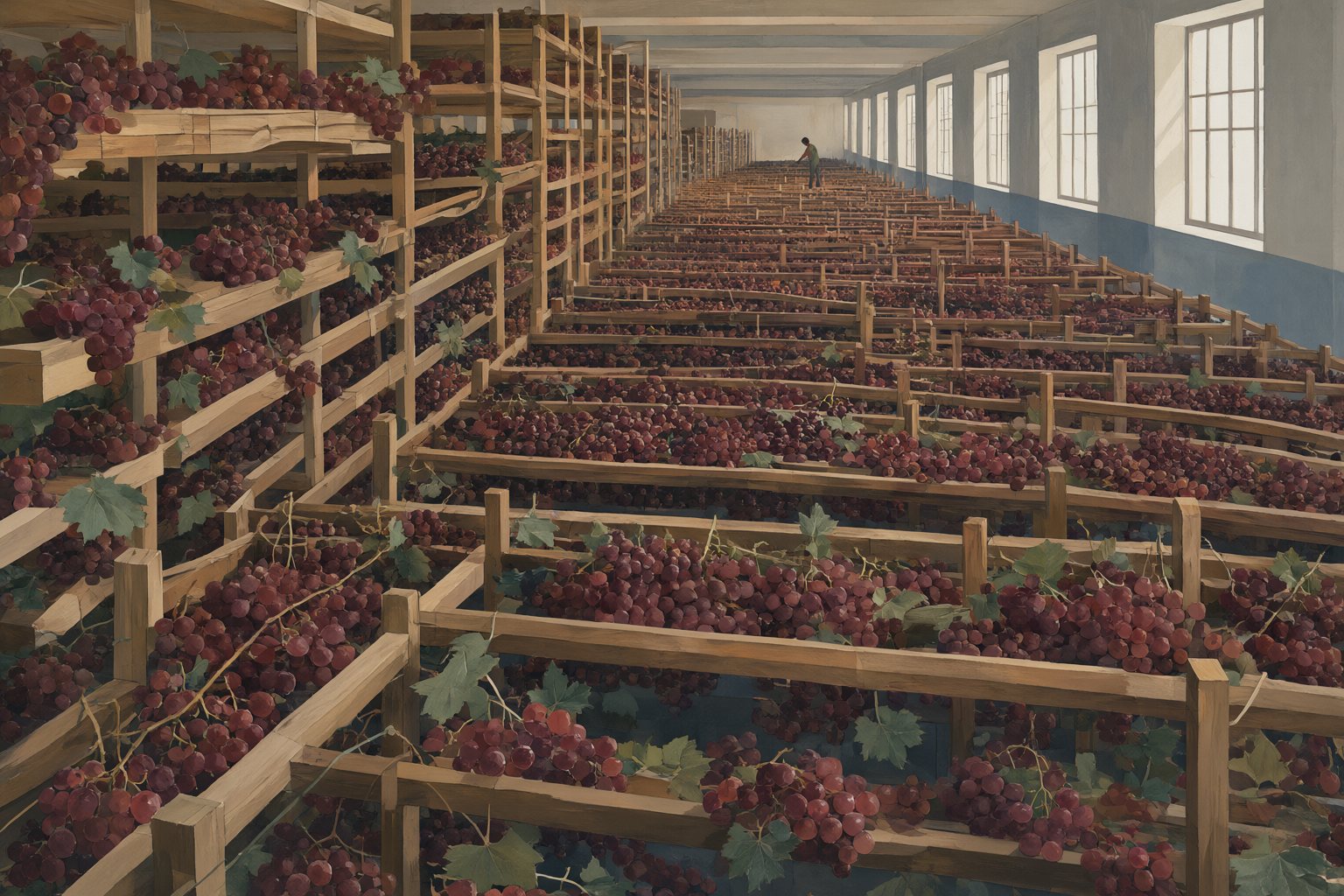
Then there is the pantry. European legislation on additives allows up to 2,000 milligrams of sulphur dioxide per kilo in treated dried apricots and raisins. The comparison should not be pushed too far, because a hundred grams of dried fruit and a glass of wine are not consumed in the same way, but the order of magnitude is instructive: a still red may not exceed 150 milligrams per litre. And yet nobody eyes a dried apricot with the suspicion they reserve for Montepulciano.
A notice, not a verdict
“Contains sulphites” is an honest and useful statement for those who need it, but it has become a convenient scapegoat: it puts a technical name to a discomfort that almost always has other causes. The result is a market that sells the absence of sulphur dioxide as a virtue in itself, when a wine with no additions can be splendid or fragile, and one sulphured with a light hand can be cleaner and longer-lived than either. The interesting question is not whether sulphites are present, because they almost always are. It is how much, and why the producer chose that dose. And on that, sadly, the label is silent.
❦