Rosé is not watered-down red: how Italian rosato really gets its colour
Short maceration, saignée, direct pressing and the EU ban on blending white and red: how rosé is made, from Chiaretto to Etna.
There are still people who order a rosé with the air of someone apologising. As if it were a compromise, a white that didn’t quite make it or a red with water added to make it summery. It is a prejudice that dies hard, and it has a certain apparent logic: the colour sits halfway, so the wine must sit halfway too. The trouble is that the cellar works in an entirely different way. A serious rosé is born not from a mixture but from a precise choice, made within a few hours, about how much to let the skins speak.
The colour is in the skin
The starting point is obvious yet often forgotten: the flesh of almost all red grapes is pale, and the juice that runs from it is practically colourless. The colour, together with a good share of the tannins, lies in the skin. A red wine is red because the must stays in contact with the skins for days or weeks during fermentation. A rosé is rosé because that contact is cut off much earlier.
Hence the three main routes.
Short maceration is the most intuitive. The red grapes are crushed and the must stays with the skins for a brief time, from a few hours to about a day depending on the variety and the result sought. Then the liquid is separated and fermented like a white. This is where almost everything is decided: a few hours more and the wine gains colour, structure, a thread of tannin; a few hours less and it remains slighter and more luminous.
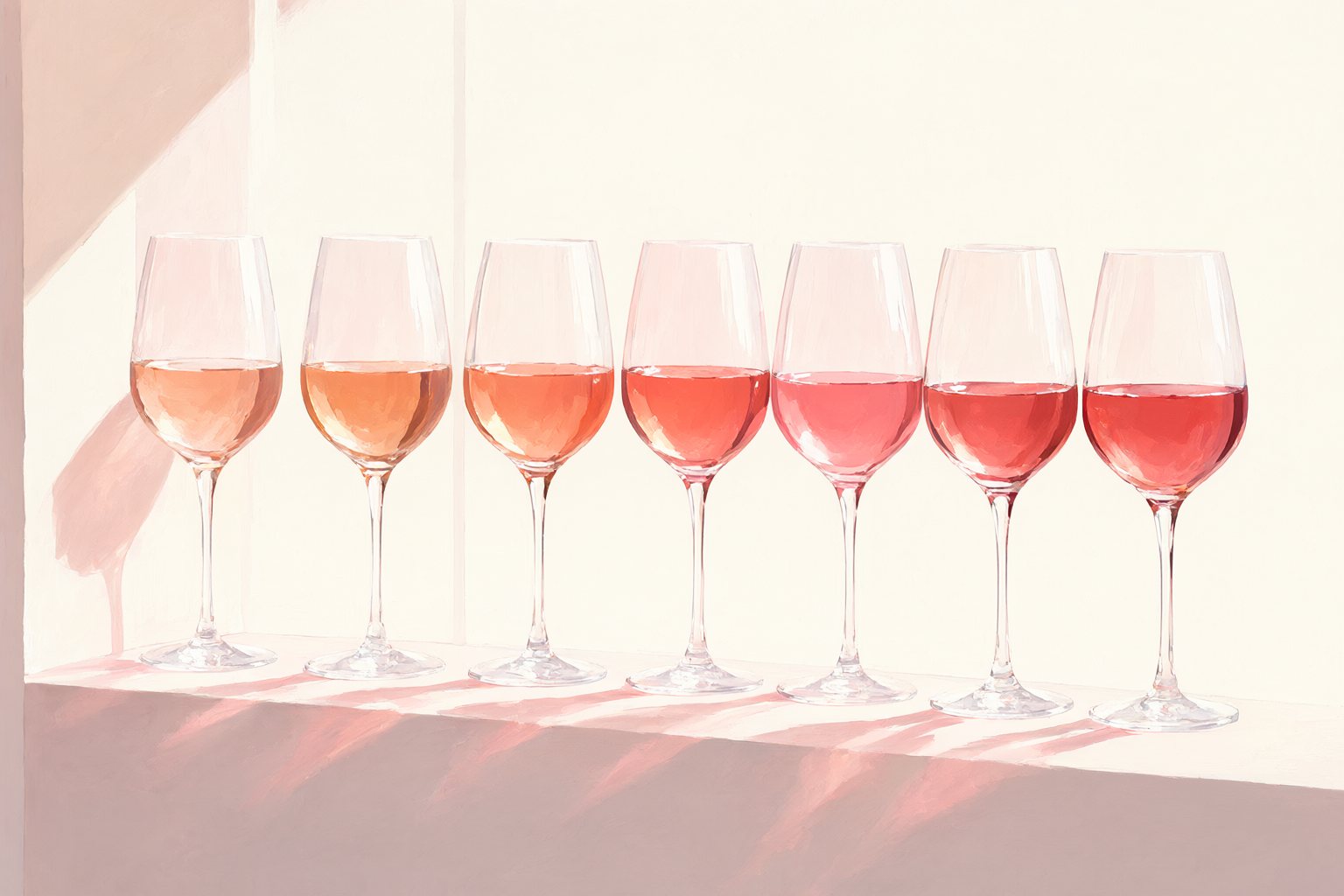
Direct pressing takes the reasoning to the extreme. The grapes, often whole bunches, go straight into the press, and the only colour that ends up in the must is what the skins release during pressing. This produces the palest rosés, the ones the colour of onion skin or petals, which over the last fifteen years have conquered the markets on the wave of Provence.
The salasso, or saignée for lovers of French, is the most ambiguous technique and therefore the most interesting. You start with a vat destined to become red and, after a few hours of skin contact, draw off part of the must. That juice becomes rosé; the rest of the vat, with more skins in proportion to liquid, will give a more concentrated red. Two wines from a single gesture. The suspicion, which the most careful producers reject with some justification, is that in these cases the rosé is the by-product of an ambitious red, not a wine conceived in its own right.
The European rule: no white plus red
And the shortcut? Mixing a finished white wine and a finished red wine to obtain a rosé is, in Europe, a practice banned in its simplest form. Delegated Regulation (EU) 2019/934, which governs oenological practices, states that a blend of a white wine and a red wine, both without a designation of origin or geographical indication, cannot produce a rosé. The ban is not new: in 2009 the Commission had proposed liberalising the practice, but the plan was withdrawn in June of that year after a united protest by producers, led by the French and Italians.
Two clarifications avoid oversimplifying. The first: the European rule explicitly concerns wines without a PDO or PGI. For appellations it is the disciplinari, the production rules, that lay down what may be done, and those of the great Italian rosés revolve around red grapes. The second: the ban does not apply to wines destined to become sparkling or semi-sparkling. That is why rosé Champagne can be made, as it often is, by adding a small proportion of red wine to a white base, the so-called rosé d’assemblage. For still rosés, then, the message is clear: the colour must come from the skin, not from the bottle next to it.
The lake: Chiaretto and Valtènesi
Italy has a longer and more varied history of rosé than prejudice would suggest, and Lake Garda is one of its centres. On the Brescia shore, at Moniga, local tradition links the birth of modern Chiaretto to Pompeo Molmenti, who towards the end of the nineteenth century devoted himself to the vine on his estate and developed a method of vinification with brief contact between must and skins. The name says it all: a pale (chiaro) wine made from red grapes. Today on that shore there is the Valtènesi appellation, created in 2011, in which the leading grape is Groppello.
On the Verona shore the protagonist is Corvina, and since 2021 the appellation has been called Chiaretto di Bardolino, with the word Chiaretto placed first, a sign of an identity that now stands on its own. The stylistic turning point is older: in 2014 the Consorzio launched what it called the Rosé Revolution, a collective move towards paler colours, gentle pressing and citrus-driven profiles. A bet on lightness that sales, especially abroad, have rewarded.
The South: Cerasuolo, Salento, Etna
Heading down towards the Adriatic, rosé changes character. Cerasuolo d’Abruzzo takes its name from the cherry, the cerasa, and its colour declares as much: an intense pink that sometimes verges on light red. For decades it was produced under the Montepulciano d’Abruzzo appellation; since 2010 it has been a DOC in its own right, with at least 85% Montepulciano. It is a grape rich in anthocyanins, which colours the must quickly: even with short macerations it yields a full-bodied rosé that behaves at the table almost like a light red. Not to be confused with Cerasuolo di Vittoria, which in Sicily is a red in every respect.
In Salento rosé is almost a mother tongue. From Negroamaro and Malvasia Nera, savoury, Mediterranean pink wines have been made for generations, and the region claims a historic first: in 1943 the Leone de Castris family, at Salice Salentino, bottled Five Roses, remembered as the first Italian rosé exported to the United States. The English name, according to the company’s history, came from the request of an Allied officer; the contrada was called Cinque Rose.
Then there is Etna, whose DOC of 1968 was the first to be recognised in Sicily. Etna Rosato requires at least 80% Nerello Mascalese, a thin-skinned grape that gives little colour and plenty of acidity. The result, on volcanic sands and at high altitude, is a taut, lean rosé, worlds away from Salento’s roundness. The same colour on paper, wines that resemble each other in almost nothing.
Pink is not a halfway house
And that is precisely the point. To say “rosé” is to indicate a method, not a style. Between a gently pressed Chiaretto di Bardolino and a Cerasuolo d’Abruzzo there is more distance than between many whites and many reds. The watered-down-red prejudice holds only until you look inside the cellar: there you discover that rosé is the wine in which the producer has the least room for correction, because everything is played out in a few hours and there is no wood or time to fix it.
My view is that Italy has a heritage of rosés it has not yet fully exploited, too often chasing Provençal pallor as if it were the only possible pink. Garda’s Rosé Revolution made sense because it started from a local history, not from a fashion. The next step would be to stop apologising for the darker rosés too: Cerasuolo does not need to become pale to be taken seriously. It simply needs to be drunk without a raised eyebrow.
❦