Alba white truffle fair 2026: what to drink on the festival weekends
From 10 October to 6 December Alba hosts the 96th White Truffle Fair: its history, the programme and the Langhe wines to open on those weekends.
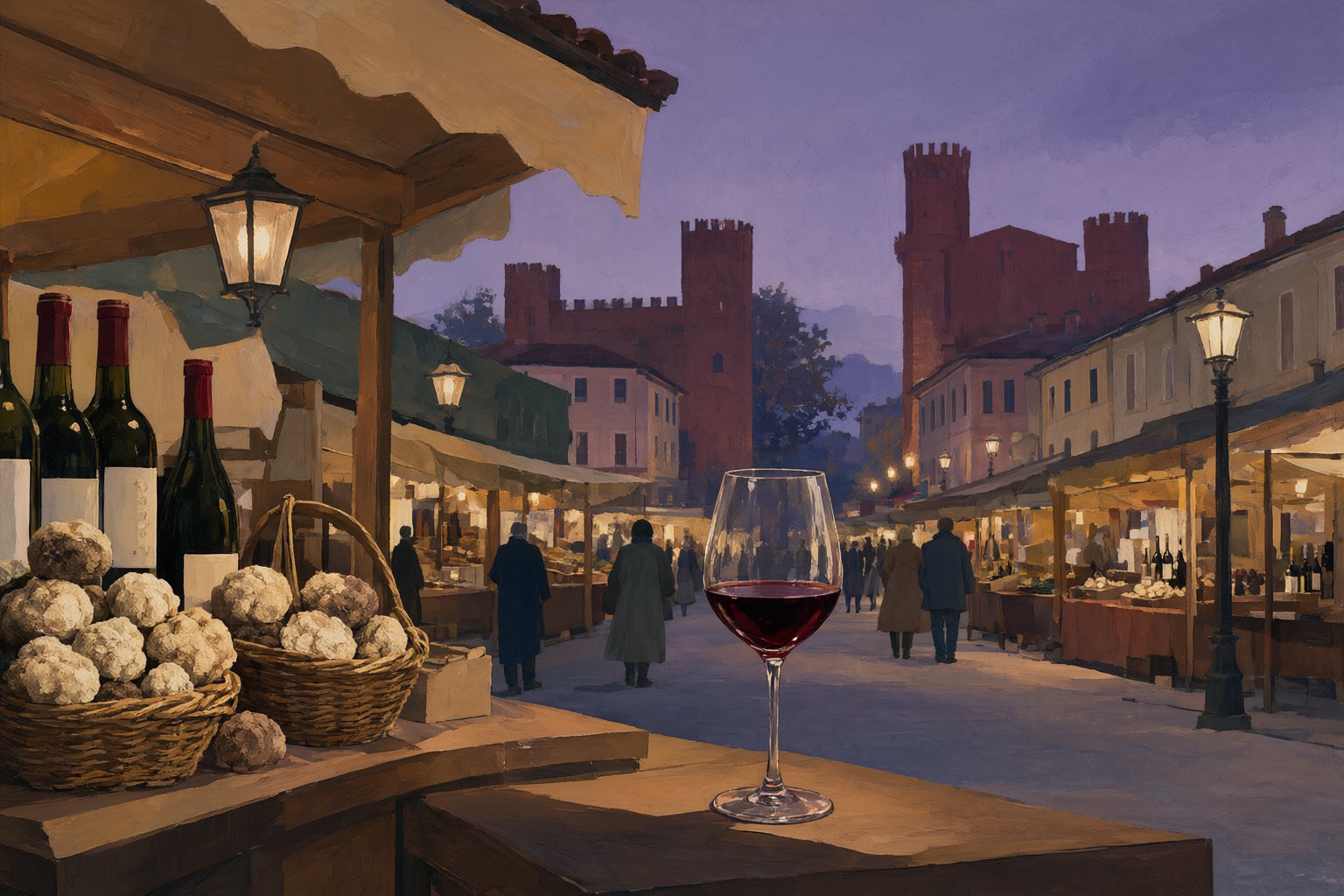
There is a moment, every autumn, when Alba stops being a town of thirty thousand people and becomes the capital of something. It happens when the scent of white truffle begins to drift out of the courtyards and the fog rises from the Tanaro to blanket the freshly harvested vineyards. From 10 October to 6 December 2026 the Fiera Internazionale del Tartufo Bianco d’Alba, the International Alba White Truffle Fair, reaches its 96th edition, and for eight consecutive weekends the town will be the most fragrant place in Italy. The truffle, though, is only half the story. The other half is in the glass, and anyone who goes with nothing but the tuber in mind risks missing the best of it.
A fair born of a restaurateur
The idea came from Giacomo Morra, a restaurateur and hotelier from Alba who, at the end of the 1920s, grasped something that was far from obvious at the time: that this knobbly underground fungus, gathered at night by taciturn men and their dogs, could become the calling card of an entire territory. Sources waver between 1928 and 1929 as the year of its birth; what is certain is that the first version of the event was grafted onto Alba’s harvest festival, under an interminable name worthy of a trade exhibition. The rest is carefully cultivated legend: the truffles presented over the years to illustrious figures, from Winston Churchill to Marilyn Monroe, have become as much a part of the myth as the tuber itself.
Since 1999 there has also been the Asta Mondiale del Tartufo Bianco d’Alba, the World Alba White Truffle Auction, usually held on a Sunday in November at the castle of Grinzane Cavour, with live links to other cities around the world. It is an evening of charity more than commerce, but its media impact is enormous: since the first edition it has raised more than 7.7 million euro. The exact date of the 2026 edition, at the time of writing, has not yet been published.
The theme chosen for this year is “Autentiche Relazioni”, authentic relationships: between the trifolao, the truffle hunter, and his dog, between the seeker and the woods, between those who produce and those who come from outside. Coming from a fair that has lived on relationships since its very first day, it sounds almost like a statement of intent.
What to expect in town
The heart of the fair will be, as always, the Mercato Mondiale del Tartufo Bianco d’Alba, the World Market, in the Cortile della Maddalena, open on Saturdays and Sundays. Here truffles are sniffed, weighed in the hand, debated and bought under the eye of quality controls designed for those who could not tell a magnatum from an impostor. Around it, the programme includes cooking shows with chefs, guided tastings, sensory analysis of the truffle, activities for families and children, the medieval procession and the Palio degli Asini, the donkey race Alba invented to poke fun at the far more serious palio of Asti.
One practical tip worth more than any guidebook: the middle weekends of October and November are the most crowded. If you can choose, the last weekends, when the air is already cold and the truffle season often at its best, have a more intimate charm. And arriving early in the morning, while the market is still quiet, is another way of seeing the fair.
What to drink with white truffle
White truffle is an ingredient at once overbearing and fragile. Its perfume is invasive, but it fades quickly, and above all it cannot bear competition. That is why the rules of pairing are almost more a matter of respect than of taste.
The first rule: no wines that are too young or too tannic. A Barolo from the latest vintage on the market, its tannins still rough and the oak to the fore, risks flattening everything. Nebbiolo becomes the ideal companion once it has a few years behind it and has developed tertiary notes, forest floor, dry leaves, leather, faded rose, which converse with the truffle rather than challenge it. The Barolo regulations require at least 38 months of ageing, 18 of them in wood; those of Barbaresco at least 26, 9 of them in wood. But for truffle it pays to go well beyond the minimum.
With a fried egg or with tajarin al burro, the fine buttered egg pasta of the Langhe, the two dishes in which the truffle truly rules, a mature Barbaresco is often the most elegant choice: it has the same aromatic structure as Barolo but a finer weave. Those who prefer to stay lighter can turn to a Nebbiolo d’Alba or a Langhe Nebbiolo, less demanding but honest.
And then there is white wine, which many forget. Roero Arneis, born on the left bank of the Tanaro just across from Alba, has a freshness and a note of almond that go well with a fonduta or a carpaccio with shavings of truffle. For something more structured, a Piedmontese white with a few years in bottle can surprise. Barbera d’Alba, with its cutting acidity, works better with richer dishes, such as a finanziera or a braise, than with raw truffle.
One rule applies to all of them: the wine must be served at the right temperature, not too warm. A Nebbiolo at 20 degrees turns alcoholic and smothers the more delicate aromas.
The Langhe, beyond the fair
The beauty of these weekends is that the fair is only the front door. Since 2014 the vineyard landscapes of Langhe-Roero and Monferrato have been a UNESCO World Heritage Site, and in autumn the reason is obvious to anyone driving south from Alba: hills striped with rows of vines turning from green to yellow to rusty red.
The castle of Grinzane Cavour, besides the auction, houses the Enoteca Regionale Piemontese, a good introduction to the wines of the area. In Barolo, the Falletti castle is home to a wine museum that tells the story of the appellation with a contemporary slant. In Barbaresco, the regional enoteca occupies a deconsecrated church, and it is one of the most evocative places in which to taste. And from La Morra, the belvedere offers one of the broadest views over the Barolo vineyards, especially on foggy mornings, when the hills emerge like islands.
In early October the Nebbiolo harvest is often still under way or only just finished: a good moment to see the cellars at work. Many estates open by appointment: better to organise in advance, because on fair weekends the slots go quickly.
And for those who stay at home? A bottle of Barbaresco with a few years on it, a plate of tajarin al burro and, if the budget allows, a few shavings of truffle. Otherwise a fried egg and a glass of Nebbiolo: it isn’t Alba, but it comes close.
Practical information
- Dates: from 10 October to 6 December 2026, at weekends (96th edition)
- Venue: Alba (Cuneo); the Mercato Mondiale del Tartufo Bianco d’Alba is held in the Cortile della Maddalena, on Saturdays and Sundays
- World Auction: usually on a Sunday in November at the castle of Grinzane Cavour (2026 date to be confirmed)
- Official website: fieradeltartufo.org
Our verdict? The fair deserves a visit at least once in a lifetime, but the real luxury is not the biggest truffle in the market: it is a slow lunch in a hillside trattoria, with a Nebbiolo that has had the time to become itself.
❦