Champagne Day 2026: on Friday 23 October we open northern France
Champagne Day returns on 23 October: areas, grapes, maisons and vignerons, dosage, how to celebrate and an honest comparison with Italian sparkling wines.
There is something comical about a wine that needs a world day. Champagne is already the planet’s default toast: graduations, weddings, Formula 1, New Year’s Eves. And yet since 2009 it has also had a date all of its own, and this year it falls on Friday 23 October. It was invented not by a trade body or a maison, but by a Californian blogger, Chris Oggenfuss, who proposed online a day to celebrate the drink and watched the idea multiply hashtag by hashtag. The rule is simple: the fourth Friday of October, every year.
A northern wine, on a bed of chalk
Champagne is a region at the limit: at those latitudes, until a few decades ago, grapes struggled to ripen with any regularity. It is precisely this fragility that created the style. Base wines that are acidic, lean, almost surly, which on their own would convince few but which, refermented in bottle and left for a long time on their lees, become something else entirely.
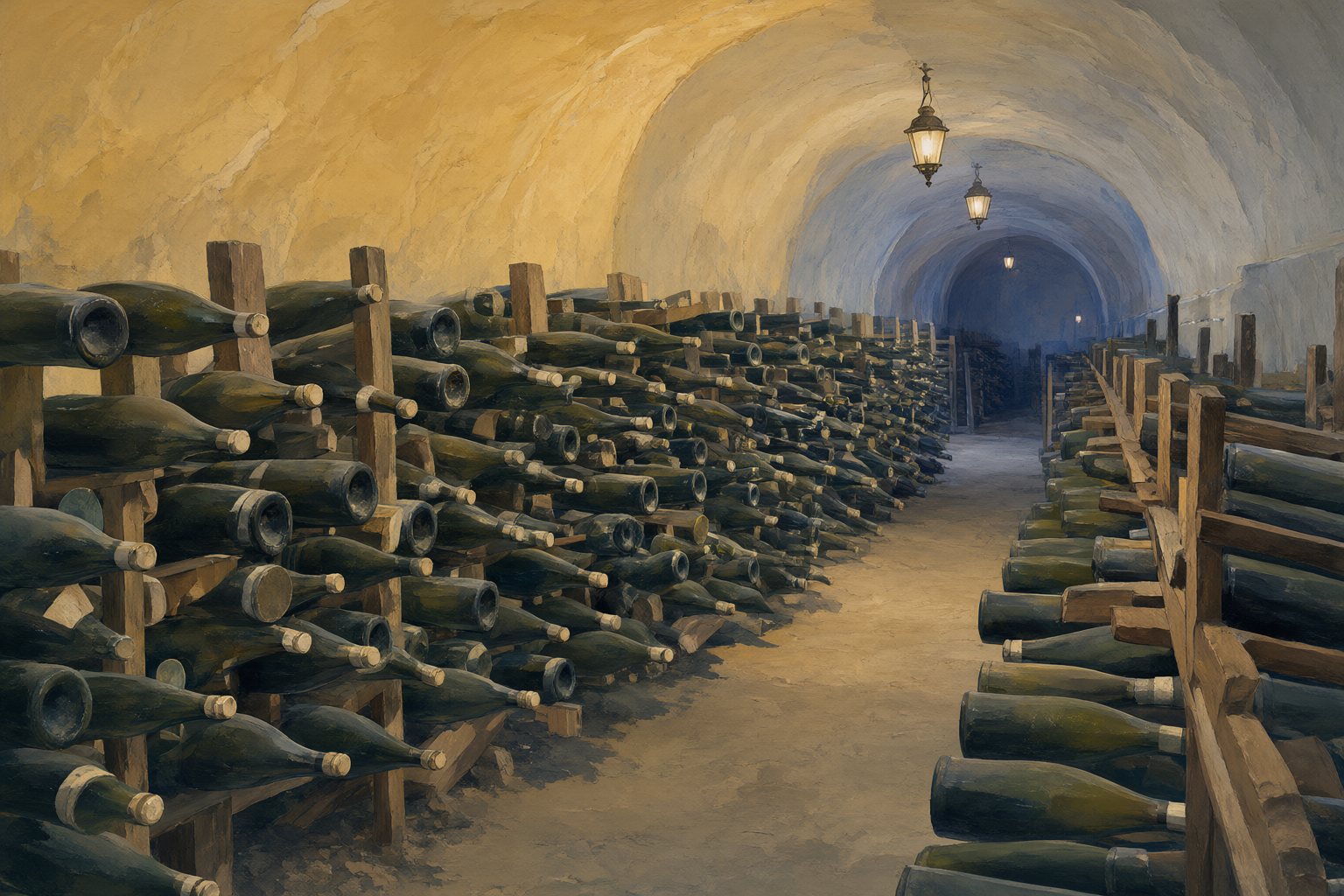
Beneath the vineyards lies chalk, which drains water and returns it slowly to the roots. The same chalk, quarried as far back as Gallo-Roman times, gave Reims its crayères, underground pits where millions of bottles now rest at an almost constant temperature. In 2015 UNESCO inscribed the “coteaux, maisons et caves” of Champagne on its World Heritage List: hillsides, houses and cellars, in other words the whole system, not just the landscape.
The numbers give a sense of scale. The vineyard covers about 34,000 hectares spread across 319 communes, the so-called crus. The main areas are the Montagne de Reims, the kingdom of Pinot Noir; the Vallée de la Marne, where Meunier is at home; the Côte des Blancs, almost entirely Chardonnay; and further south the Côte de Sézanne and the Côte des Bar, the latter far from the historic heart and planted overwhelmingly to Pinot Noir. Seventeen communes hold Grand Cru status, forty-two Premier Cru.
Three grapes, a thousand blends
The regulations allow seven varieties, but three are what count: Pinot Noir, Chardonnay and Meunier share the vineyard in almost equal parts, with Pinot Noir slightly in the lead. Arbane, Petit Meslier, Pinot Blanc and Pinot Gris survive in minimal percentages.
The key word is blending. Most Champagne is non-vintage: wines from different grapes, villages and above all different years are combined, drawing on the reserve wines kept in the cellar. The aim is to achieve the house’s recognisable style every year, whatever the weather has been up to. Vintage Champagne, made only in years deemed worthy, is the exception and not the rule. The regulations require at least 15 months in the cellar before release for non-vintage, at least 12 of them on the lees, and three years for vintage. Serious houses almost always go well beyond.
Maisons and vignerons: who does what
Champagne lives on a singular economic balance. On one side are some 370 maisons, which ship over two thirds of the volume but own a minority share of the vineyards; on the other some 16,000 vignerons, who own most of the vines and largely sell their grapes to the houses or deliver them to one of the 130 cooperatives. The maisons buy, blend and build the brand. Many growers, for some decades now, have taken to bottling their own.
To find out who is behind a bottle, just look at the small initials next to the registration number on the label. NM, négociant manipulant, indicates a house that buys grapes and vinifies them. RM, récoltant manipulant, a grower who produces from their own grapes: these are the so-called “grower Champagnes”, which have brought into the glass the idea of a single village, a single plot, sometimes a single variety. CM denotes a cooperative. It is not a hierarchy of quality, but a key to reading: the maison tells the story of a style, the grower the story of a place.
The market, meanwhile, is not going through its best period. In 2025 some 266 million bottles were shipped, the third consecutive year of decline after the post-pandemic peak.
Dosage, or how much sugar
The last gesture before the final cork is the dosage, the small addition of liqueur that determines how dry or sweet the wine will be. The categories are fixed by law and must be read the opposite way to how they sound. Brut Nature: no added sugar and less than 3 grams per litre. Extra Brut: between 0 and 6. Brut, by far the most widespread category: less than 12. Then the trick: Extra Dry, between 12 and 17, is sweeter than Brut. Sec goes up to 32, Demi-sec up to 50, Doux exceeds 50.
The trend of recent years is towards ever lower dosages, helped by warming: riper grapes need less sugar to balance the acidity. But dosage is not a vice to be corrected. A well-calibrated Brut does not taste sweet, it tastes complete, and a Demi-sec still makes sense with dry pastries, far more than a Brut, which against dessert turns bitter and sharp.
How to celebrate, and where Italy comes in
The best way to honour 23 October is to use it as a comparative lesson. Two bottles of the same style, one from a maison and one from a grower, or a Blanc de Blancs from the Côte des Blancs next to a Blanc de Noirs from Pinot Noir: in half an hour you learn more than in a year of absent-minded toasts. Tulip-shaped glasses, not coupes nor the narrowest of flutes; a temperature of around 8-10 degrees, not freezer-cold. And, for once, at the table: with roast chicken, fried food, aged cheeses.
The comparison with Italian sparkling wines comes naturally, and should be made without complexes. Let us set aside the question of method, which we have already covered: here we are talking Metodo Classico against Metodo Classico. Franciacorta, Trento DOC, Alta Langa and Oltrepò Pavese work with the same base grapes, Chardonnay and Pinot Nero, but in different climates. More sun in Franciacorta, more altitude in Trentino and the Alta Langa. The result is wines often riper in fruit, sometimes less incisive, which do not need much sugar to stay in balance.
The real differences are cultural. Champagne has built everything on blending and reserve wines; in Italy the vintage carries more weight, and Alta Langa, for example, is by regulation always a vintage wine and requires at least 30 months on the lees, double the French minimum for non-vintage. And then there is scale: Italy’s Metodo Classico appellations are young (Trento DOC dates from 1993, the Franciacorta DOCG from 1995) and small compared with a system that ships hundreds of millions of bottles.
Practical information
- When: Friday 23 October 2026 (Champagne Day falls every year on the fourth Friday of October).
- Where: everywhere. There is no central event: wine shops, wine bars and restaurants organise their own tastings, and the hashtags #ChampagneDay and #WorldChampagneDay circulate on social media.
- To find your way: the website of the interprofessional body is champagne.fr; the calendar of days devoted to wines and grape varieties is published on wsetglobal.com.
One last opinion, to close. Champagne Day only makes sense if you drink with a little more curiosity than usual. Open a French bottle, by all means. But set beside it an Italian Metodo Classico of equal ambition and taste them together: neither will come out defeated, and you will come out a little less naïve.
❦