Hospices de Beaune 2026: the auction that sets the price of Burgundy
On 15 November, at the Halles de Beaune, the 166th Vente des Vins des Hospices: its history, how the auction works and why the whole market is watching.
There is one place in the world where a wine still in barrel, barely a few weeks old, is sold for hundreds of thousands of euros before a packed hall, and where the entire trade of a region holds its breath to learn what its vintage is worth. That place is the Halles de Beaune, on the third Sunday of November. On Sunday 15 November 2026 the 166th Vente des Vins des Hospices de Beaune will take place, conducted, as in recent years, by Sotheby’s: the oldest charity wine auction, and probably the most closely watched.
A hospital with vineyards
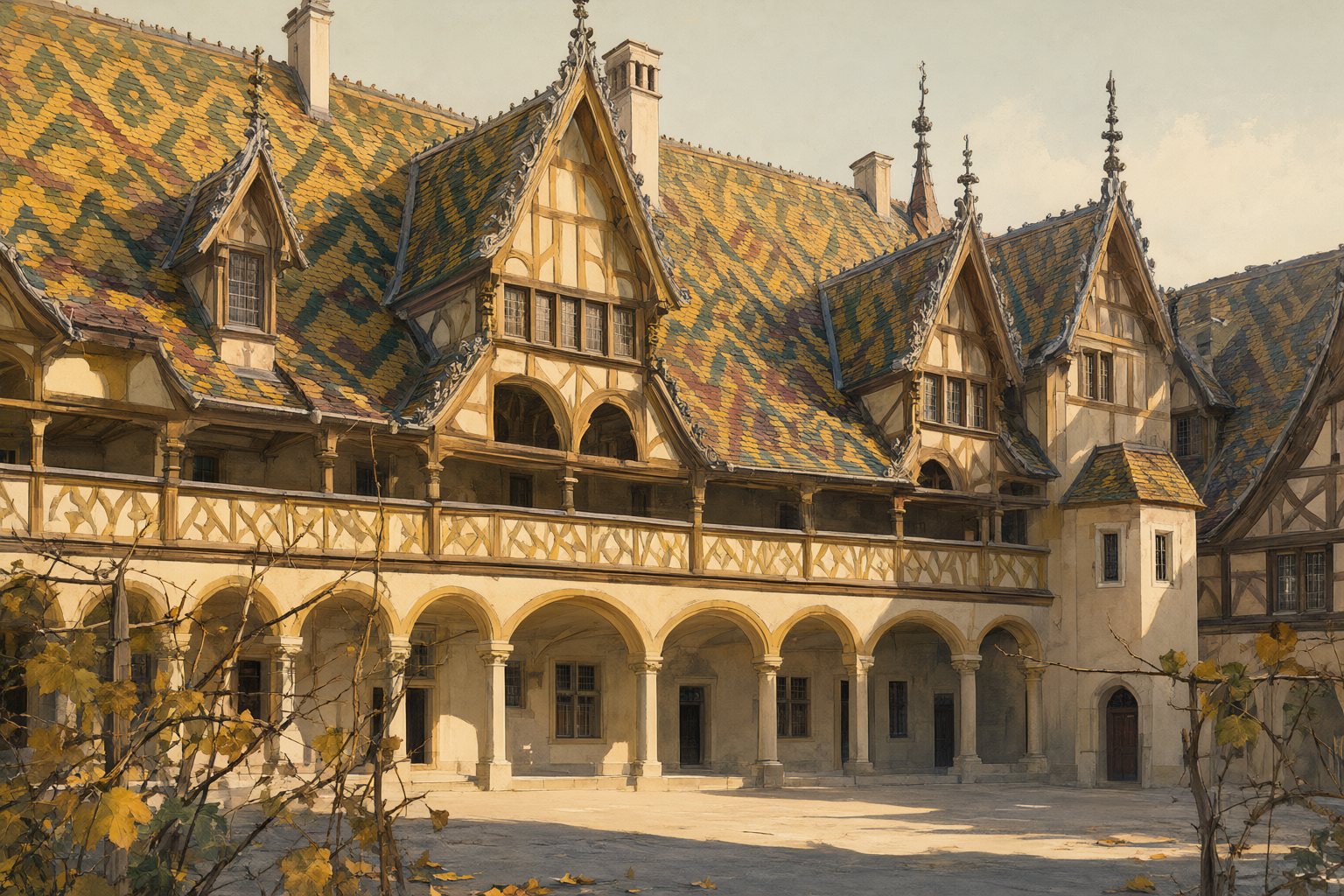
It all began in 1443, when Nicolas Rolin, chancellor to Philip the Good, Duke of Burgundy, and his wife Guigone de Salins founded the Hôtel-Dieu in Beaune, a hospital for the poor in a region exhausted by the end of the Hundred Years’ War. The building is one everyone knows even without ever having been there: the courtyard, the wooden galleries, the roof of glazed tiles in yellow, green, red and black lozenges that has become the very emblem of Burgundy.
The vineyards came early, by donation: the first dates from 1459, and over the centuries benefactors and local families went on leaving parcels to the institution. The result is an estate that today runs to almost 61 hectares, around 85% of it grand cru and premier cru, from the Côte de Nuits to the Côte de Beaune, and certified organic since 2024. The Hospices civils de Beaune is still a public hospital body, and the proceeds of the auction fund the hospital, training, museums and the domaine itself.
The sale by auction, on the other hand, is a nineteenth-century idea: the first was held in 1859. Since then the event has become a ritual, and the ritual has needed a bigger stage.
How it works, candles included
At the Halles you do not buy bottles but pièces, the Burgundian barrels of 228 litres, the equivalent of about 288 bottles. Each lot corresponds to a cuvée from the domaine’s vineyards, often named after a historic donor, and the wine has only just finished fermenting: it is a purchase made sight unseen, or nearly. Whoever wins a barrel then entrusts it to a Burgundy house that looks after its ageing and bottling, which is why bottles bearing the Hospices name alongside the names of different négociants can be found on the market.
Until 2004 the auction was a matter for professionals, chiefly local négociants. In 2005 its management passed to Christie’s, which opened it to private buyers and introduced a detailed catalogue and remote bidding; since 2021 the hammer has belonged to Sotheby’s.
And the candles? Tradition called for a sale à la bougie: a lot was knocked down to the last bid made before two small flames went out, one after the other. A slow, theatrical method, and hardly compatible with hundreds of lots in a single afternoon. Sources agree that today it survives only for a few chosen moments, while the rest proceeds at the auctioneer’s pace; as to which lots are still sold this way from year to year, we have found no single rule.
The most eagerly awaited moment remains the charity pièce, known as the Pièce des Présidents or Pièce de Charité: a special barrel, usually a grand cru, whose proceeds go to causes chosen afresh each year, with celebrity presidents acting as sponsors on stage. For 2026 the theme is rare diseases, and the beneficiary associations announced are DEBRA France, which works on epidermolysis bullosa, and ARSLA, devoted to ALS and motor neurone diseases. In 2025 the charity barrel reached €400,000, a record for the category.
Burgundy’s thermometer
Why should a charity auction interest people who simply drink wine? Because it is the first public price of the new vintage. It comes in November, when the wine is still cloudy in barrel and nobody else has yet set a price list: négociants, importers and collectors look to the results from the Halles as a seismograph of the market’s mood.
It must be read with caution, of course. Prices are inflated by charitable spirit, by the staging and by the desire to be seen; nobody believes a barrel of Beaune is really worth what it fetches in the hall. But the direction matters more than the absolute figure: if the average rises, Burgundy feels entitled to nudge its prices upwards; if it falls, a season of prudence begins. In 2025 the 165th edition took around €18.75 million under the hammer for more than 550 pièces, with an average of close to €34,000 a barrel, up 4.6% on the year before. It was the fifth year running with an average above €30,000: a clear signal, in a region where prices have long been outpacing the wages of the people who drink the wine.
The 2026 vintage promises to put the thermometer to the test. The Hospices describe a season marked by drought and heat, a lightning harvest of nine days between 15 and 24 August, and a crop described as rather small: powerful tannins, concentrated aromas, high alcohol. Low yields and high concentration are usually the combination that gets paddles moving in the hall. There is also an anniversary to honour: the Pommard appellation turns 90, having been created on 11 September 1936, and the domaine owns 7.2 hectares of it.
The Trois Glorieuses weekend
The auction is the heart of a weekend the Burgundians call the Trois Glorieuses, this year from 14 to 16 November. On Saturday the Confrérie des Chevaliers du Tastevin holds its chapter at the Château du Clos de Vougeot; Sunday belongs to the Halles and the auction; on Monday Meursault closes proceedings with the Paulée, the lunch at which everyone brings their own bottles and pours them for their neighbours. All around, Beaune fills with open cellars, tastings and crowds (the Festivinales programme is listed from 13 to 15 November).
Anyone going should know that the auction itself is better followed from outside than from within: the hall is reserved and crowded, while the town provides the real show. It is wise to book accommodation well in advance, even in Dijon or in the villages of the Côte, and to leave room for a visit to the Hôtel-Dieu, which is busier on those days but no less beautiful.
Those who stay at home can do the most sensible thing of all: open a bottle from the Côte de Beaune on Sunday afternoon, as the results come in. A Pommard, to toast its ninetieth birthday, or a white from Meursault, ahead of the Paulée. You do not need a grand cru to feel part of the celebration: you need only the thought that, a few hundred kilometres away, someone is deciding what that glass is worth.
And that is precisely the somewhat paradoxical charm of the Halles. A charity auction that sets the price for an entire region, a fifteenth-century ritual conducted by a global auction house, a wine that nobody has yet truly drunk. You may find all this excessive, and it is. But as long as Burgundy continues to measure itself here, every third Sunday of November, it is worth at least knowing what is going on.
Practical information
- Event: 166th Vente des Vins des Hospices de Beaune
- Auction date: Sunday 15 November 2026
- Trois Glorieuses weekend: 14–16 November 2026
- Venue: Halles de Beaune, Beaune (Côte-d’Or, Burgundy)
- Auction house: Sotheby’s
- Charity 2026: rare diseases, in support of DEBRA France and ARSLA
- Official website: hospices-de-beaune.com
❦