Vino novello 2026: Italy’s new wine is uncorked on 30 October, by law
Italian vino novello 2026 arrives on 30 October: the rules, carbonic maceration, how long it keeps, how it differs from Beaujolais Nouveau and why it lost its shine.
Some wines wait years before letting anyone taste them. Vino novello, Italy’s new-vintage wine, waits a few weeks, and then for one precise minute: 00:01 on 30 October. Before that moment it may not appear on a shelf or in a glass served to the public, not even by mistake. Afterwards, it has a short and cheerful life ahead of it. On Friday 30 October 2026 the curtain will rise again on the vintage, and it is worth understanding what you are about to drink, because novello is one of the most regulated and most misunderstood wines in Italy.
A date set by decree
The day is not a marketing gimmick. The rules for novello are set out in an annex to the ministerial decree of 13 August 2012, which fixes its release for consumption at 00:01 on 30 October of the harvest year. Until 2012 the date was 6 November: bringing it forward by a week also had the effect, not entirely by chance, of getting the Italian wine onto tables before its French cousin.
There is just one exception, and it is in Puglia: Lizzano rosso novello, in the DOC near Taranto, keeps the old date of 6 November. A small regulatory enclave that says a great deal about how much every Italian designation cares about its own calendar.
The rules do not end there. The term “novello” is reserved for DOP and IGP wines whose production rules explicitly provide for it; the grapes must come one hundred per cent from that year’s harvest, without the blending with other vintages permitted for other wines; the minimum alcohol content is 11 per cent, residual sugar may not exceed 10 grams per litre, and bottling must be completed by 31 December. The vintage must appear on the label. Even the transport documents, if the journey begins before 30 October, must warn that the wine may not be put on sale before that day.
The trick is called carbonic maceration
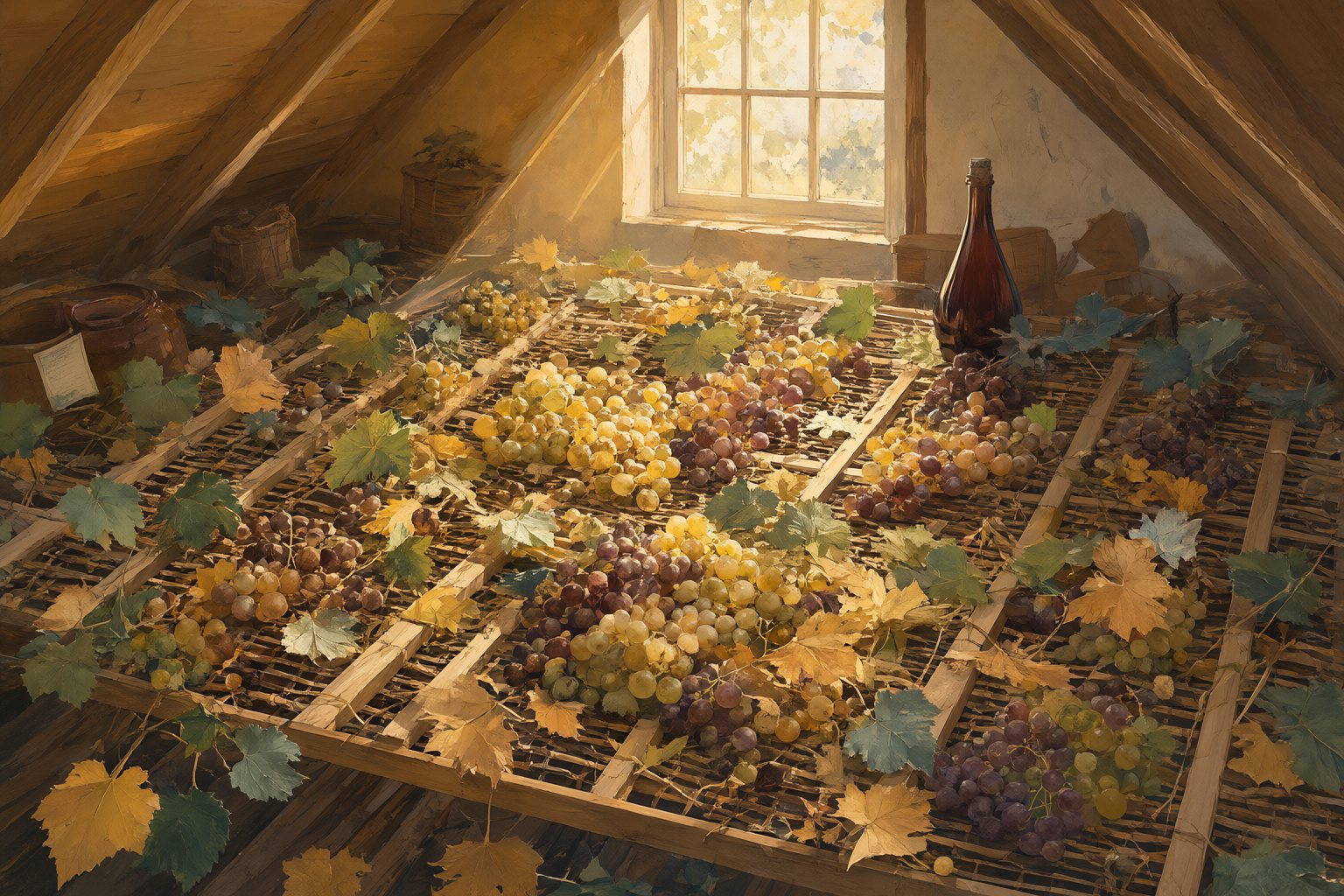
The technical heart of novello is carbonic maceration. Whole, uncrushed bunches are sealed in tanks saturated with carbon dioxide. Without oxygen, an intracellular fermentation begins inside the berries: in practice the grape starts converting its own sugars from within, developing those unmistakable aromas of crunchy red fruit, strawberry, raspberry and sometimes banana and pear drops. The tannins stay soft and the colour vivid, that purple that stains the rim of the glass.
Italian law does not require all the wine to be made this way: at least 40 per cent must come from carbonic maceration of whole grapes, while the rest may be vinified traditionally. It is a compromise that leaves producers some room to give the wine a little more structure, and it explains why two novelli can be very different from each other. Fermentation, incidentally, must last at least ten days: even a young wine needs its minimum of time.
How long it lasts, and how to drink it
Novello is made to be drunk early. The advice most often given, echoed by the farmers’ association Coldiretti, is to drink it within six months of production: in practice, by the spring. It does not improve in the cellar; on the contrary, it loses precisely what makes it enjoyable, namely the freshness of the fruit. Keeping it like a riserva is a mistake of perspective, a bit like framing today’s newspaper.
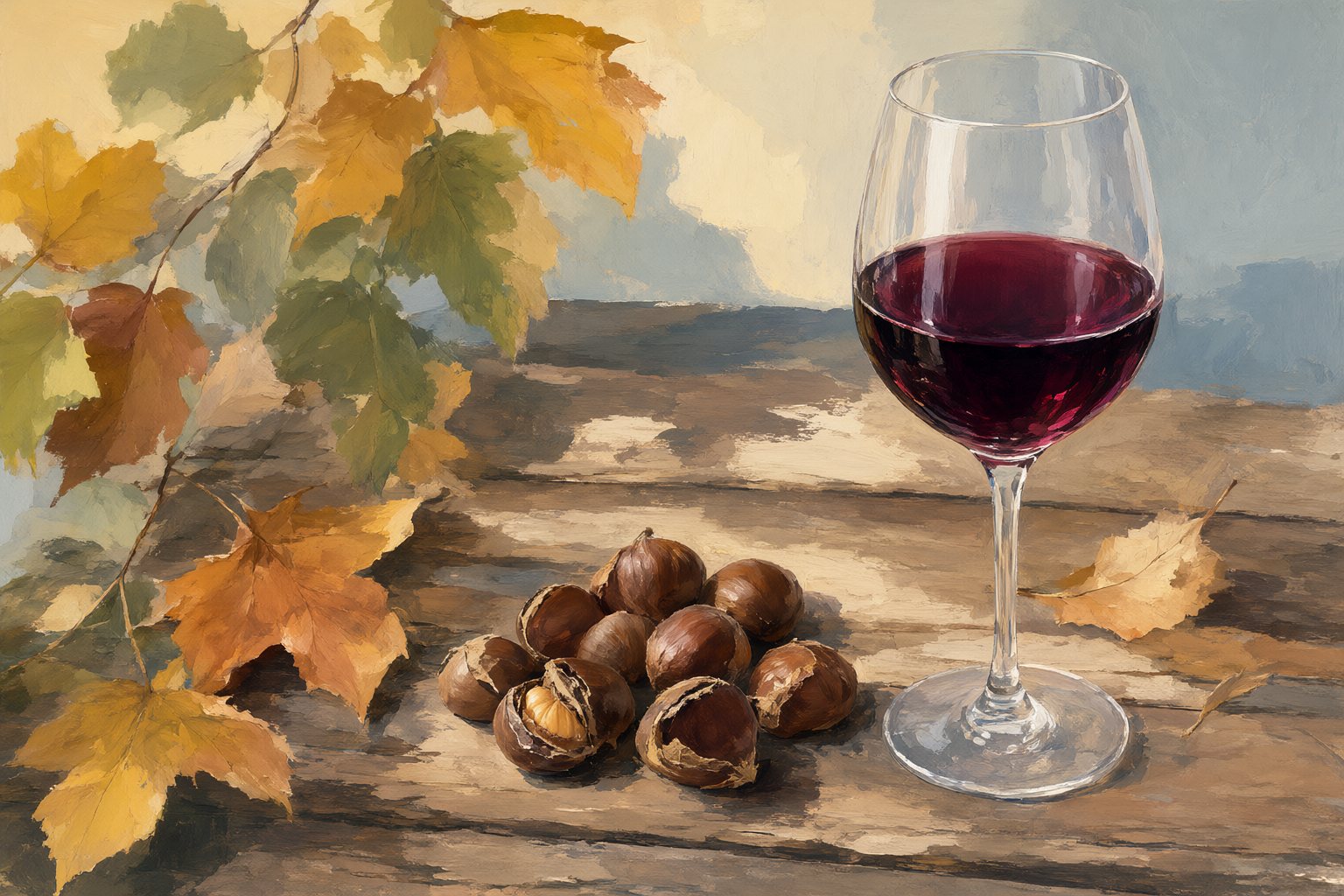
Serve it slightly cool, at around 14–16°C, in a glass that is not too wide. At the table it makes sense with everything autumn puts in the pot without too many pretensions: cured meats, bean soups, young cheeses, a pizza. The pairing with roast chestnuts is a classic to which we have already devoted a separate article; suffice it to say here that novello asks for no ceremony, and anyone who expects ceremony from it will be disappointed.
It is not a Beaujolais Nouveau (and does not want to be)
The acknowledged model is French. Beaujolais Nouveau gained official recognition in 1951 and since 1985 has been released on the third Thursday of November: this year that will be Thursday 19 November 2026, almost three weeks after Italian novello. The differences, however, go beyond the calendar.
Beaujolais Nouveau comes from a single grape, Gamay, and a single area. Italian novello, by contrast, is a cross-cutting category: it can be produced under many designations, from wildly different regions and grapes, from the Veneto to Trentino, from Tuscany to Puglia. The former has built a global ritual, with Japan among its most devoted markets. The latter has remained a home-grown celebration, tied more to San Martino and 11 November than to international marketing. The result is that the French wine has a precise identity and ours a frayed one: more variety, less recognisability.
Rise and fall of a phenomenon
Italian novello appeared in the 1970s, with pioneers such as Antinori and Gaja who were looking precisely to France. The boom came between the 1980s and 1990s, when novello became a mass event and, according to Coldiretti’s estimates, production exceeded 17 million bottles. Sources disagree on the exact year of the peak, which some place later, towards the end of the 2000s. On one point they all agree: today the figure is around 2 million bottles a year.
The reasons for the collapse are concrete. Carbonic maceration costs producers around 20 per cent more than traditional vinification, for a wine that has to be sold within a few months and cannot be kept in a warehouse waiting for the right buyer. Many growers preferred to make young, easy-drinking wines by conventional methods, without the constraints of the category and without its implicit expiry date. And taste has changed: over the last twenty years the Italian public has sought complexity, terroir and native grapes described with precision. Novello, with its berry-fruit perfume that smells much the same everywhere, ended up in the “easy wines” box, and therefore of little interest to those who wanted to learn.
Our view
Novello will not return to the glory days of the 1990s, and perhaps rightly so: those numbers were the offspring of a fashion more than of a passion. But dismissing it as a second-rate wine is just as lazy. Well made, it is an instant snapshot of the harvest just completed, the only way to taste the vintage before it becomes a vintage. On 30 October it is worth opening one with curiosity, without expecting a great red: what it promises is freshness, and that is more honest than many wines that promise more.
Practical information
- Release of vino novello 2026: Friday 30 October 2026, from 00:01
- Exception: Lizzano rosso novello, from 6 November 2026
- Beaujolais Nouveau 2026: Thursday 19 November 2026
- Legal reference: ministerial decree of 13 August 2012 (annex on vino novello)
- When to drink it: preferably by the spring following the harvest
❦