How to give a bottle of wine as a gift without embarrassing yourself
How to choose wine as a gift: the person first, the story before the price, birth-year vintages, the magnum, dinner-party etiquette and the right note.
A bottle of wine is the easiest present in the world, and that is precisely why people get it wrong so often. You walk into a wine shop ten minutes before dinner, point at something with a serious-looking label, pay and leave with a clear conscience. Then, at your friend’s house, the bottle ends up in a row of others identical in spirit, if not in shape: chosen in a hurry, so as not to look bad. A well-chosen wine, on the other hand, says something. And to make it speak takes only a little care, almost none of which has anything to do with how much you spend.
The person first, then the bottle
The question to ask is not “which wine is good?” but “who will drink it, and when?”. An enthusiast with a full cellar does not need yet another important red: they will be happier with a curiosity, a grape on the verge of extinction, a region nobody talks about, something they can tell stories about in turn. Someone who drinks little but with pleasure wants a bottle that is ready, to be opened without ceremony and without the fear of wasting it. Someone who does not drink at all simply deserves a different present: insisting is a gesture for yourself, not for them.
The occasion matters too. A thank-you is not a birthday, a house move is not a graduation. For a new home, a wine for keeping works well: it gets opened in a few years and carries with it the memory of that day. For a dinner tonight you need something else, and we will come to that.
A story beats a label
Price is the laziest criterion there is, and also the most transparent: anyone who receives an expensive bottle chosen only because it was expensive can tell at once. Far better to start from a connection. A wine from the region the recipient comes from, or the one where they spent their happiest holidays. A wine from the place where you met. A small producer you have actually visited, whose cellar you can describe, the steep vineyard, the dog asleep beneath the barrels.
A bottle like that becomes a topic of conversation, and the value people attach to it grows with the story, not with the receipt. It is also the best way to avoid the unspoken comparison with someone who knows wine better than you do: on the ground of storytelling nobody can beat you, because the story is yours.
The birth-year vintage: lovely, but not for every wine
Giving a wine from the year the guest of honour was born is a touching idea, and one of the riskiest. The vast majority of wines are not made to last for decades: fresh whites, rosés, young and fragrant reds are meant to be drunk in their first few years. A twenty-year-old wine picked at random is less a gift than an experiment.
The categories that genuinely stand the test of time are few and well known. Fortified wines, to which alcohol is added during production, are the most robust. Vintage Port, for example, is declared only in the best years: each house decides whether to declare, the sample is approved by the Douro’s regulatory body, and when many of the great houses choose the same year it is called a general declaration, roughly three times a decade. After about two years in large casks it goes into bottle, and it is there, in the glass, that it matures for decades. Madeira is perhaps the most indestructible of all: the Frasqueira category, from a single harvest, requires some twenty years of ageing before release (the details of cask versus bottle vary depending on the source). Then there are the great noble-rot sweet wines such as Sauternes, German Rieslings with residual sugar, and among Italian reds the great names for ageing, Barolo, Barbaresco, Brunello, Taurasi, but only in the right vintages and the right hands.
Two warnings. The first: an old wine is only as good as its storage, and the bottle’s history (where it has been, at what temperature, upright or lying down) matters as much as the vintage on the label. Buy from someone who can tell you where it comes from. The second: for someone turning thirty, the wine of their birth year is a feasible challenge; for someone turning eighty, it is almost always a relic to be looked at rather than drunk. That is fine, as long as you know it and say so.
There is also a simpler route: give a newborn baby, or a couple getting married, a wine built for ageing from their own year, to be opened in ten or twenty years. In that case, the recipient supplies the time.
Size matters: the magnum
If there is one format that turns a bottle into an event, it is the magnum, a litre and a half, twice a standard bottle. It is not just for show. Between the wine and the cork there is more or less the same amount of air in both formats, and the oxygen that seeps through the cork over time is similar: in a magnum that air is spread across twice as much wine, which therefore tends to evolve more slowly and stay fresh for longer. For a gift meant for keeping, that is a serious argument.
At a dinner, on the other hand, a magnum is a statement of intent: it says “let’s drink this together”, and it is hard to ignore. Which is exactly why it should be chosen with a little tact. Bringing one to a dinner for four can put your host in the awkward position of either opening it or apologising for not doing so.
At dinner: you leave the bottle, you don’t demand it
This is where the most common faux pas happen. The etiquette is simple: whoever brings the wine gives it, they do not serve it. Your host has probably already thought about the wines for the menu, and is under no obligation to open your bottle, nor are you entitled to ask. If you see it vanish into the kitchen, you have given a good present, not suffered a slight. If you really do want it opened, because you chose it for that dish or because it is a bottle for sharing, say so beforehand, with a phone call, not on the doorstep with your coat still on.
Avoid, too, wines that need looking after: a red with heavy sediment that needs decanting, a white that should be served ice-cold arriving at room temperature. If you want it drunk straight away, bring it ready.
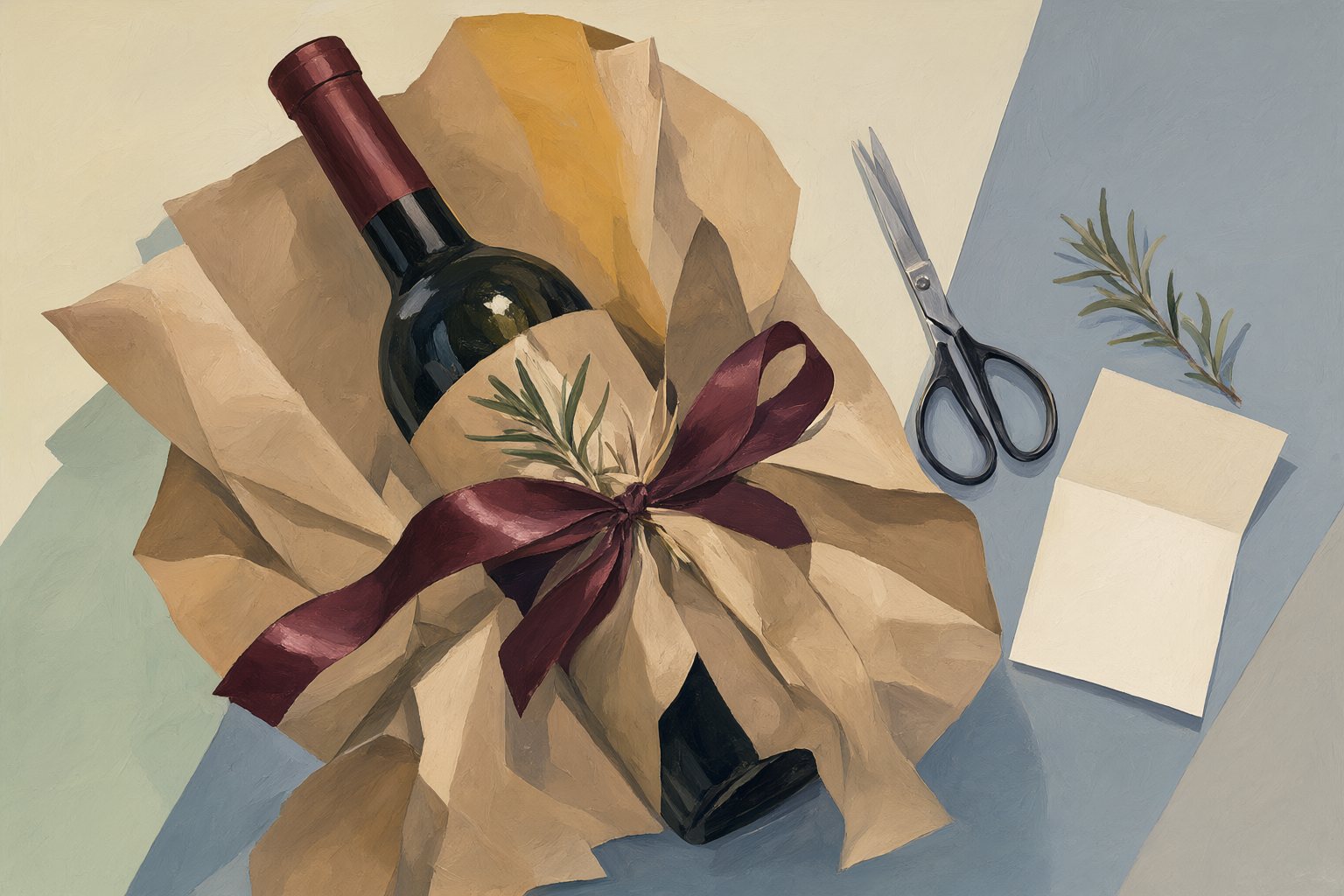
As for the wrapping, less is more. Plain paper, a ribbon, at most a wooden box if the bottle is for keeping. Glittery gift bags hide the bottle, which is precisely the part the recipient wants to see.
A few lines on the card
The detail that makes the difference takes a few minutes: a card with a couple of lines about the wine. Not a technical sheet, not scores, just the essentials: where it comes from, why you chose it, when to drink it. “Open within a couple of years, with something roasted.” “From the village where we spent that summer.” “From the year you were born: maybe it’s tired, maybe it’s wonderful, let’s find out together.” That way the bottle keeps talking even when you are not there, and whoever opens it in three years’ time will still know why it is there.
In the end, a well-given wine is more like a good letter than a pretty parcel. You choose it with someone in mind, add a few sincere words, and let it go. Those who spend a lot so as not to think too hard give an expensive present. Those who think a little more give one that is remembered, and often spend less.
❦