A wine cellar at home: what you really need to age wine
Stable temperature, humidity, darkness and calm: what matters when storing wine at home, in a wine fridge or a cupboard, and which bottles are worth the wait.
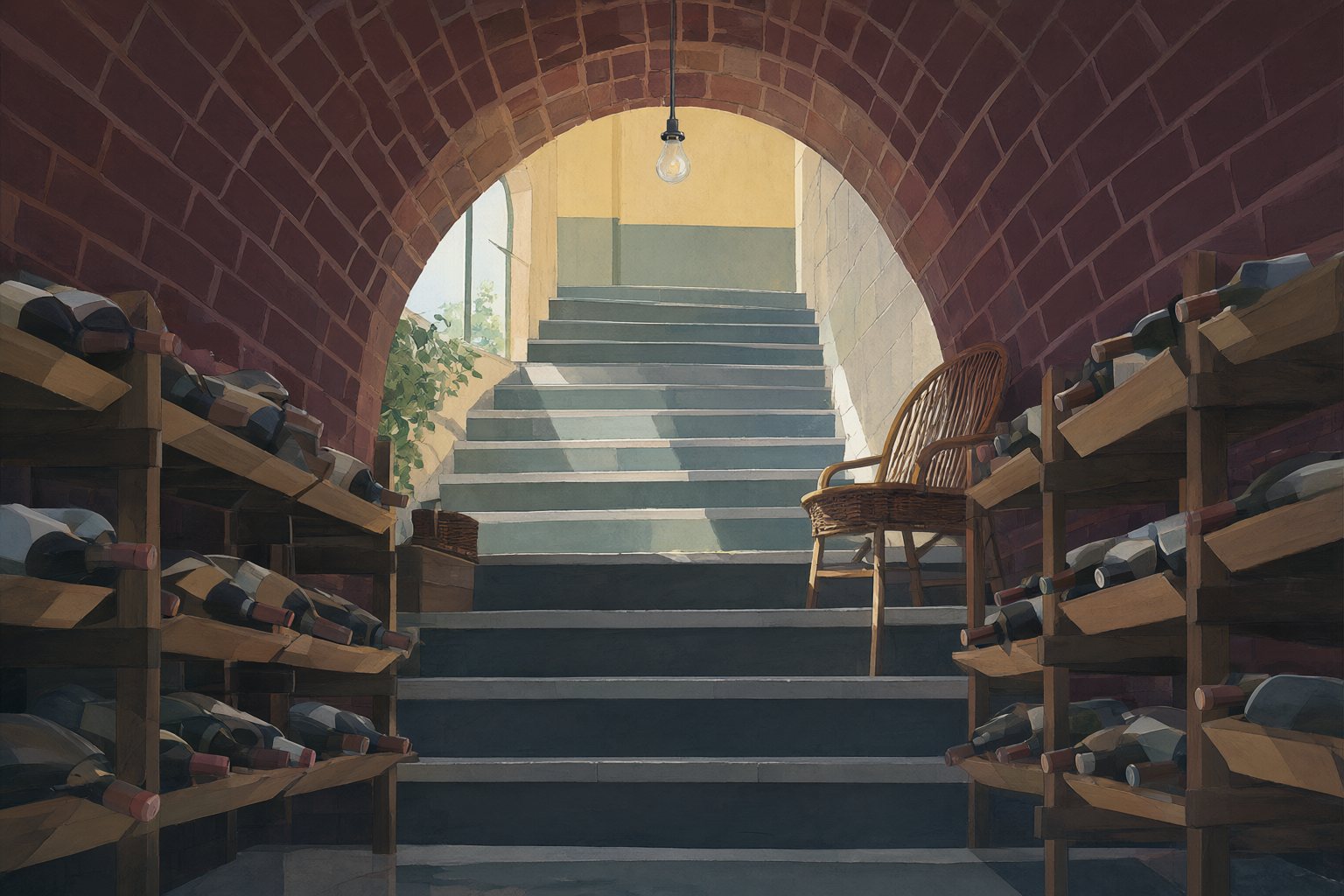
Almost all the bottles that come to a bad end are ruined not by time but by good intentions. We buy them meaning to “lay them down”, stand them upright on top of the fridge or in a brightly lit display cabinet in the living room, and a few years later we open a tired, cooked wine that tastes more of waiting than of evolution. The problem is not the lack of a cellar carved into the tufa. It is not knowing what a cellar actually does for wine.
The good news is that its demands are few and fairly simple. The bad news is that they all have to be met at once.
Temperature: stable before cold
The figure that circulates most often is around 12–14 °C, and the most authoritative references move within a similar range, roughly between 10 and 15 °C. It is a sensible bracket: cool enough to slow the chemical reactions through which wine matures, not so cold as to halt them.
But the number itself matters less than people think. A space that stays steadily at 16 or 17 °C will age wine a little faster, and for many bottles destined for only a few years of waiting that is no tragedy. What does the damage is rapid swings: the room that catches the sun by day and cools down at night, the cupboard next to the boiler, the repeated shift from warm to cold. The liquid expands and contracts, the cork works, air gets in a little at a time. A slow seasonal fluctuation, on the other hand, wine tolerates without complaint: historic cellars have always had one.
If I had to choose, I would take a corner that sits at 17 °C all year round over one that swings from 10 in January to 24 in August.
Humidity, darkness, calm
Humidity matters above all for the cork. In air that is too dry, cork tends to lose elasticity on the exposed side, and a cork that shrinks lets oxygen through. The value most often quoted as ideal is around 70–75%, though in all honesty research on a precise threshold is scarce and the recommendations vary. Rather than chasing a number, it is better to avoid the extremes: the air of a heated flat in winter is too dry, while a cellar with water dripping down the walls makes labels go mouldy and, in the long run, damages the space itself.
Darkness is the most underrated factor. Light, ultraviolet light in particular, triggers reactions that can give wine unpleasant smells, of boiled cabbage or wet cardboard. Most at risk are light whites and sparkling wines, all the more so if bottled in clear or pale green glass. A lit display cabinet is a handsome piece of furniture and a dreadful place to keep wine.
Then there are vibrations. The literature on the subject is less solid than tradition suggests, and it is not clear how much vibration is needed to do measurable harm. Common sense, though, is on the side of calm: no bottles on top of the washing machine, on the fridge or near a compressor that switches on and off all day. The same goes for moving them about: a wine that is constantly being shifted is never at rest.
Finally, smells. Cork is porous, and a cupboard that shares its air with paints, detergents or jerrycans of petrol is not a cellar.
Lying down, with a few exceptions
Bottles closed with a natural cork are kept lying down, so that the wine stays in contact with the cork and keeps it supple. It is a sensible rule, although some now argue that the humidity in the bottle’s headspace is already enough to protect the cork, and that a slight tilt is even preferable to perfectly horizontal. The debate remains open; when in doubt, laying them down costs nothing.
Bottles with screwcaps or synthetic closures can stand upright without any problem. And on metodo classico sparkling wines opinions differ: some prefer them upright for long periods, but for a few months the question is irrelevant.
A practical detail: whites and sparkling wines go on the lowest part of the rack, where the air is coolest.
Wine fridge or cupboard?
A climate-controlled wine fridge solves temperature, darkness and, in the better models, a degree of humidity stability in one go. It is the safest choice for anyone living in a modern flat, where there is rarely a spot that stays cool in summer. It does have its limits, though: capacity runs out sooner than you would imagine, the compressor generates some vibration, and cheaper models tend to dry out the air. It is worth choosing appliances designed for storage and not just for service, that is, with a single zone at a constant temperature rather than lots of “serving” zones.
A cupboard, or a shared cellar in an apartment building, can work perfectly well, on one condition: measure before you fill it. A thermometer that records minimum and maximum and a hygrometer, left there for a whole summer and a whole winter, tell you everything you need to know. If the variation is slow and limited, if no light gets in and there are no heat sources, that space is worth more than many an expensive cabinet. If it goes above 25 °C in July, better to forget it: the only wine you can keep there is wine to be drunk within a few weeks.
What to wait for, and what not to
And here is the point that makes everything else easier: the great majority of wine produced is meant to be drunk young. The freshness, the fruit, the liveliness of an aromatic white, a rosé or a light red are their whole point, and time in bottle takes them away without giving anything back. For these wines a cellar is unnecessary: a cool, dark place for a few months is enough.
The wines worth waiting for are those with the structure to do so: sustained acidity, serious tannins, concentration, sometimes residual sugar. Nebbiolo from Barolo and Barbaresco, Sangiovese from the best vintages and areas, Aglianico, the great reds of Bordeaux and top-tier Burgundies, some Rieslings, Chenin Blancs and vintage Champagnes, sweet and fortified wines. Even among these, though, not all improve in the same way, and many producers today make wines that are enjoyable early on. Buying two or three bottles of the same wine and opening them years apart remains the best way to understand when the moment has come.
A cellar is an idea of patience
I believe the real mistake is to think of a cellar as a storeroom. It is rather a selection: a few bottles chosen because they will have something to say in ten years, kept in a stable, dark and quiet place. Everything else should be drunk, and with pleasure, without the guilt of not having “aged” it. Better twenty right bottles in a monitored cupboard than two hundred forgotten in a display cabinet under the spotlights.
❦