What wine with panettone and pandoro? Stop opening the brut
Why dry sparkling wine does not work with Italy’s Christmas cakes, and which wines to choose instead, from Moscato d’Asti and passito to Recioto and Brachetto.
Ten to midnight, the panettone already open on the table, someone wrestling with the wire cage of a brut. The cork pops, everyone applauds, glasses are raised, teeth sink into the slice. And at that precise moment the wine turns sour, almost metallic, and the cake suddenly seems cloying. Nobody says so, because it is New Year’s Eve. But everybody notices.
The ritual of serving dry sparkling wine with dessert is one of the few mistakes Italians make with absolute consistency, year after year, at home and in many restaurants alike. It is worth understanding why it does not work before choosing what to put in its place.
The problem with sugar
The rule sommeliers repeat ad nauseam is simple: the wine must be at least as sweet as the dish it accompanies, ideally a little sweeter. It is not a matter of personal taste but of how the tongue works. The sugar in the dessert saturates the receptors, and when a wine with very little residual sugar arrives, the palate perceives only what is left, namely acidity and bitterness. A brut, which under EU rules contains less than 12 grams of sugar per litre, comes off badly against a cake with a great deal more sugar than that. The bubbles add a further sensation of sharpness.
The same happens, incidentally, with extra brut and pas dosé, which contain even less sugar. The point is not the quality of the sparkling wine: even a great metodo classico, Italy’s traditional-method fizz, seems a worse wine than it is when set beside panettone. The midnight toast is perfectly fine, as long as it is drunk before the first slice is cut. Then you change bottles.
Panettone and pandoro are not the same thing
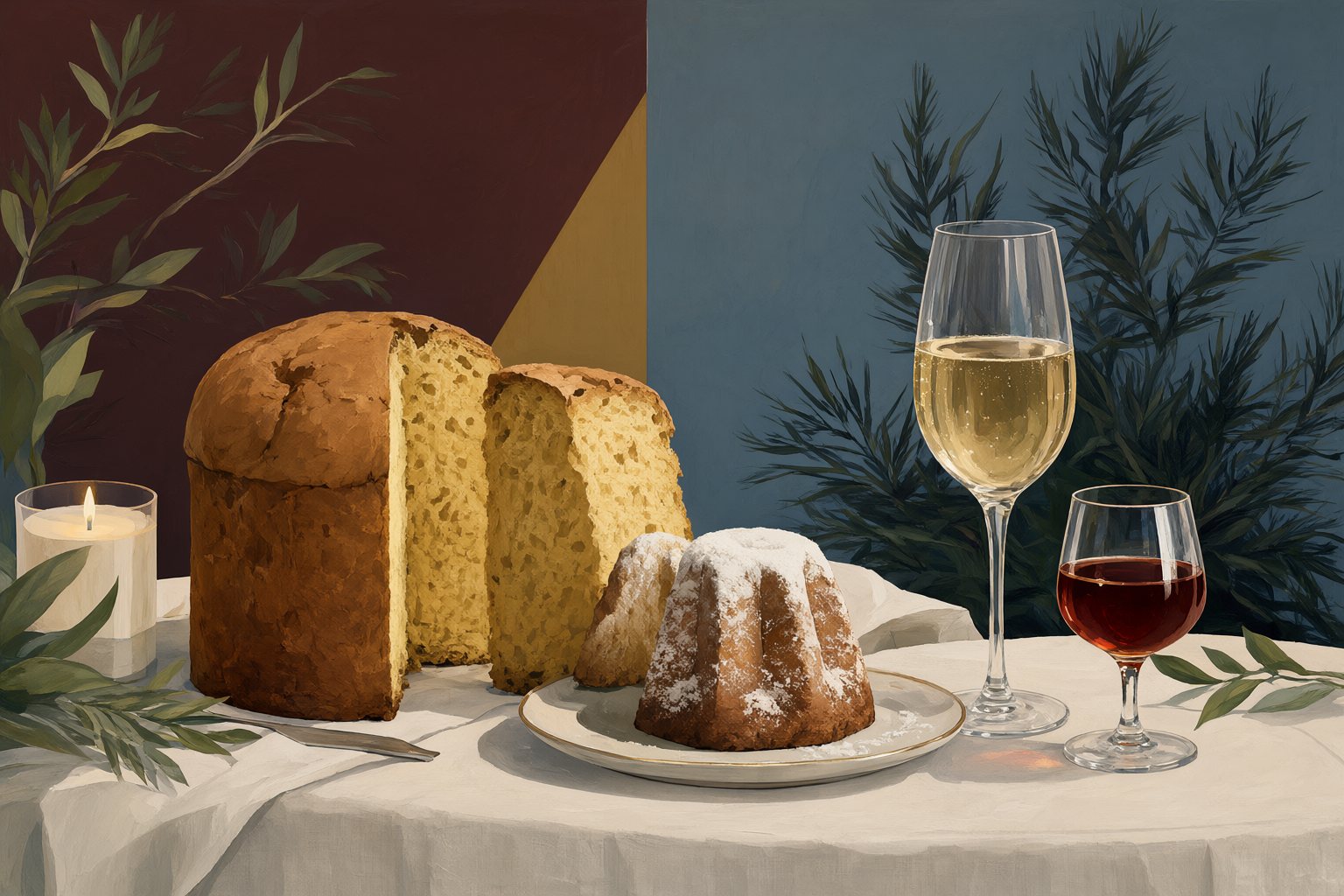
Before choosing the wine, it pays to take a good look at the cake. Milanese panettone, in its classic version, is a leavened dough rich in butter and egg yolks, with raisins and candied citrus peel. It has a distinct aromatic side, fruity and citrusy, and a certain moistness. Veronese pandoro, shaped like an eight-pointed star, has neither candied peel nor raisins: it is more buttery and softer, smells of vanilla and arrives at the table covered in icing sugar, which instantly heightens the sense of sweetness.
Translated into the glass: panettone wants a wine that converses with citrus and dried fruit, and can take something more structured. Pandoro is more delicate but sweeter on the surface, and wants a wine that cuts through the butter without overwhelming it with intrusive aromas. Then there are the filled versions, with chocolate, pistachio and assorted creams: there the rules go out of the window and it is best to reason case by case, often moving towards sweet red wines.
The wines that really work
The most natural candidate, and the one that does least harm for those who would rather not think too hard about it, is Moscato d’Asti. The DOCG’s production rules require an actual alcohol content of between 4.5 and 6.5 per cent and a pressure not exceeding 2.5 bar: it is therefore a light wine, barely sparkling, sweet without being heavy. The aromas of sage, peach and white flowers of Moscato Bianco marry with the candied peel of panettone and bring freshness to pandoro. It also has a social advantage not to be underestimated: at that strength, at half past midnight, it does no damage.
Those who want something more frothy can turn to Asti, the fully sparkling version of the same designation, choosing the sweet styles. Or, staying in the world of bubbles made by the traditional or Martinotti (tank) method, look on the label for the words demi-sec or dolce, which indicate a level of residual sugar suited to dessert. Reading the label, in this case, is half the job.
For traditional panettone, however, the leap in quality comes with wines made by appassimento, the drying of grapes before fermentation. Recioto di Soave, a DOCG since 1998, is made from Garganega grapes left to dry for weeks or months after the harvest: it has notes of dried apricot, honey and almond that seem written specifically for candied fruit. Rarer and more demanding is the red counterpart, Recioto della Valpolicella, made from the same grapes as Amarone but with fermentation stopped before all the sugar has been consumed. It is an interesting choice for chocolate panettone, less so for the classic version.
Tuscan Vin Santo is the traditional pairing, with its oxidative nuances of hazelnut, caramel and dried fruit. It works well with panettone provided it is genuinely sweet: drier versions also exist, and with those you are back to the original problem. The same goes for the great passiti, or dried-grape sweet wines, of the South and the islands, from Pantelleria’s Moscato to the Malvasia of the Lipari islands, which have the sweetness and ripe fruit to hold their own against a rich leavened cake.
Finally there is Brachetto d’Acqui, a Piedmontese DOCG since 1996: red, aromatic, sweet and low in alcohol, starting from a minimum of 6 per cent in the sparkling version. With plain pandoro it risks seeming a little too perfumed, but it becomes almost irresistible with chocolate or red-fruit versions, and it has the merit of bringing a festive colour to the table without any effort.
A small map for New Year’s Eve
To sum up, with no pretence of dogma. For classic panettone, Moscato d’Asti if you want lightness; Recioto di Soave, Vin Santo or a Moscato passito if you want depth. For pandoro, Moscato d’Asti or a sweet sparkling wine, with fine bubbles to clean away the butter. For the chocolate versions, Brachetto d’Acqui or Recioto della Valpolicella. In every case, dessert wine should be served cool but not ice-cold, and in small measures: a finger of passito is worth more than a full glass.
As for cost, Moscato d’Asti remains one of the most affordable of the wines mentioned; dried-grape wines, because of their very low yields and the work they require, inevitably cost more and are often found in half bottles, which are more than enough for a family table.
The toast and the dessert are two different moments
Dry sparkling wine is not to blame. It is a splendid wine for the aperitif, for fish, for the countdown. The problem stems from the idea that bubbles are an evening dress fit for every occasion, including one where they have no business being. At New Year the popping cork is a ritual, and rituals are not to be tampered with. But they can be separated: toast with the brut, put the glass down, and when the panettone arrives, open the other bottle. It is a tiny gesture, and it turns a slice of cake eaten out of duty into one of the best moments of the evening. If the new year is to bring a few good resolutions, this is the easiest one to keep.
❦