What wine for the Christmas Eve fish feast, from baccalà to capitone
Salt cod, eel, fried fish, crudo and spaghetti alle vongole: a guide to wine pairings for Italy’s meatless Christmas Eve dinner, region by region.
Christmas Eve is the one evening of the year when the whole of Italy pretends to be on a diet and then lays the table for seven, nine, sometimes thirteen courses. The cenone della Vigilia, the great Christmas Eve dinner, is “meatless” only as far as the liturgy is concerned: no meat, of course, but fried food, butter, olive oil by the gallon and enough fish to stock a harbour. Amid all this, the wine is often chosen at the last minute, by a single criterion: white, because there’s fish. It is a rule that holds for half the evening and collapses, without fail, for the other half.
One table, many Italies
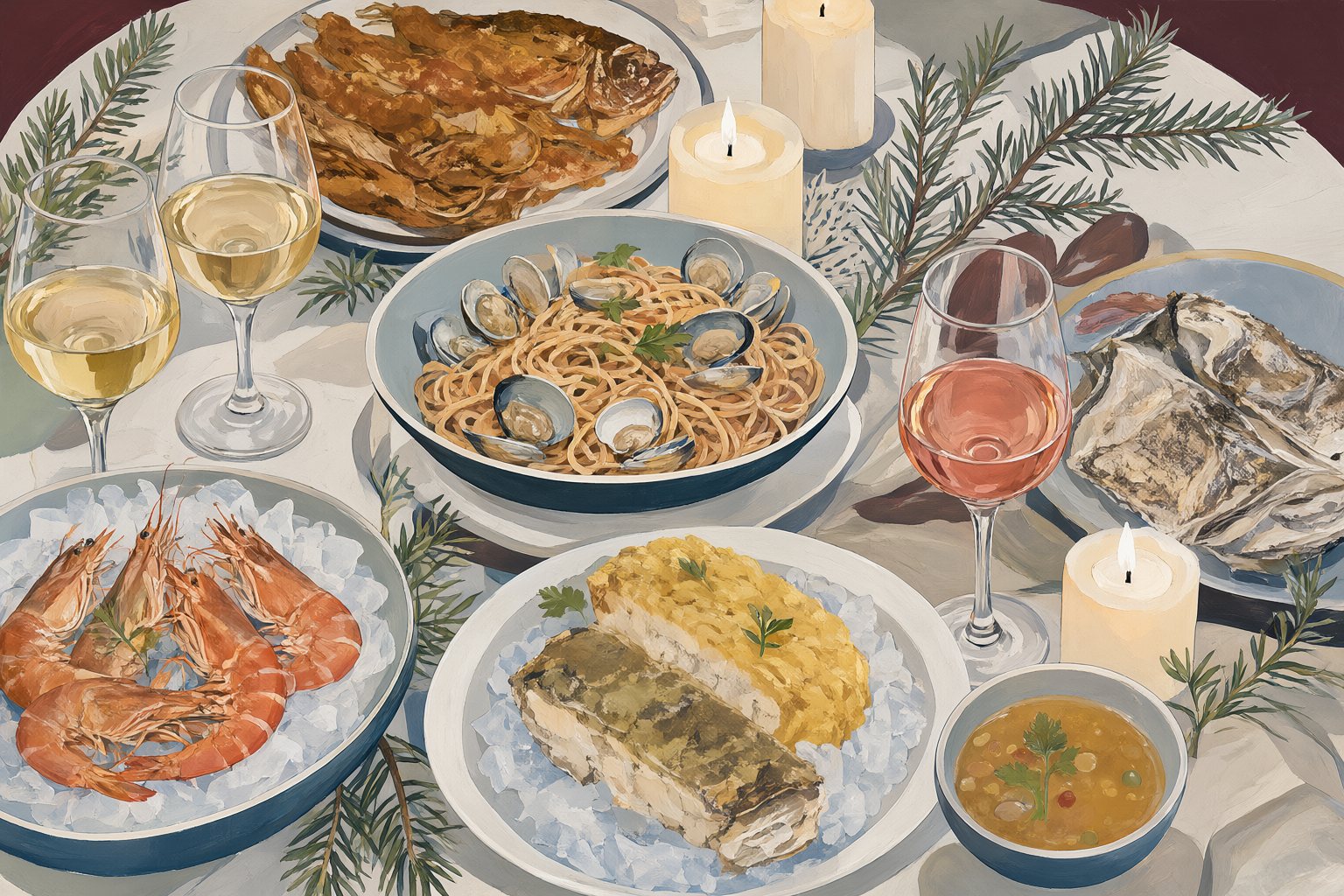
The point is that “the fish dinner” does not exist as a single dish. There are ten different dinners, one per region and often one per family. In Naples and Rome the historic star is capitone, the large, fatty female eel, fried or stewed; in the south there is always a frittura mista, with battered salt cod, anchovies and vegetables. In the Veneto, baccalà alla vicentina, which despite its name is made with stockfish, cooks slowly with milk, onion, oil and anchovies and comes to the table with polenta; since 1987 a confraternity in Sandrigo has watched over the recipe. Then there are the crudi, raw fish and shellfish, which over the last twenty years have conquered the antipasto even where tradition made no room for them, and spaghetti alle vongole, which unites north and south more than any reform.
With a menu like that, a single wine from start to finish is a losing bet. Better to think in families of dishes and let the bottles take turns.
Crudi and antipasti: acidity, salt, bubbles
Oysters, langoustines, red prawns, tuna or amberjack tartare ask for one thing only: a wine that cleans without covering. Here Italian traditional-method sparkling wine is unbeatable, provided it is genuinely dry. A Franciacorta or a Trento DOC in pas dosé or extra brut style has just the right tension for the iodine of oysters; Alta Langa, which the rules require to spend at least thirty months on the lees, adds a depth that copes well even with the fattiest tartares.
Those who prefer a still white can look to wines from the coast and from altitude: a Vermentino di Gallura, a DOCG since 1996, has savouriness and a slight bitter note that marries well with raw shellfish; an Etna Bianco, from Carricante, brings an almost cutting acidity and a volcanic minerality that strikes sparks with crudo. Best avoided at this point in the evening are whites aged at length in new oak: on raw fish, vanilla becomes an intruder.
Clams, fried fish and capitone: where the white needs shoulders
Spaghetti alle vongole looks like a delicate dish and isn’t. There’s garlic, there’s parsley, often there’s chilli, and above all there’s the clam juice, saline and almost brothy. A white that is too slight disappears. What works here are the great territorial whites of central and southern Italy: a Verdicchio dei Castelli di Jesi, with its almondy finish; a Fiano di Avellino or a Greco di Tufo, the first rounder and smokier, the second more nervy and mineral; a Falanghina del Sannio for those sticking with the Campanian classic.
Fried fish is another matter. Oil calls for bubbles or acidity, and bubbles are the simplest and most fitting answer. But there is a less obvious choice worth trying: a serious rosé. Cerasuolo d’Abruzzo, from Montepulciano grapes and a DOC in its own right since 2010, has deep colour, crunchy fruit and enough structure to keep up with battered salt cod and fried anchovies. It is not a compromise: it is the wine the frittura has been waiting for.
Capitone deserves a chapter of its own. It is a fatty, almost meaty fish, and stewed with tomato or marinated in vinegar it changes face entirely. Fried, it holds up beautifully with a mature Fiano or a traditional-method sparkler with a few years behind it; stewed, it can even take a light red served cool, a red Lacryma Christi del Vesuvio or a Gragnano from the Sorrento Peninsula, the sparkling red that in Naples has always accompanied home cooking. A red with fish on Christmas Eve will scandalise a relative or two: let it.
Baccalà and stockfish: the moment when white isn’t enough
Baccalà alla vicentina is the test bench for every theory. Long cooking, milk, anchovies, polenta: it is a soft, enveloping dish of great persistence. Light whites surrender by the second mouthful. You need whites with structure and a little development, and the Veneto has them at home: a Soave Classico, ideally from hillside vineyards and with a few years in bottle, has the creaminess and the almond note to rest on the dish without overpowering it. A nearby alternative is Lugana, more citrusy and linear.
The stewed salt cod of central and southern Italy, with tomato, olives and capers, opens the door once again to rosés and to young, low-tannin reds. Here too Cerasuolo comes in handy, as does a Salento rosé from Negroamaro, as long as it is drunk cool and from its most recent vintage.
Three bottles are enough
There’s no need to open important bottles for every course. Christmas Eve rewards variety more than rarity. A practical rule that works: a dry sparkler for the crudi and the fried dishes, a structured white for the clams and the baccalà, a rosé or a light red as a wild card for the tomato-based dishes and for whoever has had enough of white by halfway through the evening. Three well-chosen bottles are worth more than twelve opened out of habit.
Watch the temperatures, which on Christmas Eve are always wrong: structured whites served ice-cold lose half of what they have to say, and sparkling wines left on the table for an hour turn flat and tepid. A bucket of water and ice, not just ice, solves most of the problems.
Fish does not demand white
If there is one thing to take away from this evening, it is that the “fish equals white” rule is a legacy of menus far simpler than the ones we actually put on the table on 24 December. The Christmas Eve dinner is a cuisine of fat, salt, frying and tomato, and it calls for wines with acidity, savouriness and, sometimes, a little colour. Rosé is the great forgotten wine of this evening, and perhaps it is the one that best represents it: festive, versatile, able to sit between the crudo and the capitone without embarrassment. Next year, try putting one in the middle of the table and see who notices first.
❦