The wine list without the anxiety: a survival guide for the restaurant table
How to read a restaurant wine list, talk to the sommelier, handle the tasting, understand the mark-up and bring your own bottle without embarrassment.
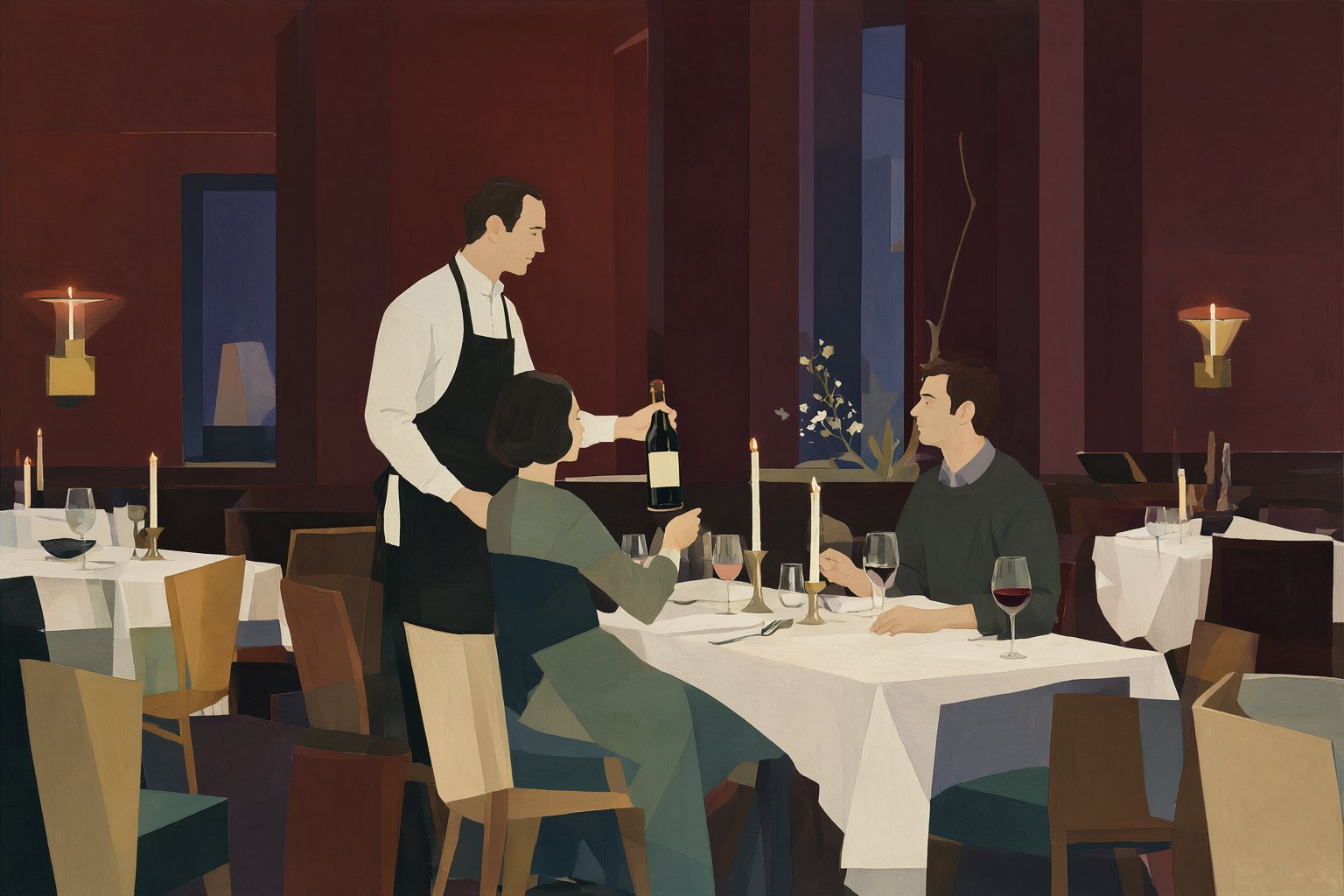
The waiter hands you the wine list, and suddenly the table becomes an exam hall. Everyone is looking at you, the volume weighs as much as a telephone directory, and the temptation is always the same: to point at the second-cheapest bottle, the one nobody will suspect of meanness. Breathe. The list is not a test; it is a slightly longer menu. And the person handing it to you, in most cases, simply wants you to leave happy.
Read the list like a map
A well-made wine list has a logic, and finding it is half the work. It is usually arranged by type (sparkling, whites, rosés, reds, sweet wines), then by region or country, sometimes by grape. Some younger lists group by style, such as “taut, saline whites”. No system is better than the others: what matters is understanding which one the restaurant has chosen.
Before losing yourself among the names, look at two things. The first is the cooking: a serious list is designed for that menu, and the local wines are often the most carefully chosen part. The second is how the prices are distributed: seeing where most of the labels are concentrated tells you where the restaurant has invested, and where the most interesting choices are hiding. A practical clue: the less famous areas of a list, the ones nobody orders on reflex, are often where the sommelier has put their personal taste.
Talking to the sommelier (and naming your budget without naming it)
The sommelier is neither an examiner nor a salesman in disguise. Their job is to translate your wishes into a bottle, and to do so they need three pieces of information: what you will be eating, what you like, how much you want to spend. The first two you give willingly. The third is the one that causes panic.
The trick, as old as the profession, is to indicate a figure without saying it out loud. Open the list, point to the price of a bottle that fits your intentions and say something like: “We were thinking of something around here, perhaps more in this style.” The sommelier will understand instantly, and your guests at the table will see only a finger resting on the page. A good professional will suggest options within that bracket, not a step above. If they do go higher, it is not elegance: it is a small impropriety, and you can decline without a second thought.
Be concrete about taste too. “A red that’s not too heavy” or “a white with a bit of acidity” is worth more than any technical term dropped to make a good impression. And if there is a wine you know and like, name it: it is the most useful reference you can offer.
The tasting ritual: not a referendum on taste
The bottle arrives, it is shown to you with the label facing you, it is opened, and a sip is poured. This small ceremony has a precise purpose, and it is not to ask whether you like the wine. It serves to check two things: that the bottle is the one you ordered (vintage included) and that the wine has no faults.
The best-known fault is so-called “cork taint”, linked above all to one molecule, 2,4,6-trichloroanisole (TCA), which can contaminate cork. You recognise it by a smell of wet cardboard, damp cellar, mould; in mild cases the wine simply seems flat, mute, devoid of fruit. Other possible problems are oxidation in a wine that should not have it (a tired colour, out-of-place notes of baked apple or raisined fruit) or a glaringly wrong serving temperature, which, however, can be corrected without changing the bottle.
Sniffing the cork is of little use: a cork can smell odd and the wine be perfect, or vice versa. Your nose belongs in the glass. A sniff, a sip if need be, a nod. There is no need to put on a performance.
When you really can send it back
If the wine is faulty, sending it back is legitimate, and a serious restaurant will replace it without argument. If you are unsure, say so simply: “I think there may be something wrong with it, would you mind tasting it?” The sommelier will taste it and, in most cases, will either agree with you or explain why that note is part of the wine’s style. Some natural wines, for example, can have unusual aromas that, to a nose used to something else, seem like faults.
What you cannot do, strictly speaking, is return a sound bottle because it does not live up to your expectations. You chose a tannic red and find it too tannic? The wine is doing its job. That said, if the choice was suggested by the sommelier and the result is far from what was described, many professionals would rather change it than have an unhappy customer. It is a courtesy, not a right: treat it as such.
The mark-up, or why the bottle costs what it does
The price on the list is not the shelf price, and it never will be. The mark-up pays for things you cannot see from the wine shop: service, glasses (which break), temperature-controlled storage, capital tied up in the cellar for years, bottles opened and discarded, the expertise of the person serving you.
How much does it weigh? There is no fixed rule, and the figures circulate more as legends than as data. It is often said that the average mark-up is about three times the purchase price, but in a 2025 interview with Gambero Rosso the Roman wine merchant Paolo Trimani described this as more of an exception than the norm. A training document published by FIPE, the Italian federation of hospitality businesses, proposes instead a sliding model: higher multipliers, around 3.5, for inexpensive wines, falling gradually to 2 for the more expensive ones. It is a teaching example, not a table that every restaurant applies.
The practical consequence, if the sliding model is the one the restaurant uses, is counter-intuitive: proportionally, the most modest bottles are the ones on which the mark-up weighs most. This does not mean you should always move up a bracket, but that the “second-cheapest so as not to look stingy” choice is often the poorest value on the list.
By the glass, and the bottle brought from home
Wine by the glass is the solution for those who drink little, for those who want to change wine with every course, for tables where everyone orders a different dish. Until a few years ago it often meant bottles that had been open for days; today many restaurants use systems that preserve the wine with inert gas, and some draw the wine through the cork with a needle without uncorking the bottle, making it possible to serve even important labels by the glass. Asking how long a bottle has been open is not rude.
Finally, corkage: the option of bringing your own wine and paying a fee for the service. In Italy it is not a right as such, in the sense that no rule obliges the restaurateur to accept a bottle brought by the customer, and there is no fee established by law. Each restaurant decides whether to allow it, on what terms and at what price. The common-sense rule is to phone ahead, not to bring a wine that is already on the list, and perhaps to offer the sommelier a glass, which never hurts.
The truth is that the wine list causes anxiety only as long as you treat it as an exam to be passed alone. The moment you look up and ask a question, the dinner improves. And almost always the wine does too.
❦